



 The Quiet Cabinet

Attacus atlas
Atlas moth: facts about one of the world's largest moths
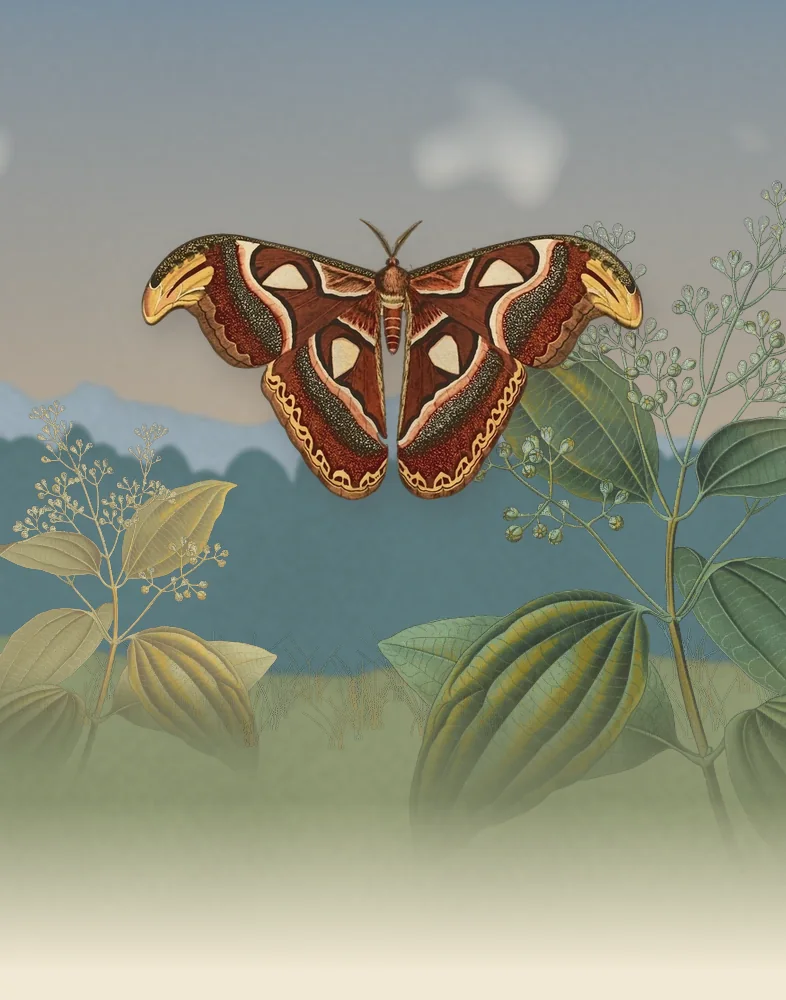
The Atlas moth is one of the largest moths on Earth. Spread out, its wings can measure 25 to 30 centimetres from tip to tip, wider than this page's column on many phones, with an area of about 160 square centimetres.
How big is it?
Only a few moths rival it. The White Witch of Central and South America, and the Atlas moth's close relative Attacus caesar, have longer wingspans; the Hercules moth of New Guinea and Australia has a greater wing area. Among the world's moths, the Atlas is in the very first rank. It's named after Atlas, the Titan of Greek myth, for its size. The female is noticeably larger and heavier than the male.
Wingtips like snakes' heads
Look at the tip of each forewing: curved and patterned, it looks like the head of a snake. When a predator comes near, the moth moves its wings to make the likeness stronger. In Cantonese its name means "snake's head moth".
A week or two to live
The adult Atlas moth has no working mouth. It can't eat or drink at all, and lives only one to two weeks on the fat it stored as a caterpillar. In that time it has one task: the male follows the female's scent, which he can detect from several kilometres away, and she lays her eggs.
Its caterpillar and cocoon
The caterpillar is dusty green with white, waxy spines, and grows up to 11.5 centimetres long. It feeds on the leaves of trees such as citrus, cinnamon and guava. When it's fully grown, it spins a papery cocoon about 7 to 8 centimetres long, woven with dried leaves, and the moth comes out about four weeks later. In India its brown, woolly silk, called fagara, has been spun on a small scale; it's thought to be tougher than the silk of the mulberry silkworm.
Where it lives
In the forests and shrublands of South and Southeast Asia, from India and southern China to Indonesia, including Borneo, in dry tropical forest, secondary forest and scrub.
The plate it comes from
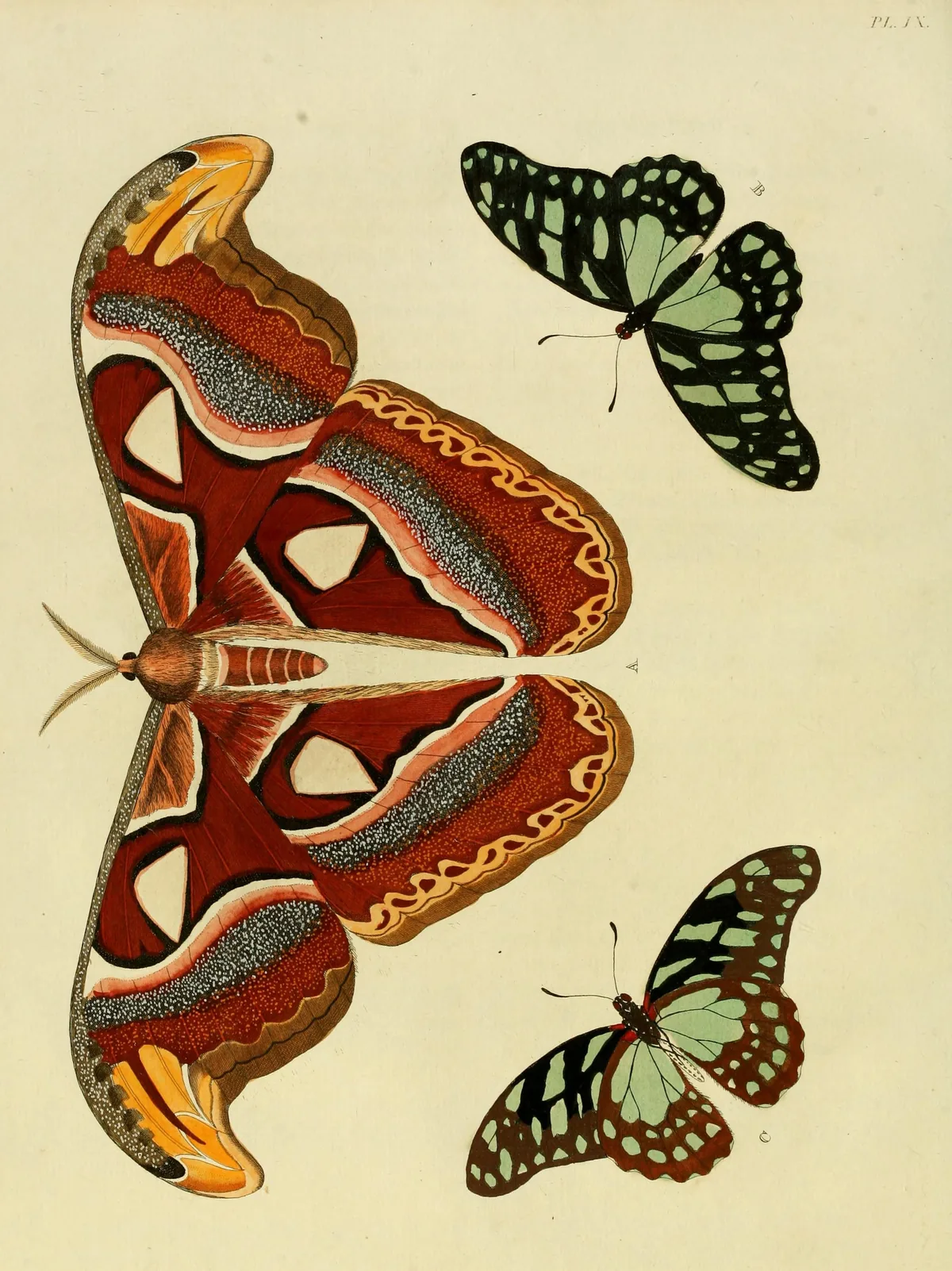
The Atlas moth in The Quiet Cabinet was engraved and coloured by hand in Amsterdam in the 1770s, for Pieter Cramer's book of exotic butterflies and moths. Cramer drew adults only, so its Field Guide page has no caterpillar. It flies above Ceylon cinnamon, drawn from Köhler's Medizinal-Pflanzen (1887–1898). The White Witch, which outspans it, is in the same chapter.
In The Quiet Cabinet
It's one of the thirteen species of the Curiosity Cabinet, the game's last chapter, part of the Butterfly Collection. When its case is completed, a flute joins the plate's music.
Sources
- Wikipedia, Attacus atlas
- Animal Diversity Web, Attacus atlas
More from the journal

Black-veined White: the butterfly Britain lost
A large white butterfly with black veins, lost from Britain around 1925 for reasons still unknown. Its story, its caterpillars' silk nests, its strange female.

Broad-bordered Yellow Underwing: orange hidden beneath
A brown late-summer moth that hides bright orange hindwings with a broad black border, showing them only in flight. How to know it, and its many forms.

Buff-tip moth: the moth that looks like a broken twig
A moth that rests looking just like a snapped birch twig, whose yellow-and-black caterpillars feed in crowds and strip branches bare. How to know the Buff-tip.