



 The Quiet Cabinet

Aporia crataegi
Black-veined White: the butterfly Britain lost
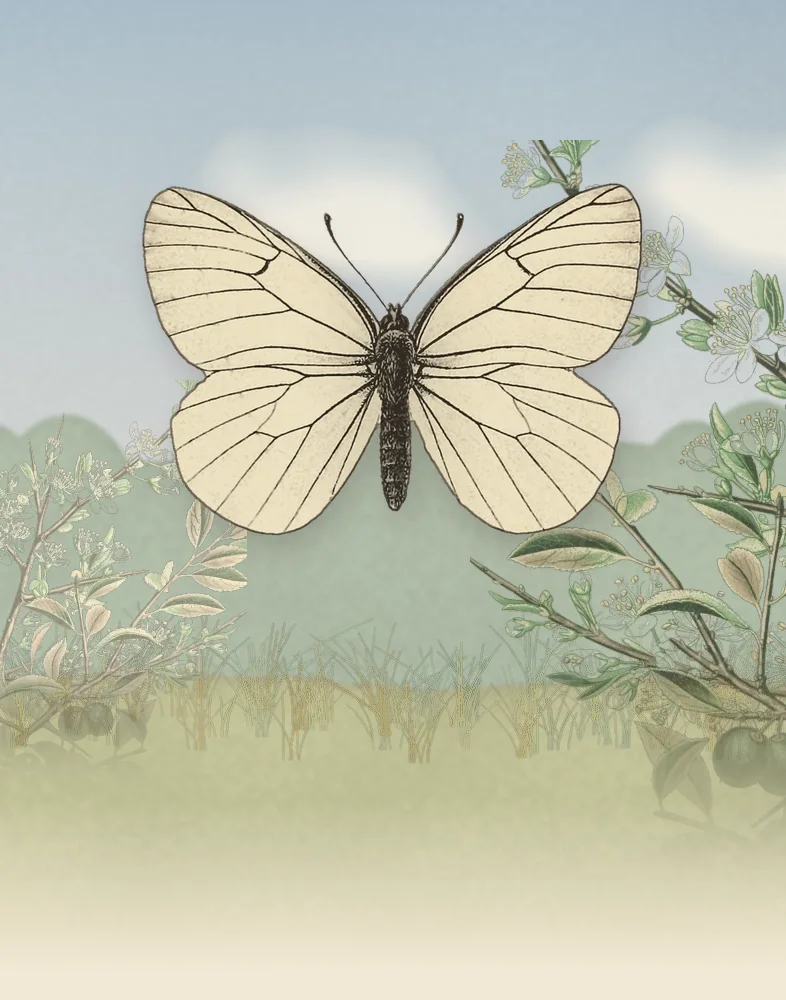
The Black-veined White was first recorded as a British butterfly in 1667. Around 1925 it disappeared, and no one has been able to say for certain why.
How to recognise it
- Size: fairly large, with a wingspan of about 69 to 76 millimetres.
- Colour: white, with every vein drawn in black, as if in ink.
- The female is a puzzle. She rubs her wings together and loses many of her scales, so her wings look almost transparent. What the habit is for remains a mystery.
A butterfly lost
It was always counted rare in Britain, though it was, and is, often very common on the continent. It lived in the southern half of England and in south Wales, in orchards, lanes, gardens and meadows, wherever its food plants grew, and its strongholds were Kent, with some 40 colonies, Hampshire, Gloucestershire and Sussex. Its colonies rose and fell greatly from year to year, and its last stronghold was the south-east.
The cause of its loss is a mystery, because its food plants never became scarce. Disease encouraged by wet autumns, mild winters and more birds taking the caterpillars have all been suggested. The only documented attempt to bring it back, in Fife in Scotland, worked only while the caterpillars were protected from birds.
Elsewhere it ranges from Spain and North Africa across Europe and temperate Asia to Japan, and it is not threatened there. It flew in one generation, from late June into August, most of all in July.
Its caterpillars and their silk nests
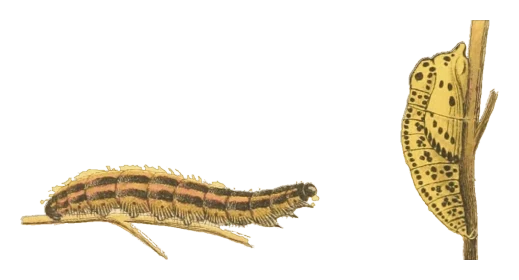
The female laid her bright yellow eggs in batches of 100 to 200 under the leaves of blackthorn and hawthorn. The young caterpillars lived together in a web, and spent the winter in a tough, greyish silk nest spun between leaves and around a twig, each in its own compartment: "a very secure and snug abode", in the words of the naturalist F. W. Frohawk. In spring they came out on warm days to feed on the opening buds, and fed alone before they became a chrysalis, pale greenish-yellow spotted with black.
The plate it comes from
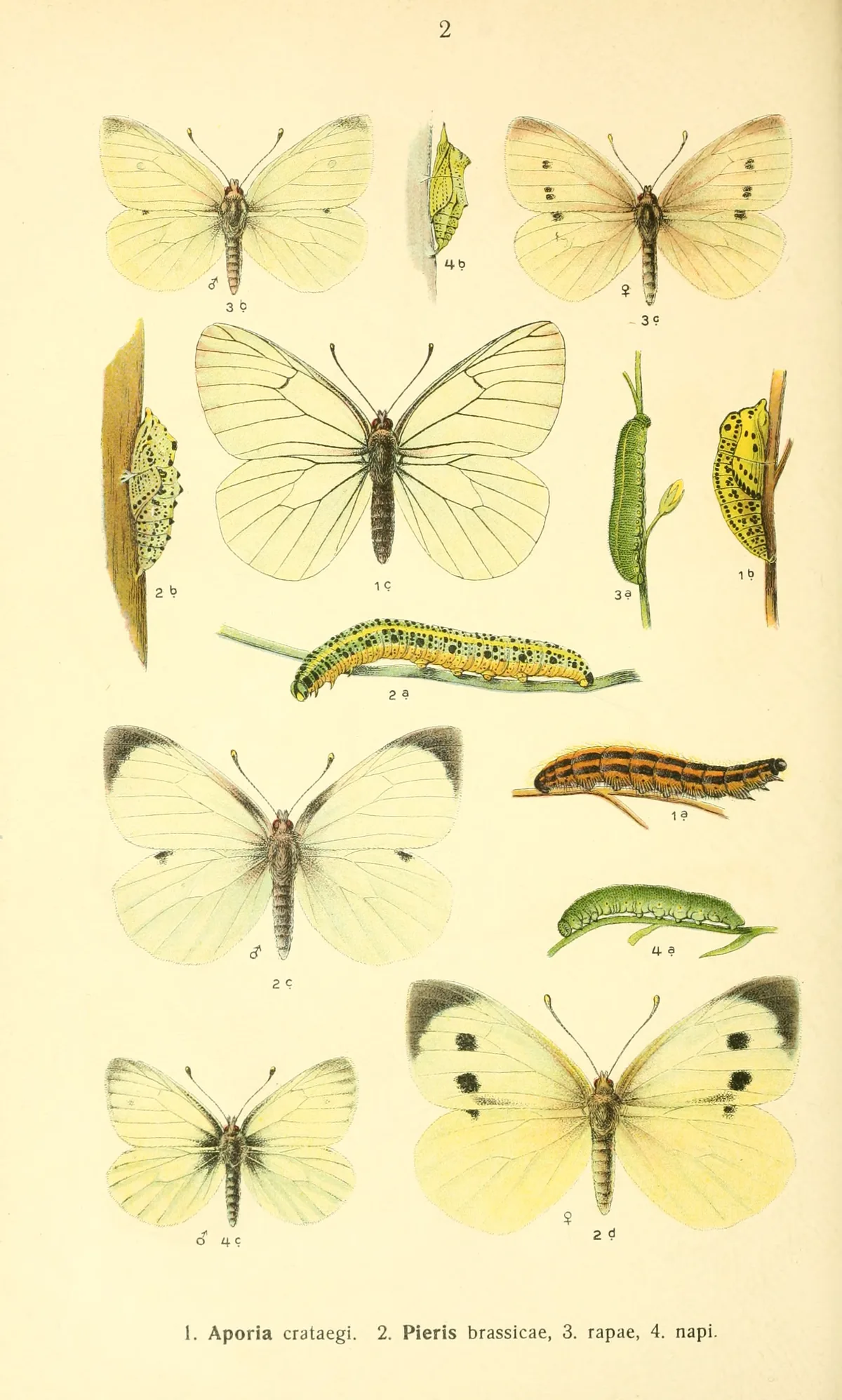
The Black-veined White in The Quiet Cabinet is figure 1c of this plate, above the cabbage whites. On its Field Guide page it flies above blackthorn, drawn from Otto Wilhelm Thomé's Flora von Deutschland, Österreich und der Schweiz (1885).
In The Quiet Cabinet
It's one of the thirteen species of the Meadow, the game's second chapter, part of the Butterfly Collection. When its case is completed, a celesta joins the plate's music.
Sources
- Butterfly Conservation, Black-veined White
- UK Butterflies, Black-veined White
More from the journal

Broad-bordered Yellow Underwing: orange hidden beneath
A brown late-summer moth that hides bright orange hindwings with a broad black border, showing them only in flight. How to know it, and its many forms.

Buff-tip moth: the moth that looks like a broken twig
A moth that rests looking just like a snapped birch twig, whose yellow-and-black caterpillars feed in crowds and strip branches bare. How to know the Buff-tip.
Chalkhill Blue butterfly: the silver-blue of the chalk downs
A milky silver-blue butterfly found only on chalk and limestone downs, whose caterpillar eats one plant and is tended by ants. How to know it and where to see it.