



 The Quiet Cabinet

Phalera bucephala
Buff-tip moth: the moth that looks like a broken twig
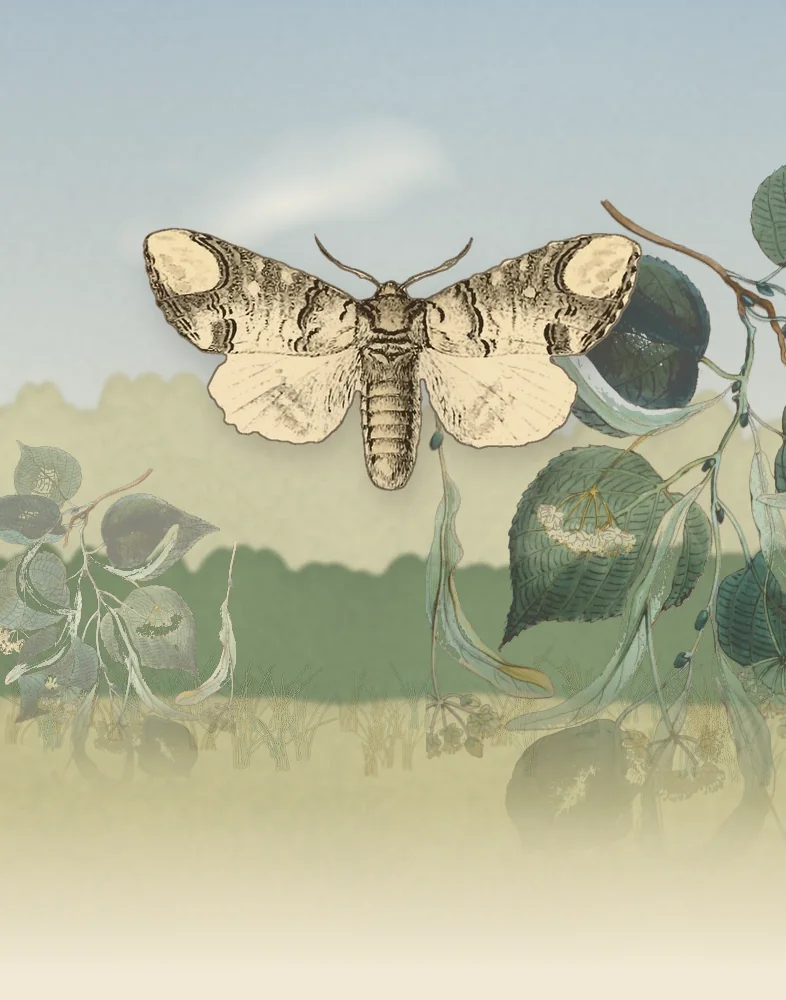
Few disguises are as good as the Buff-tip's. At rest it holds its wings almost upright, and it looks remarkably like a broken twig of silver birch: grey, bark-mottled wings for the stick, and two pale buff patches, one at the head and one at the wingtips, for the snapped ends of pale wood.
How to recognise it
- Size: a wingspan of about 42 to 68 millimetres.
- Forewings: grey, mottled like bark, with a large buff patch at each tip.
- The head: a buff patch on the front of the thorax, matching the tips.
- Hindwings: creamy white.
When to see it
The Buff-tip flies in June and July. It flies at night and often comes to lights, usually after midnight; now and then one is found by day, resting on a twig or on the ground, where it is easy to pass by.
It lives in open woodland, scrub, hedgerows and gardens, and is widespread and quite common in Britain, especially in the south, more local in Scotland. It is found across Europe, except the Arctic and Greece, and into Asia.
Its caterpillars

The caterpillars are yellow and black, and when young they feed together, in crowds that can strip a whole branch bare; as they grow they go their own ways. They eat the leaves of many trees, sallows, birches, oaks, hazel, alder, limes, elms, beech and more, and prefer trees in sunny spots. They can be found from July to early October. The Buff-tip spends the winter as a glossy, dark chrysalis underground, and some wait through two winters.
The plate it comes from
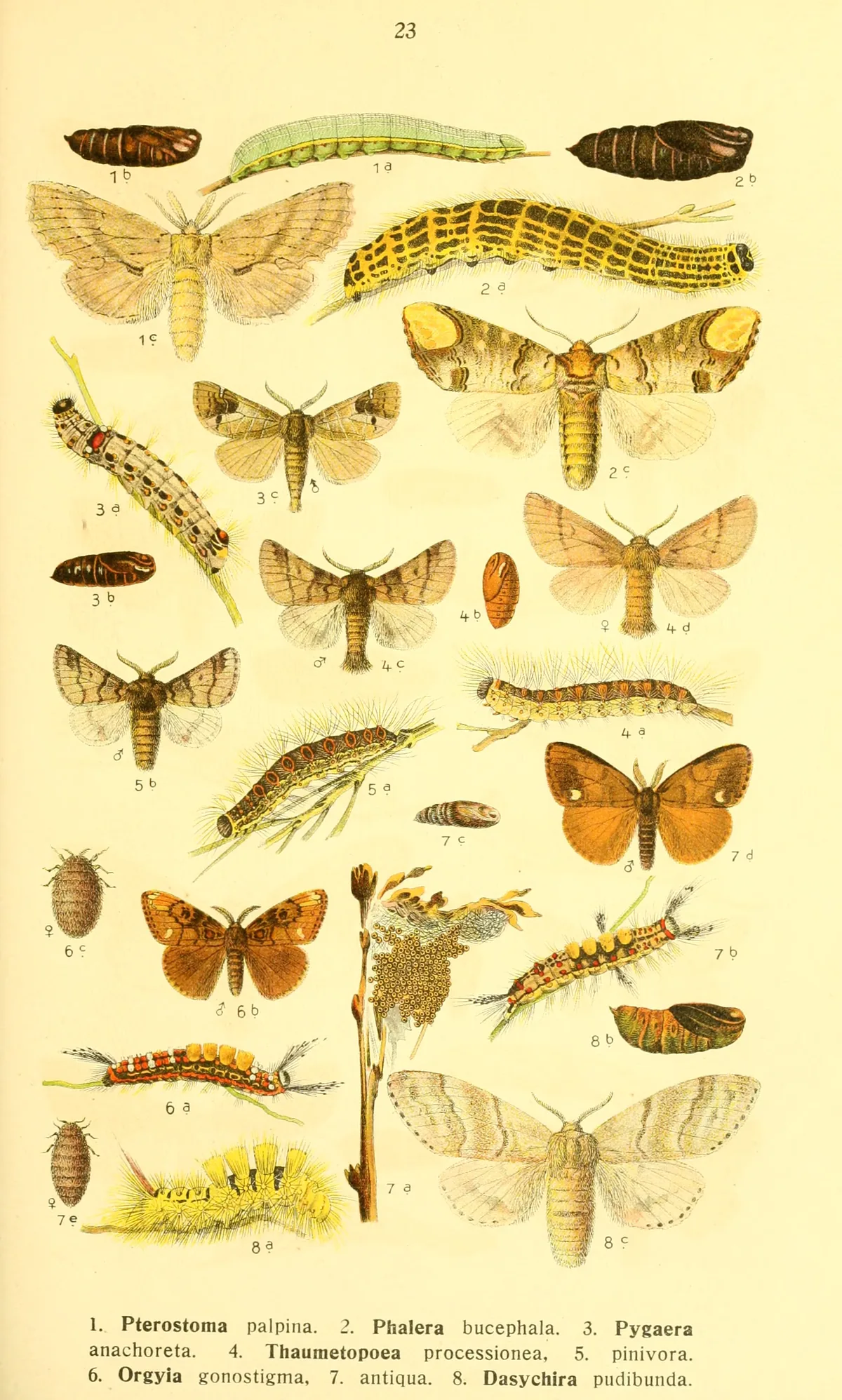
The Buff-tip in The Quiet Cabinet is figure 2c of this plate. On its Field Guide page it flies above small-leaved lime, drawn from the Dutch Flora Batava.
In The Quiet Cabinet
It's one of the thirteen species of the Forest, the game's third chapter, part of the Butterfly Collection. When its case is completed, a felt piano joins the plate's music.
Sources
- Butterfly Conservation, Buff-tip
- UKMoths, Buff-tip
- Wikipedia, Phalera bucephala
More from the journal

Black-veined White: the butterfly Britain lost
A large white butterfly with black veins, lost from Britain around 1925 for reasons still unknown. Its story, its caterpillars' silk nests, its strange female.

Broad-bordered Yellow Underwing: orange hidden beneath
A brown late-summer moth that hides bright orange hindwings with a broad black border, showing them only in flight. How to know it, and its many forms.
Chalkhill Blue butterfly: the silver-blue of the chalk downs
A milky silver-blue butterfly found only on chalk and limestone downs, whose caterpillar eats one plant and is tended by ants. How to know it and where to see it.