



 The Quiet Cabinet

Polyommatus coridon
Chalkhill Blue butterfly: the silver-blue of the chalk downs
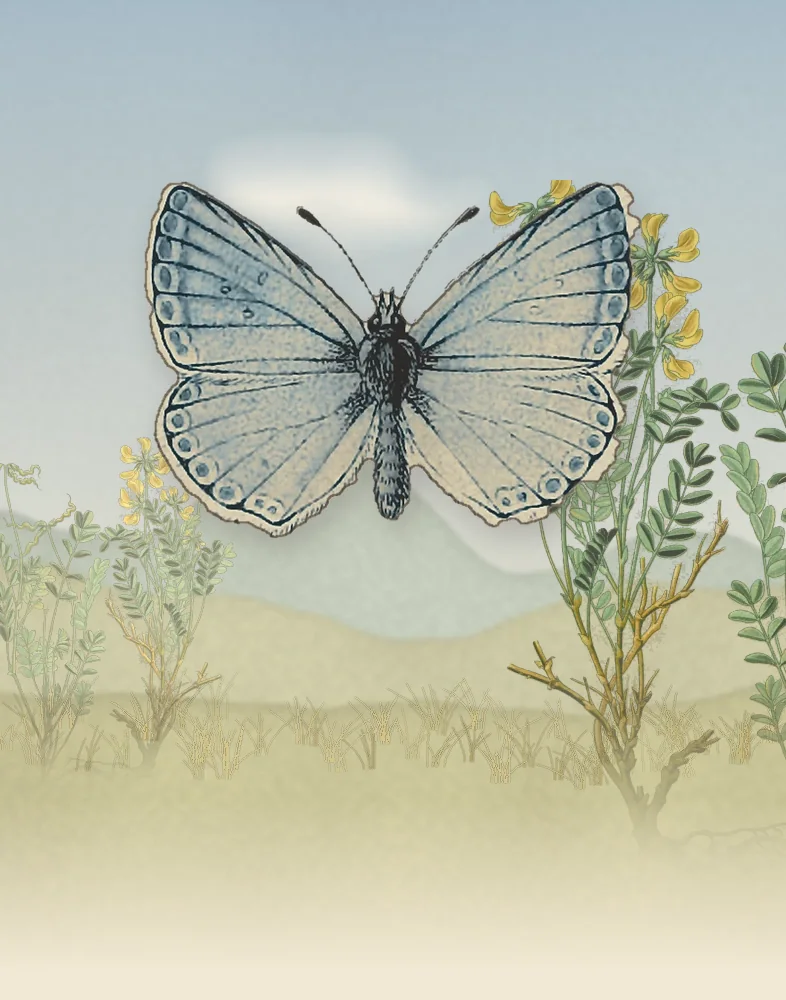
On a hot August day on a south-facing chalk slope, the males of the Chalkhill Blue fly low over the turf in such numbers, searching for females, that the ground itself can seem to shimmer. At good sites many hundreds may be out at once.
How to recognise it
- Size: a wingspan of about 33 to 40 millimetres.
- The male is a pale, milky sky-blue, paler than any other British blue but the much larger Large Blue, with a thin dark border and a white fringe.
- The female is chocolate brown, with a row of orange spots and a dusting of blue near the body. She is easily confused with the female Brown Argus, which has no blue, and the female Adonis Blue, whose dark veins run out into the white fringe.
A butterfly of the chalk
The Chalkhill Blue lives only on chalk and limestone grassland, because its caterpillar eats only one plant, horseshoe vetch, which grows nowhere else. Its colonies are on warm, sheltered hillsides, in southern England south-east of a line from Gloucestershire to Cambridgeshire; it isn't found in Scotland, Wales or Ireland.
It has one generation a year. The butterflies come out in mid-July and are at their peak at the end of July and in early August. The males gather on dung and damp earth to take up salts, and at good sites the butterflies roost together at night on grass stems, sometimes several to a stem.
Its caterpillar, and the ants
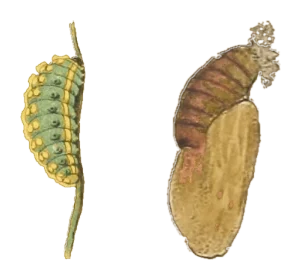
The female lays her eggs one at a time, on or near the vetch, and they wait a long time: the caterpillar forms inside the egg in late summer and stays there through the winter, up to eight months, hatching in spring. It feeds mostly at night and hides at the foot of the plant by day.
Its secret is a small gland on its back, whose secretions ants come for. In return they give it some protection. The chrysalis forms on the ground beneath the plant and attracts ants too, which are believed to carry chrysalises away and bury them.
How it's faring
Its numbers have held fairly steady, but it is found in far fewer places than it was: between 1976 and 2019 its range in Britain shrank by about 82 per cent. It is listed as Vulnerable on Great Britain's Red List.
The plate it comes from
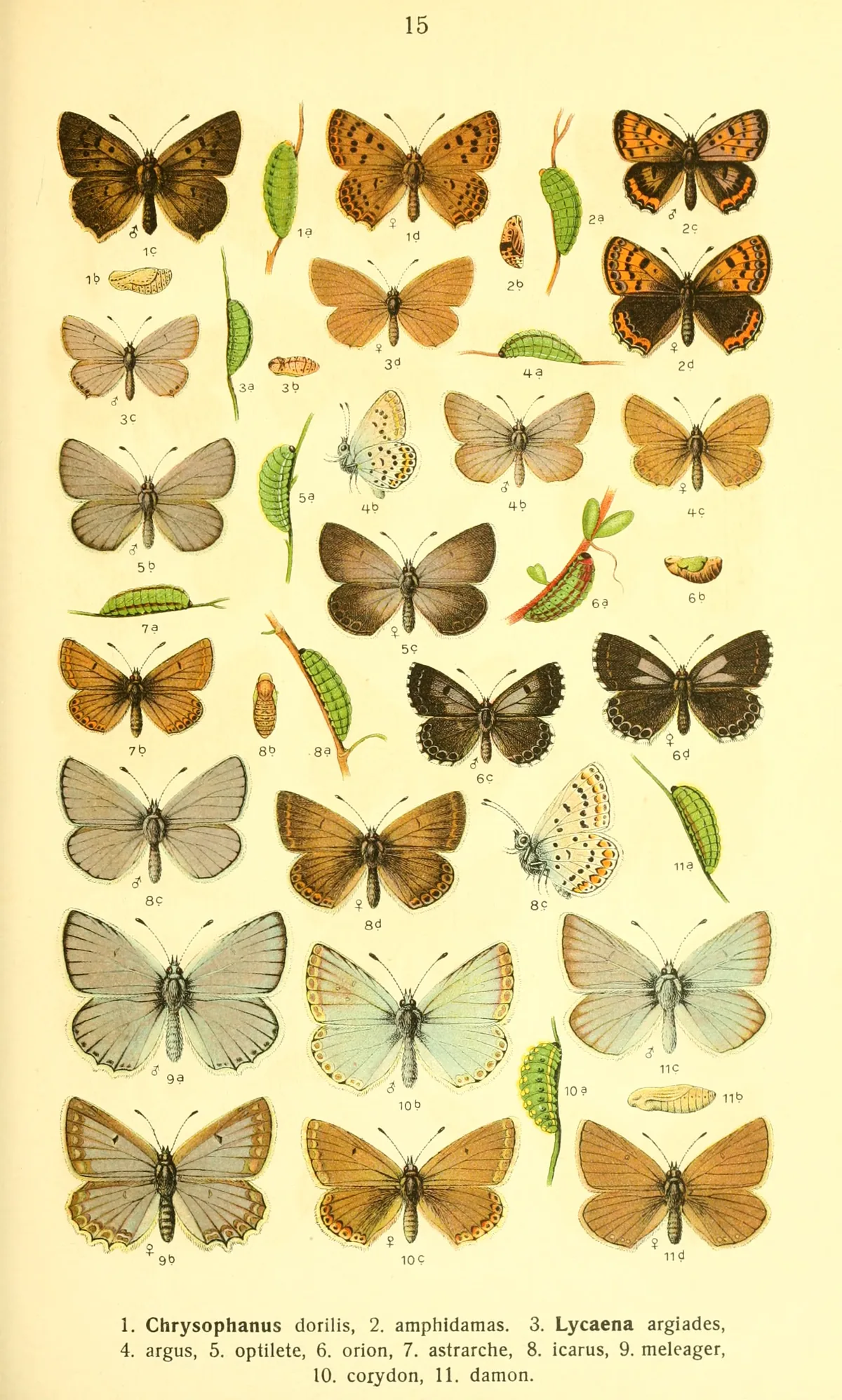
The Chalkhill Blue in The Quiet Cabinet is figure 10b, Eckstein's male, from the same plate as the Common Blue. On its Field Guide page it flies above horseshoe vetch, drawn from Otto Wilhelm Thomé's Flora von Deutschland, Österreich und der Schweiz (1885). Its brown female turns up in the game as a rare form.
In The Quiet Cabinet
It's one of the thirteen species of the Meadow, the game's second chapter, part of the Butterfly Collection. When its case is completed, a harp joins the plate's music.
Sources
- Butterfly Conservation, Chalk Hill Blue
- UK Butterflies, Chalkhill Blue
More from the journal

Black-veined White: the butterfly Britain lost
A large white butterfly with black veins, lost from Britain around 1925 for reasons still unknown. Its story, its caterpillars' silk nests, its strange female.

Broad-bordered Yellow Underwing: orange hidden beneath
A brown late-summer moth that hides bright orange hindwings with a broad black border, showing them only in flight. How to know it, and its many forms.

Buff-tip moth: the moth that looks like a broken twig
A moth that rests looking just like a snapped birch twig, whose yellow-and-black caterpillars feed in crowds and strip branches bare. How to know the Buff-tip.