



 The Quiet Cabinet

Gonepteryx rhamni
Brimstone butterfly: facts, caterpillar and food plant
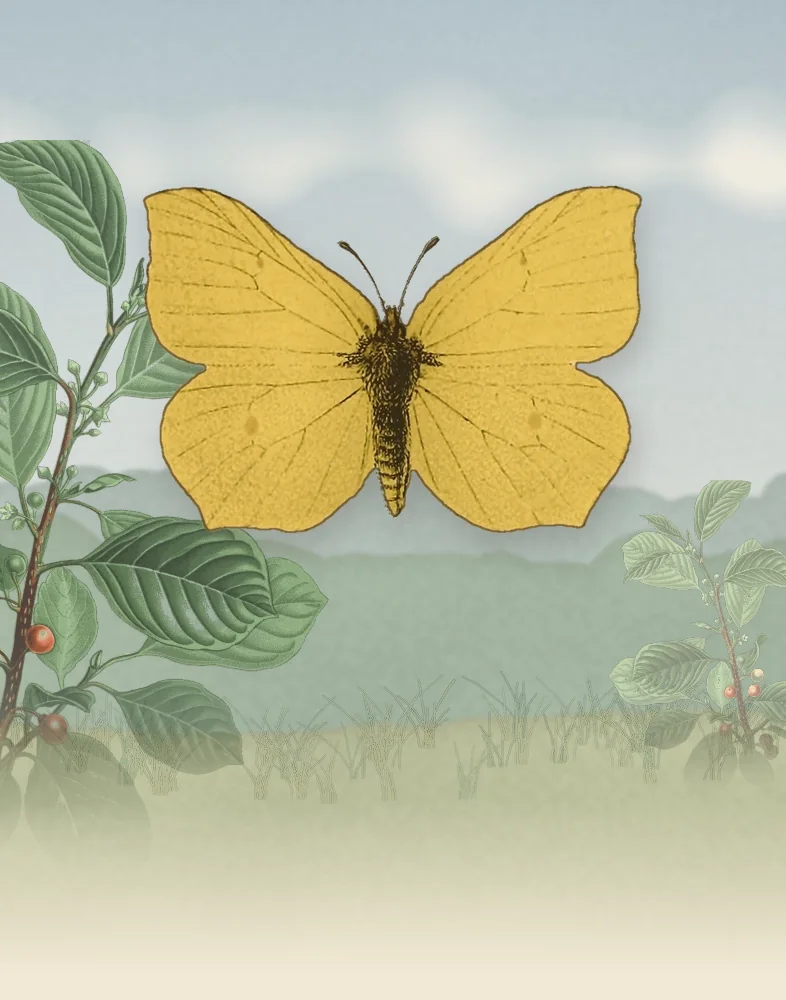
On the first warm day of spring, often in April, a single bright yellow butterfly drifts along a hedgerow. It's very likely a male Brimstone, and it has been alive since last summer.
How to recognise it
- Size: a wingspan of about 60 millimetres.
- The male is a clear sulphur yellow above and yellow-green beneath.
- The female is a very pale green, almost white, and is easily mistaken for one of the whites.
- The shape: each wing ends in a small point, and the veins are strong. When it settles with its wings closed, it looks remarkably like a leaf.
Some say the word butterfly first meant this one: the "butter-coloured fly" of the male's yellow.
A butterfly that sleeps through winter
Most butterflies spend the winter as an egg, a caterpillar or a chrysalis. The Brimstone spends it as a butterfly, hidden among evergreen leaves, often ivy, holly or bramble, where its leaf-like wings hide it. That's why it's one of the first butterflies seen each year: it doesn't have to grow up first, only to wake.
Adults may live more than ten months, longer than any other British butterfly. The ones that wake in spring fly most in April and May, mate and lay their eggs; their children become butterflies in August, feed through the late summer, and then sleep through the winter in turn.
Its caterpillar and food plants
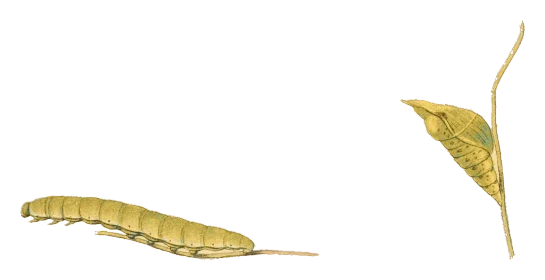
The Brimstone lays its eggs one at a time on the undersides of the youngest leaves of just two shrubs: buckthorn, which grows mostly on chalk and limestone, and alder buckthorn, on damp, acid ground. The green caterpillar rests along the middle of a leaf, very well hidden, and gives itself away only by the bites it takes from the leaf's edges. Its chrysalis looks like a curled leaf too, and in its last days the yellow of the wing shows through it.
Planting buckthorn or alder buckthorn is one of the simplest ways to bring Brimstones to a garden.
Where to see it
Look along woodland edges, hedgerows, roadside verges and scrubby grassland. In Britain it's common in England and Wales, less common in Ireland and very rare in Scotland, though it has been spreading north in recent years. It feeds on many spring and summer flowers, among them primroses, bluebells, dandelions, thistles and knapweed.
The plate it comes from
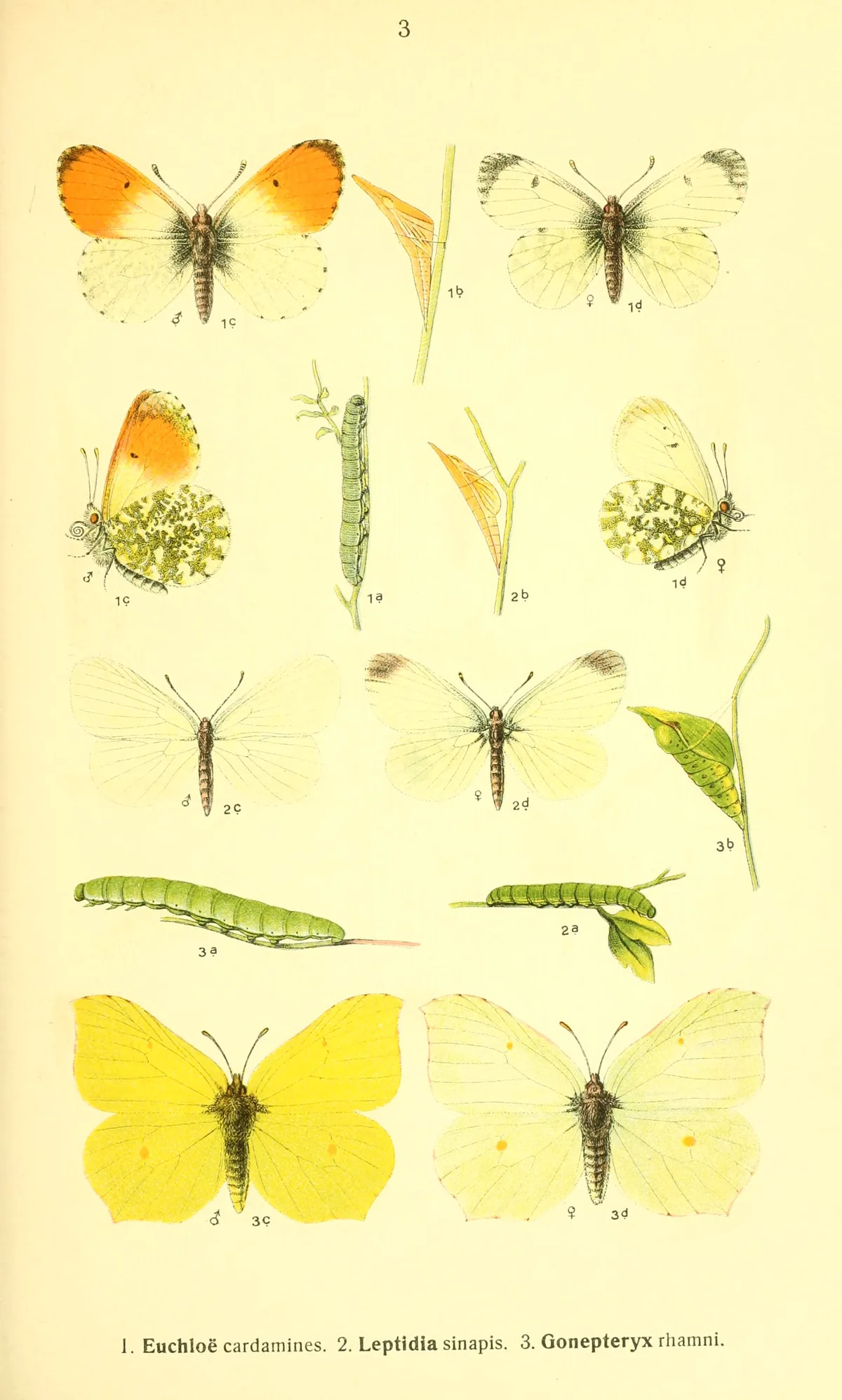
The Brimstone in The Quiet Cabinet is figure 3c, Eckstein's male. On its Field Guide page it flies above alder buckthorn, drawn from Otto Wilhelm Thomé's Flora von Deutschland, Österreich und der Schweiz (1885). Its pale female turns up in the game as a rare form.
In The Quiet Cabinet
It's one of the twelve species of the Garden, the game's first chapter, which is free. When its case is completed, a music box joins the plate's music.
More from the journal

Black-veined White: the butterfly Britain lost
A large white butterfly with black veins, lost from Britain around 1925 for reasons still unknown. Its story, its caterpillars' silk nests, its strange female.

Broad-bordered Yellow Underwing: orange hidden beneath
A brown late-summer moth that hides bright orange hindwings with a broad black border, showing them only in flight. How to know it, and its many forms.

Buff-tip moth: the moth that looks like a broken twig
A moth that rests looking just like a snapped birch twig, whose yellow-and-black caterpillars feed in crowds and strip branches bare. How to know the Buff-tip.