



 The Quiet Cabinet

Tyria jacobaeae
Cinnabar moth: the red moth and its striped caterpillars
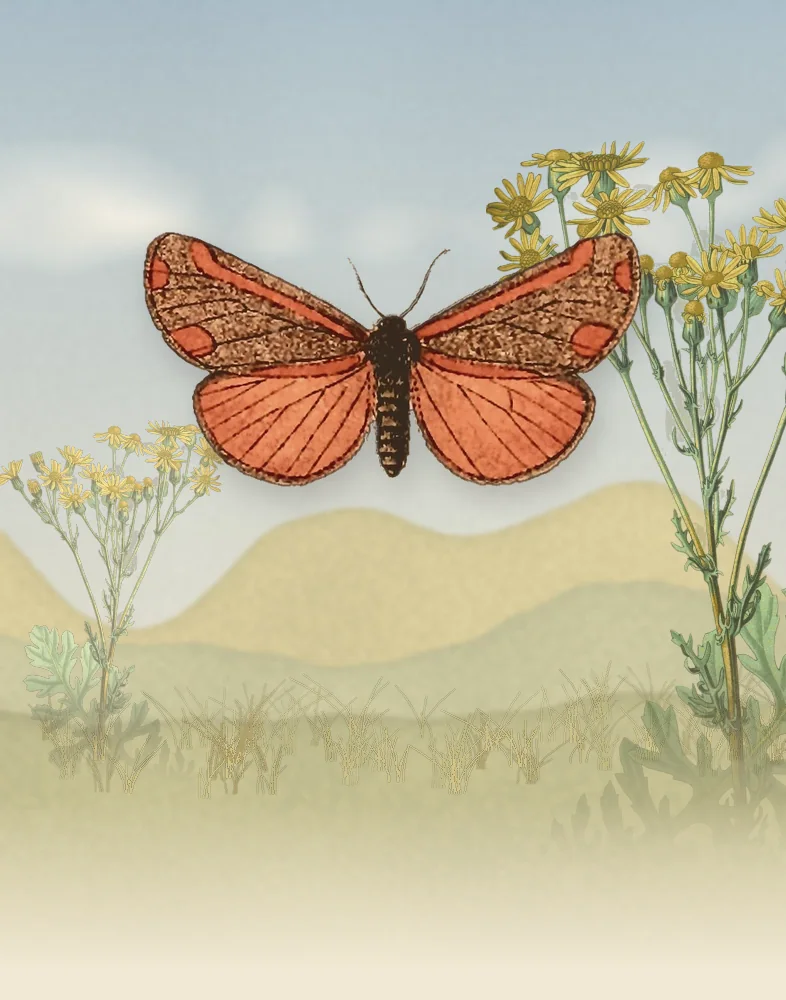
In July, a patch of ragwort can be crawling with caterpillars hooped in yellow and black, eating it down to bare stalks. They are the young of the Cinnabar, a moth as bright as they are.
How to recognise it
- Size: a wingspan of about 34 to 46 millimetres.
- Colour: black wings with bold crimson-red markings, and crimson hindwings. Only the burnets are anything like it.
- The name: it's named after cinnabar, a red mineral, for the colour of its wings.
- Rarely, the red is replaced by yellow, or the wings are entirely black.
A moth of day and night
The Cinnabar flies from May to July, most of all in June. It's easily disturbed from long grass by day, and flies in sunshine, but it flies after dark too and comes to lights.
It lives in open, grassy places: waste ground, railway banks, gardens and woodland rides, and most of all on well-drained, rabbit-grazed grassland, sand dunes and heaths. It's common across most of England, Wales and Ireland; in northern England and Scotland it keeps mostly to the coast.
Its caterpillars, and ragwort's poison
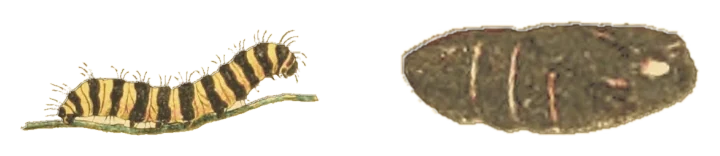
The female lays up to 300 eggs, in batches of 30 to 60, under the leaves of common ragwort. The caterpillars feed together, at first beneath the leaves, later out in the open by day on leaves and flowers, and they grow to about 30 millimetres. As they eat, they take up ragwort's bitter, toxic alkaloids. Their stripes and the moth's crimson are both warnings, and few predators eat either; cuckoos are an exception.
So many caterpillars on one plant often eat it bare before they are grown, and very few live to become a chrysalis; when food runs short, they may even turn on each other. The chrysalis spends the winter in a cocoon on the ground.
Because its caterpillars eat ragwort, the Cinnabar was taken to New Zealand, Australia and North America to help control the plant, with particular success in the western United States.
The plate it comes from
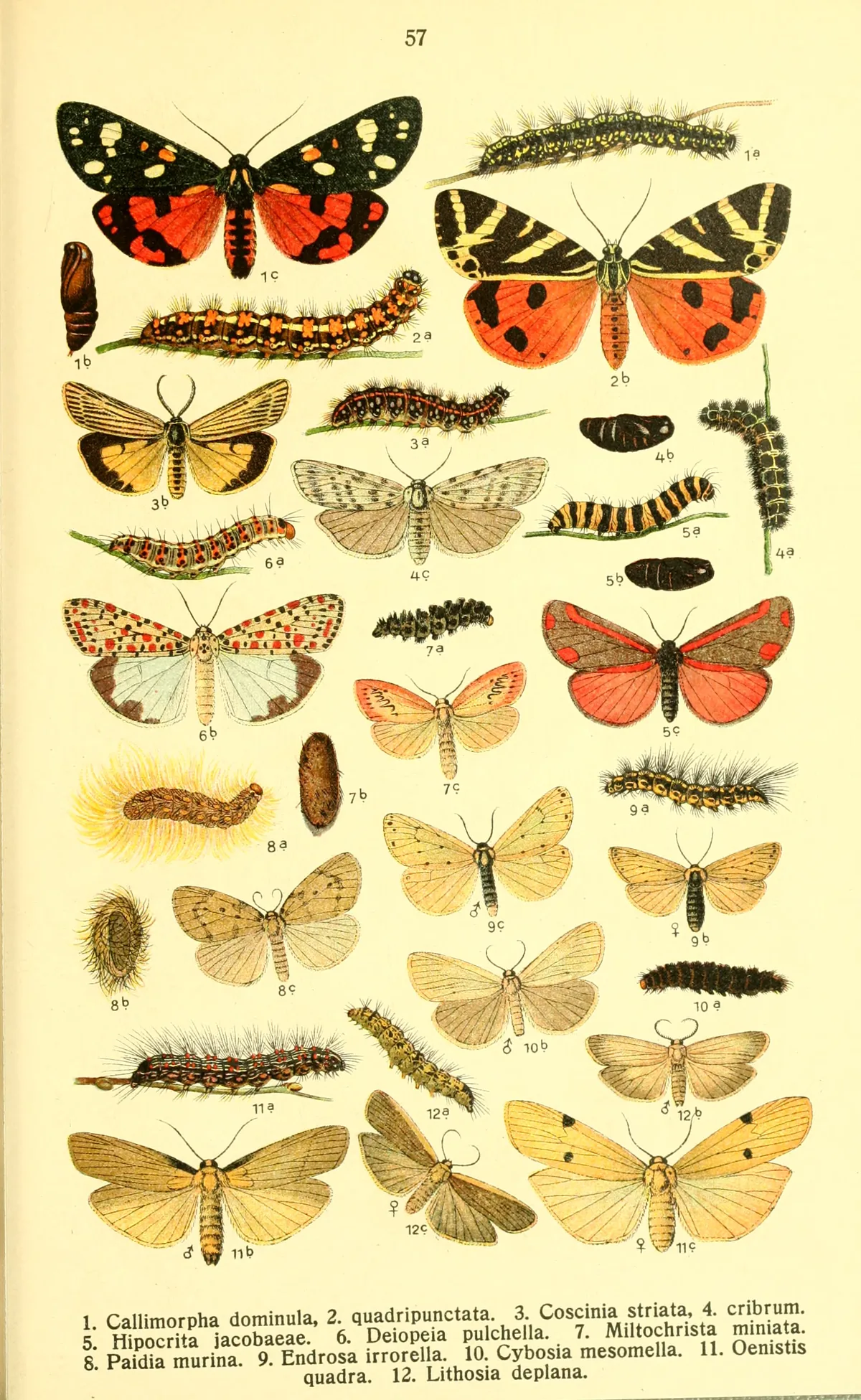
The Cinnabar in The Quiet Cabinet is figure 5c of this plate, beside the Scarlet and Jersey Tigers and the footmen. On its Field Guide page it flies above common ragwort, drawn from Otto Wilhelm Thomé's Flora von Deutschland, Österreich und der Schweiz (1885).
In The Quiet Cabinet
It's one of the thirteen species of the Meadow, the game's second chapter, part of the Butterfly Collection. When its case is completed, a felt piano joins the plate's music.
Sources
- Butterfly Conservation, Cinnabar
- UKMoths, Cinnabar
- Wikipedia, Tyria jacobaeae
More from the journal

Black-veined White: the butterfly Britain lost
A large white butterfly with black veins, lost from Britain around 1925 for reasons still unknown. Its story, its caterpillars' silk nests, its strange female.

Broad-bordered Yellow Underwing: orange hidden beneath
A brown late-summer moth that hides bright orange hindwings with a broad black border, showing them only in flight. How to know it, and its many forms.

Buff-tip moth: the moth that looks like a broken twig
A moth that rests looking just like a snapped birch twig, whose yellow-and-black caterpillars feed in crowds and strip branches bare. How to know the Buff-tip.