



 The Quiet Cabinet

Colias croceus
Clouded Yellow butterfly: the golden migrant of summer
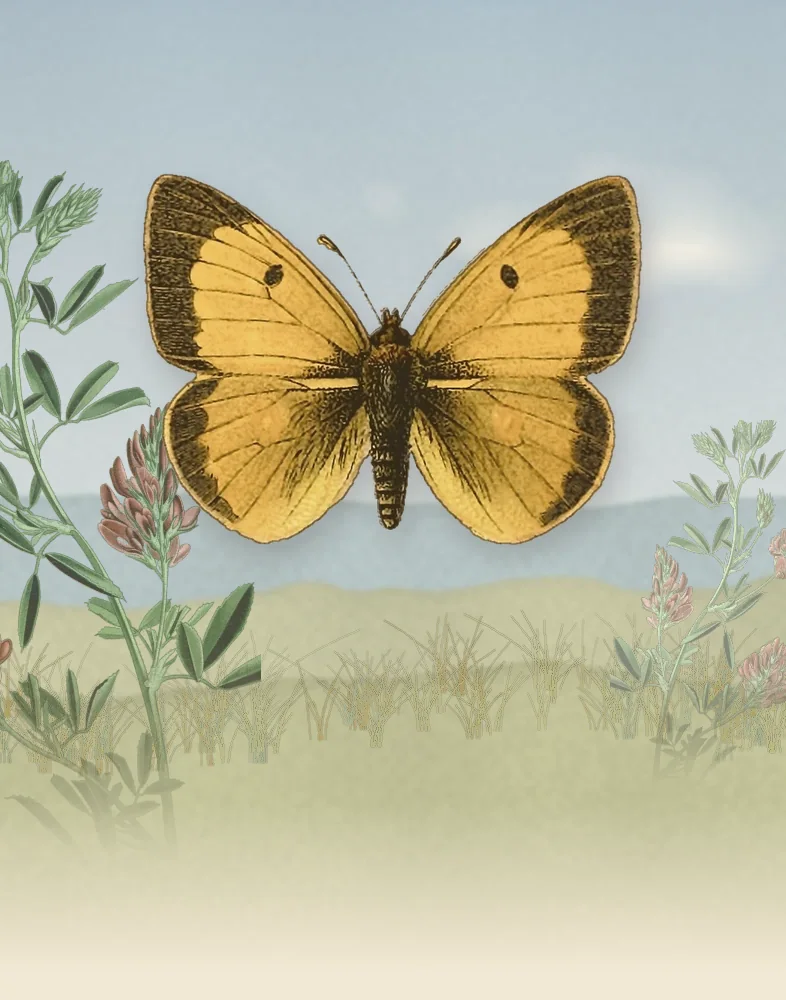
A fast, deep-yellow butterfly racing across a clover field in late summer, never quite stopping: in Britain that is almost always a Clouded Yellow, and it has come a long way.
How to recognise it
- Size: a wingspan of about 52 to 62 millimetres.
- Colour: a rich golden orange-yellow, with broad dark borders above.
- At rest: it always settles with its wings closed, so the dark borders show only in flight.
- A pale form: some females, of the form called helice, are a creamy white-yellow, and can be mistaken for the rarer Pale and Berger's Clouded Yellows.
A traveller from the south
The Clouded Yellow is a true migrant. Most of the butterflies seen in Britain fly in from North Africa and southern Europe: the first arrive in late May or early June, and far more in July and August. Their numbers vary enormously from year to year. In some summers there is a great influx, followed by breeding here, and these are remembered as "Clouded Yellow years"; in 1947, one of them, about 36,000 were estimated.
They can be seen almost anywhere open, but most often near the south coast, and in a good year they reach Scotland and Ireland. A few have managed to survive the winter in southern England as caterpillars, but most caterpillars and chrysalises are killed by damp and frost.
Its caterpillar and food plants
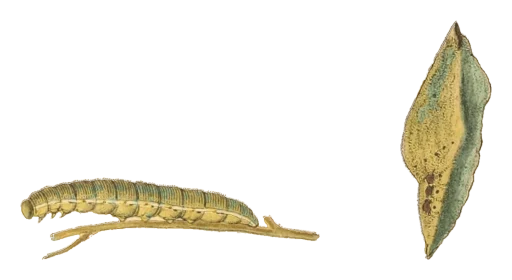
The female lays her eggs one at a time on the upper side of a leaf, up to 600 in her life. The eggs are pale yellow and turn orange before they hatch, about a week later. The caterpillar feeds on clovers and lucerne, and less often on bird's-foot trefoil; it is green, with a bright yellow and orange-red stripe along each side. Because clovers are grown so widely, the Clouded Yellow is one of the few butterflies that has no trouble finding somewhere to breed on modern farmland. In a good year there may be up to three generations.
The plate it comes from
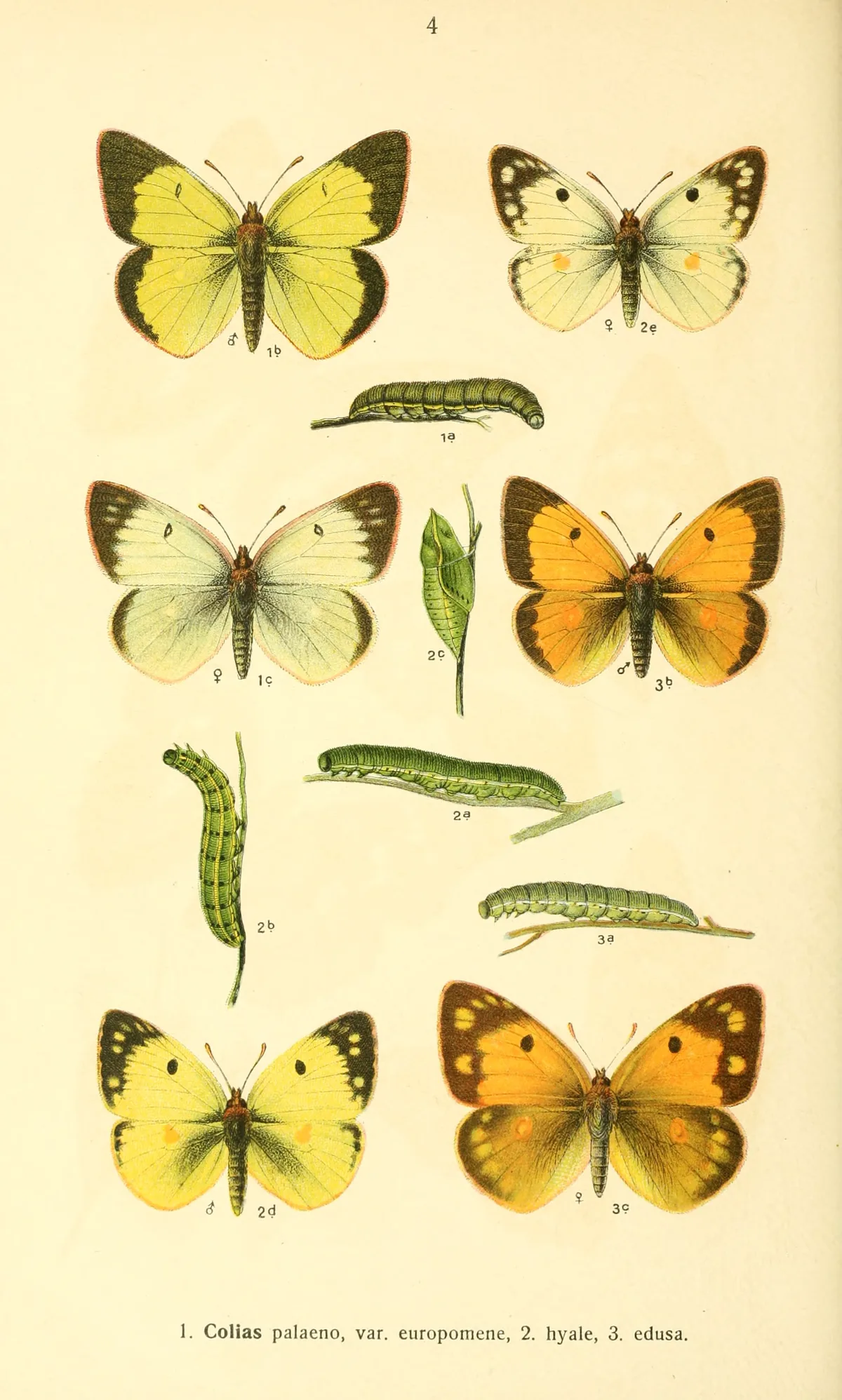
The Clouded Yellow in The Quiet Cabinet is figure 3b, Eckstein's male. On its Field Guide page it flies above lucerne, drawn from Otto Wilhelm Thomé's Flora von Deutschland, Österreich und der Schweiz (1885). Its female turns up in the game as a rare form.
In The Quiet Cabinet
It's one of the thirteen species of the Meadow, the game's second chapter, part of the Butterfly Collection. When its case is completed, a music box joins the plate's music.
Sources
- Butterfly Conservation, Clouded Yellow
- UK Butterflies, Clouded Yellow
More from the journal

Black-veined White: the butterfly Britain lost
A large white butterfly with black veins, lost from Britain around 1925 for reasons still unknown. Its story, its caterpillars' silk nests, its strange female.

Broad-bordered Yellow Underwing: orange hidden beneath
A brown late-summer moth that hides bright orange hindwings with a broad black border, showing them only in flight. How to know it, and its many forms.

Buff-tip moth: the moth that looks like a broken twig
A moth that rests looking just like a snapped birch twig, whose yellow-and-black caterpillars feed in crowds and strip branches bare. How to know the Buff-tip.