



 The Quiet Cabinet

Polygonia c-album
Comma butterfly: the white mark, summer form and comeback
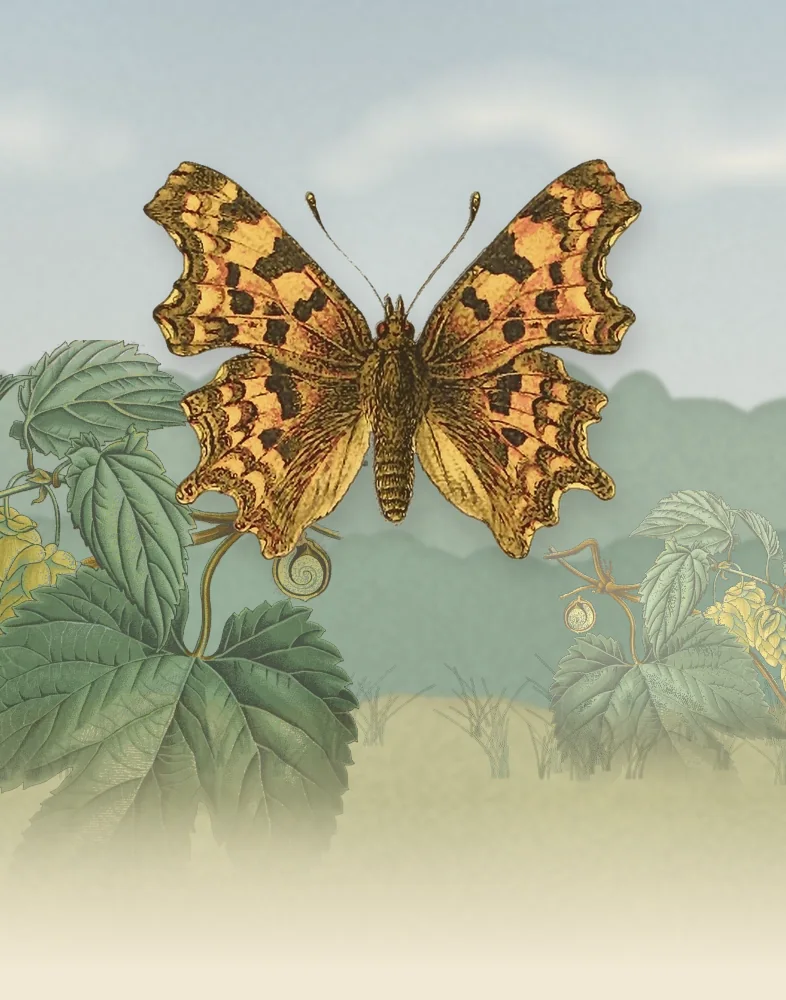
At first glance the Comma looks like a Small Tortoiseshell that has been through a hedge backwards: the same warm orange, but with wings so deeply cut and scalloped that they look torn. They aren't. The ragged edge is its disguise.
How to recognise it
- Size: medium, with a wingspan of about 55 to 60 millimetres.
- Above: orange-brown with dark spots, the edges of every wing jagged.
- Beneath: mottled dark brown, so that with its wings closed it looks just like a withered leaf.
- The comma: in the middle of each hindwing, beneath, is one small white mark shaped like a "c", or a comma. It gives the butterfly its name in English, and its Latin one, c-album, the white c.
Two forms, set by the length of the day
The Comma has a second look. Caterpillars that grow up early in the year, while the days are still lengthening before midsummer, mostly become butterflies of a paler summer form, called hutchinsoni, with a lighter, yellow-brown underside. These breed again the same summer. Caterpillars that grow up after midsummer, as the days shorten, mostly become the dark form, which doesn't breed but goes into hiding for the winter. So a warm spring brings more of the pale form, and with it more butterflies in late summer.
A winter among dead leaves
The dark butterflies feed hard before winter, on garden flowers and on ripe fruit such as blackberries and fallen plums, and then hibernate in woodland, on a tree trunk or branch, in a hollow tree or a log pile. Among dead leaves they're all but invisible. On a warm winter day one may wake and fly, and most come out in March.
Its caterpillar and food plants
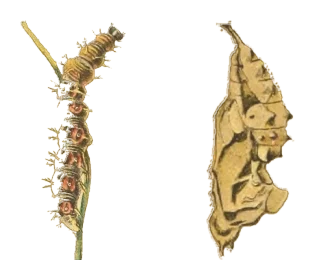
The female lays her green eggs one at a time, on the upper side of a leaf near its edge, up to 275 in her life. The older caterpillar is brown, flecked with white over its back, and resting on the top of a leaf it looks remarkably like a bird dropping, which few birds want to eat. It feeds mostly on common nettle, and also on hop, elm, currants and willow. The chrysalis hangs head down, brown and jagged, with a few small silver spots.
Gone, and back again
The Comma was once found across most of England and Wales. Then, in the 1800s, it almost disappeared: by the middle of the century it was left mainly in the counties along the Welsh border, Gloucestershire, Herefordshire and Monmouthshire. One idea is that it suffered as hop growing declined, since hop was then one of its main food plants.
Since the 1960s it has made a remarkable recovery, now living chiefly on nettles. Between 1976 and 2019 its numbers in Britain roughly tripled, and it has returned to Scotland, where it hadn't been seen since around 1870.
The plate it comes from
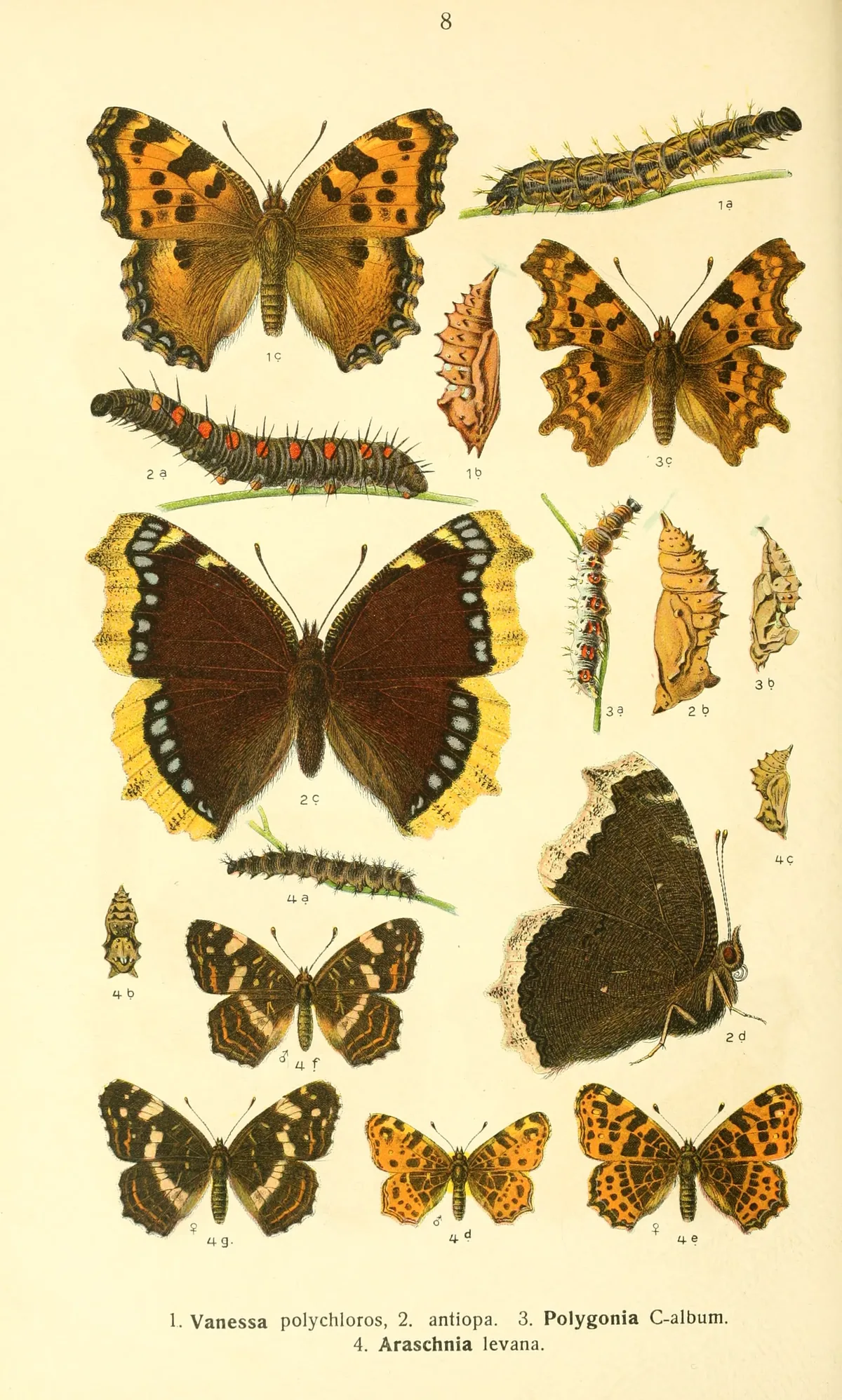
The Comma in The Quiet Cabinet is figure 3c of this plate. On its Field Guide page it flies above hop, drawn from Otto Wilhelm Thomé's Flora von Deutschland, Österreich und der Schweiz (1885). Its pale summer form turns up in the game as a rare form, and the Camberwell Beauty, from the same plate, is one of the Garden's two treasures.
In The Quiet Cabinet
It's one of the twelve species of the Garden, the game's first chapter, which is free. When its case is completed, a marimba joins the plate's music.
More from the journal

Black-veined White: the butterfly Britain lost
A large white butterfly with black veins, lost from Britain around 1925 for reasons still unknown. Its story, its caterpillars' silk nests, its strange female.

Broad-bordered Yellow Underwing: orange hidden beneath
A brown late-summer moth that hides bright orange hindwings with a broad black border, showing them only in flight. How to know it, and its many forms.

Buff-tip moth: the moth that looks like a broken twig
A moth that rests looking just like a snapped birch twig, whose yellow-and-black caterpillars feed in crowds and strip branches bare. How to know the Buff-tip.