



 The Quiet Cabinet

Polyommatus icarus
Common Blue butterfly: male, female, caterpillar and ants
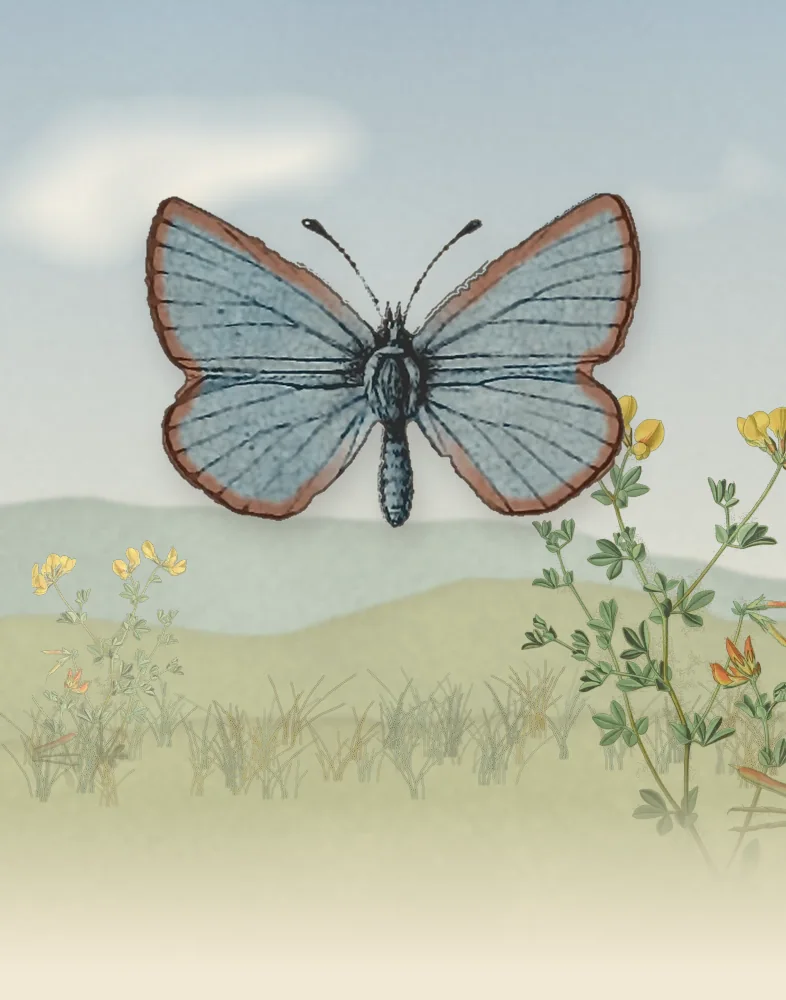
On a sunny bank in early summer, a small blue butterfly rises from the grass, circles you once and settles again a few steps on. In Britain and Ireland it is most likely a Common Blue, the most widespread blue butterfly in both islands.
How to recognise it
- Size: small, with a wingspan of about 29 to 36 millimetres.
- The male is a bright violet-blue above, with a thin dark border and a clean white fringe. In the Adonis and Chalk Hill Blues the dark veins run out into the white fringe; in the Common Blue they don't.
- The female is the surprise. In southern England she is mostly brown, with a row of orange spots along the edges. Further north and west, in Scotland and western Ireland, she grows bluer and bluer, and colonies vary among themselves.
- Beneath, both are grey-brown, scattered with small black spots ringed in white, and a band of orange spots near the edge.
A butterfly of every sunny patch
The Common Blue lives almost anywhere grass grows short and sunny: downland and dunes, road verges, woodland clearings, quarries, golf courses, cemeteries and waste ground. It's found from the south coast to Orkney, though not on Shetland or the high mountains.
In the south it has two generations a year: the first flies in late May and June, the second from late July through August, and in a warm year there may be a third. In the north there is one, in June and July. On dull days and at night the butterflies roost head down on grass stems, and several often share one stem.
Its caterpillar, and the ants
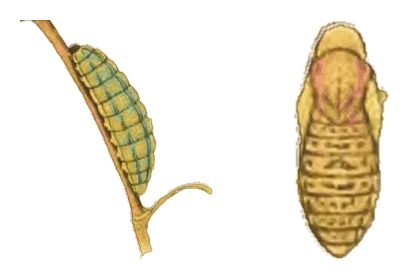
The female lays her white, bun-shaped eggs one at a time, each on the upper side of a young leaf of bird's-foot trefoil, the main food plant; black medick, restharrow, white clover and lesser trefoil are used too. The little green caterpillar feeds from beneath the leaf, leaving pale blotches where it has eaten.
Caterpillars of the last generation spend the winter small, in the leaf litter at the foot of the plant, for five or six months. In spring they finish growing, and in their last stage they become attractive to ants. The chrysalis forms on the ground, held by a few silk threads, and ants may even bury it in the earth, where they tend it.
How it's faring
The Common Blue is still common, but not as common as it was: between 1976 and 2019 its numbers in Britain fell by about 17 per cent, and it was found in about a third fewer places. A sunny, uncut patch with bird's-foot trefoil in it is one of the best things a garden or verge can offer it.
The plate it comes from
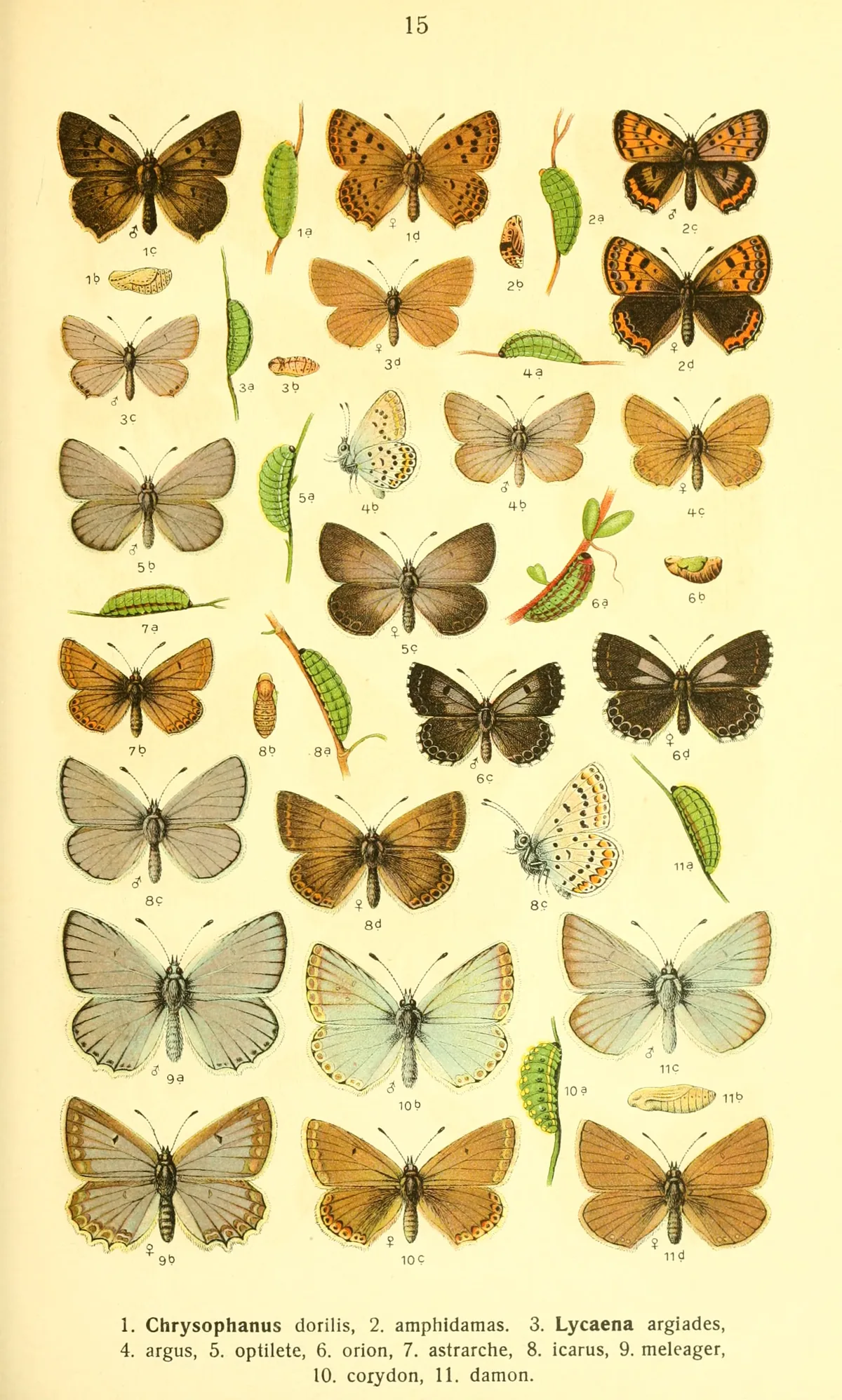
The Common Blue in The Quiet Cabinet is Eckstein's male, figure 8c. On its Field Guide page it flies above bird's-foot trefoil, drawn from Otto Wilhelm Thomé's Flora von Deutschland, Österreich und der Schweiz (1885). Both its females turn up in the game as rare forms: the mostly brown one of the south, and the bluer one of the north and west.
In The Quiet Cabinet
It's one of the twelve species of the Garden, the game's first chapter, which is free. When its case is completed, a harp joins the plate's music.
Sources
- Butterfly Conservation, Common Blue
- UK Butterflies, Common Blue
More from the journal

Black-veined White: the butterfly Britain lost
A large white butterfly with black veins, lost from Britain around 1925 for reasons still unknown. Its story, its caterpillars' silk nests, its strange female.

Broad-bordered Yellow Underwing: orange hidden beneath
A brown late-summer moth that hides bright orange hindwings with a broad black border, showing them only in flight. How to know it, and its many forms.

Buff-tip moth: the moth that looks like a broken twig
A moth that rests looking just like a snapped birch twig, whose yellow-and-black caterpillars feed in crowds and strip branches bare. How to know the Buff-tip.