



 The Quiet Cabinet

Saturnia pavonia
Emperor Moth: Britain's only silk moth
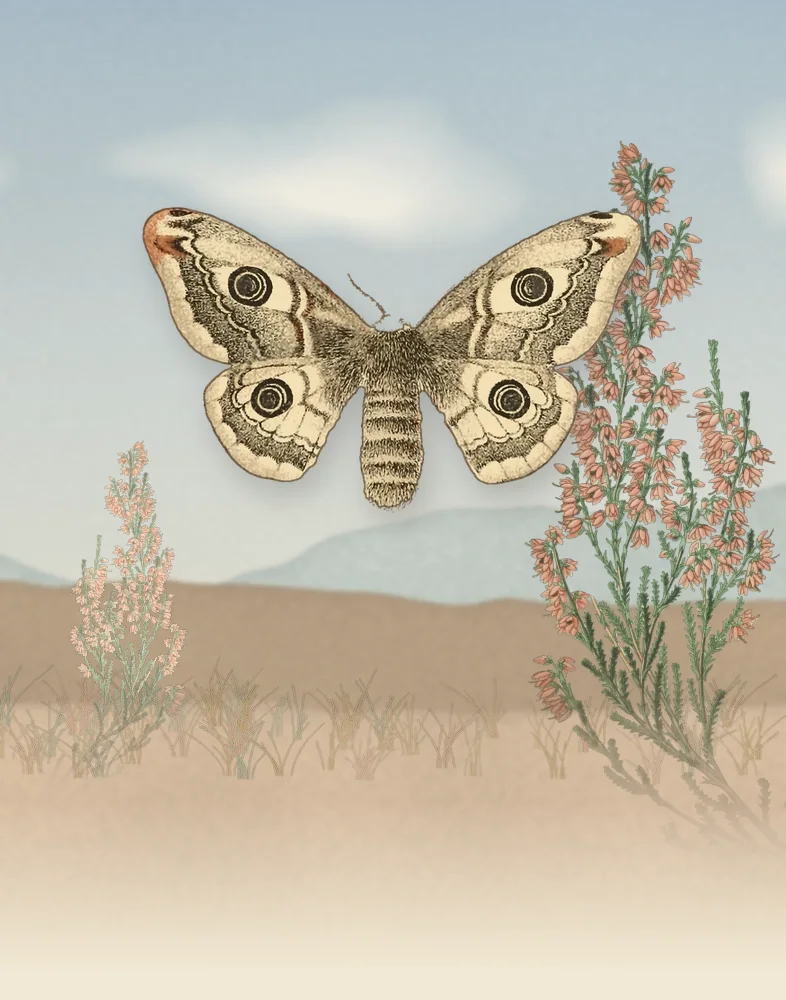
The Emperor Moth belongs to the family of the silk moths, the Saturniidae, which includes the great Atlas moth of Asia. In the British Isles it is the family's only member, and it is quite as striking as its cousins: every wing carries a large eye.
How to recognise it
- Size: a wingspan of about 55 to 80 millimetres; the female is the larger.
- The male has brown and white forewings banded with red and orange, a bold black-and-orange eyespot on each wing, and bright orange hindwings. His antennae are feathery.
- The female is grey and white, with eyespots on all four wings and plain antennae. On northern and upland moors she is often bluish-grey.
Males by day, females by night
The Emperor flies from late March through May, in one generation. The males fly fast across the heaths by day, searching for females; the females are sluggish, and fly at night, sometimes coming to lights early in the evening.
It lives on heathland and moorland, in bogs and fens, along hedgerows, field margins and rides, and on mature dunes. It is widespread over most of mainland Britain, Orkney and the Hebrides, the Isle of Man, the Channel Islands and Ireland, and its range is thought to be stable.
Its caterpillar and cocoon
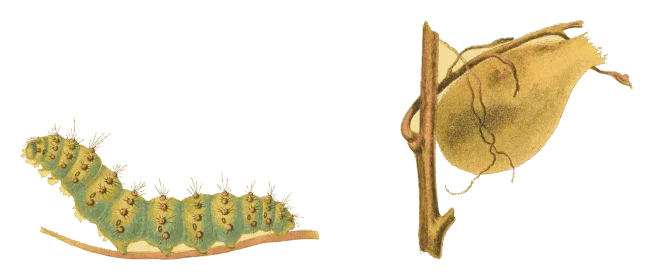
The eggs are laid in batches in April and May, and the caterpillars feed from late May to August. Young, they are black and orange; grown, they are a vivid green, with black hoops set with yellow spots. They feed mostly on heather, and on meadowsweet, bramble, hawthorn, blackthorn, sallows, birch and many more.
The cocoon is a small marvel: light brown, papery and pear-shaped, with a closed ring of stiff, upward-pointing spines round its opening. The Emperor spends the winter inside it, as a chrysalis, on a stem near the ground.
The plate it comes from
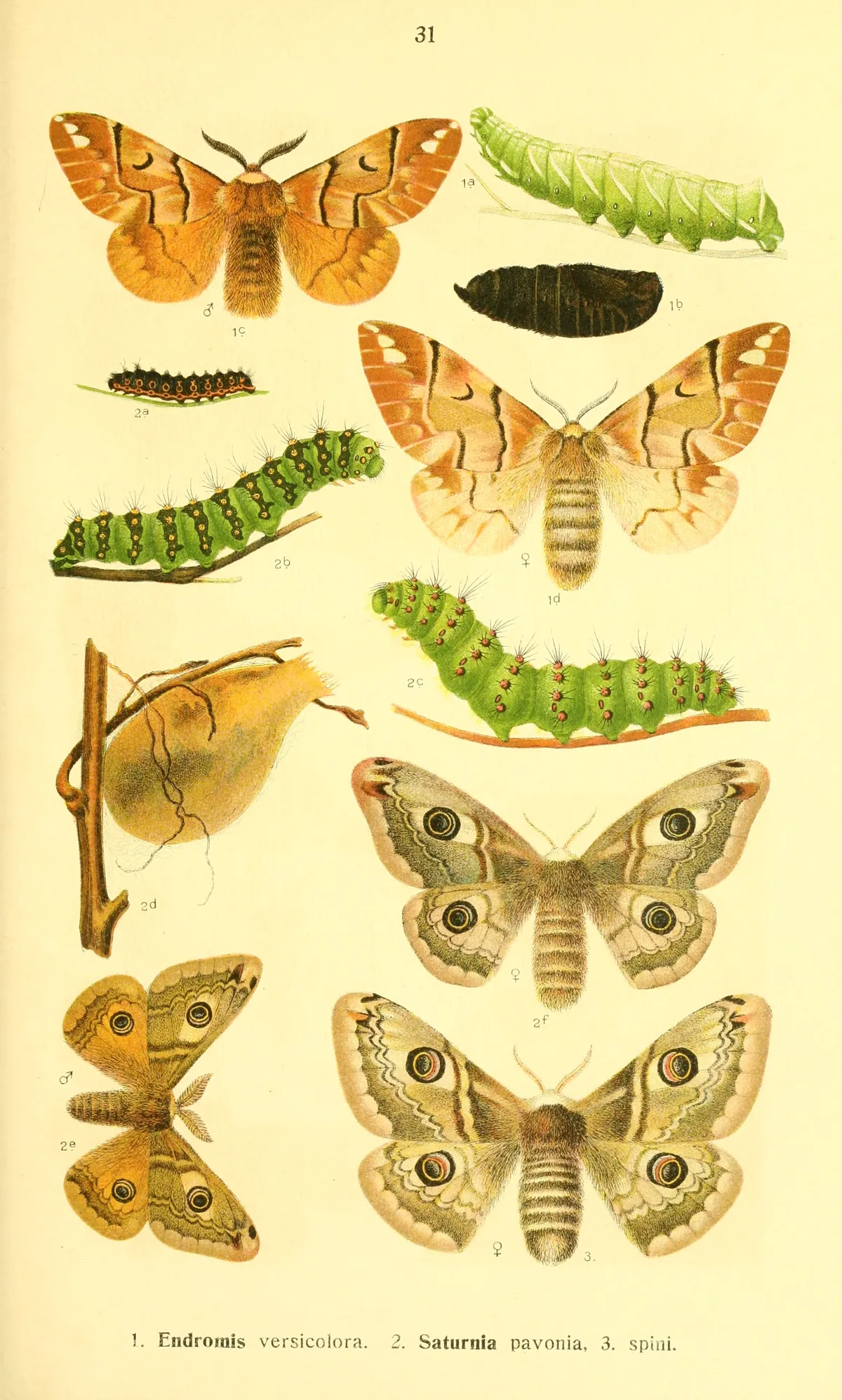
The Emperor Moth in The Quiet Cabinet is figure 2f, Eckstein's female, from the same plate as the Kentish Glory. On its Field Guide page it flies above heather, drawn from Otto Wilhelm Thomé's Flora von Deutschland, Österreich und der Schweiz (1885).
In The Quiet Cabinet
It's one of the thirteen species of the Forest, the game's third chapter, part of the Butterfly Collection. When its case is completed, a low cello joins the plate's music.
Sources
- Butterfly Conservation, Emperor Moth
- UKMoths, Emperor Moth
- Wikipedia, Saturnia pavonia
More from the journal

Black-veined White: the butterfly Britain lost
A large white butterfly with black veins, lost from Britain around 1925 for reasons still unknown. Its story, its caterpillars' silk nests, its strange female.

Broad-bordered Yellow Underwing: orange hidden beneath
A brown late-summer moth that hides bright orange hindwings with a broad black border, showing them only in flight. How to know it, and its many forms.

Buff-tip moth: the moth that looks like a broken twig
A moth that rests looking just like a snapped birch twig, whose yellow-and-black caterpillars feed in crowds and strip branches bare. How to know the Buff-tip.