



 The Quiet Cabinet

Smerinthus ocellata
Eyed Hawk-moth: the moth that flashes two blue eyes
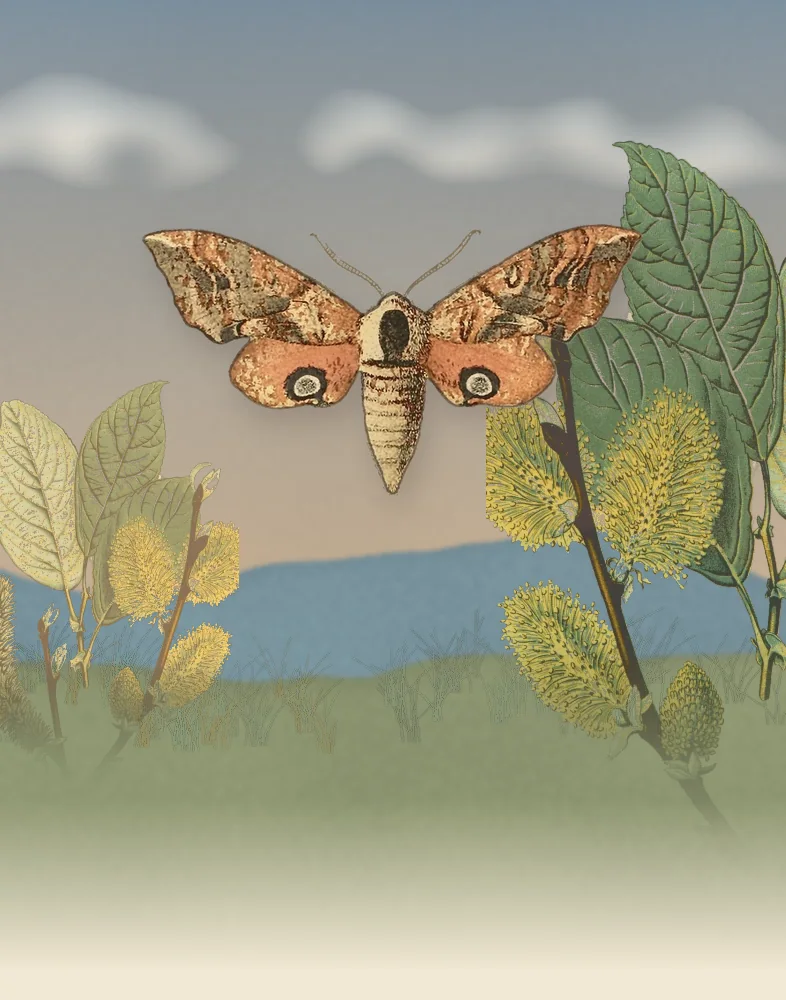
At rest on a branch, the Eyed Hawk-moth is brown and dull, its forewings the colour of bark. Touch it, and it changes in an instant: it shows its hindwings, rose-pink, each with a large blue and black eye, staring.
How to recognise it
- Size: a wingspan of about 70 to 80 millimetres.
- Forewings: shades of brown, like bark.
- Hindwings: pink at the base, shading to ochre, each with a large eyespot of blue in a black ring, hidden under the forewings at rest.
- Rare forms have yellow or deep pink hindwings, or no eye at all.
Eyes as a defence
The eyespots are kept hidden until the moth is threatened. Then they are flashed suddenly, and may startle a bird or other predator long enough for the moth to survive.
It flies from May to July, most of all in June, in one generation, and comes to lights; the adults don't feed. It lives in gardens, orchards, woods, parks, riversides, fens and scrub, and is common across England and Wales as far north as Cumbria.
Its caterpillar
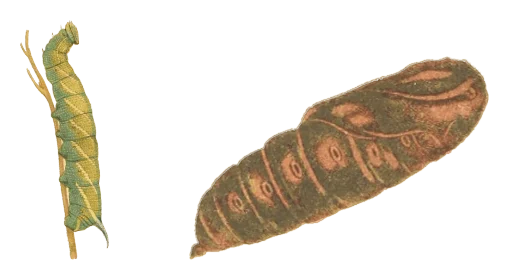
The caterpillar is pale bluish or yellowish green, with white stripes along its sides and a blue-grey horn at its tail, and grows to about 80 millimetres. It feeds from June to September on sallow and apple, wild and cultivated, and less often on poplars and aspen. In late summer it goes underground, near its food plant, and spends the winter there as a glossy dark chrysalis.
The plate it comes from
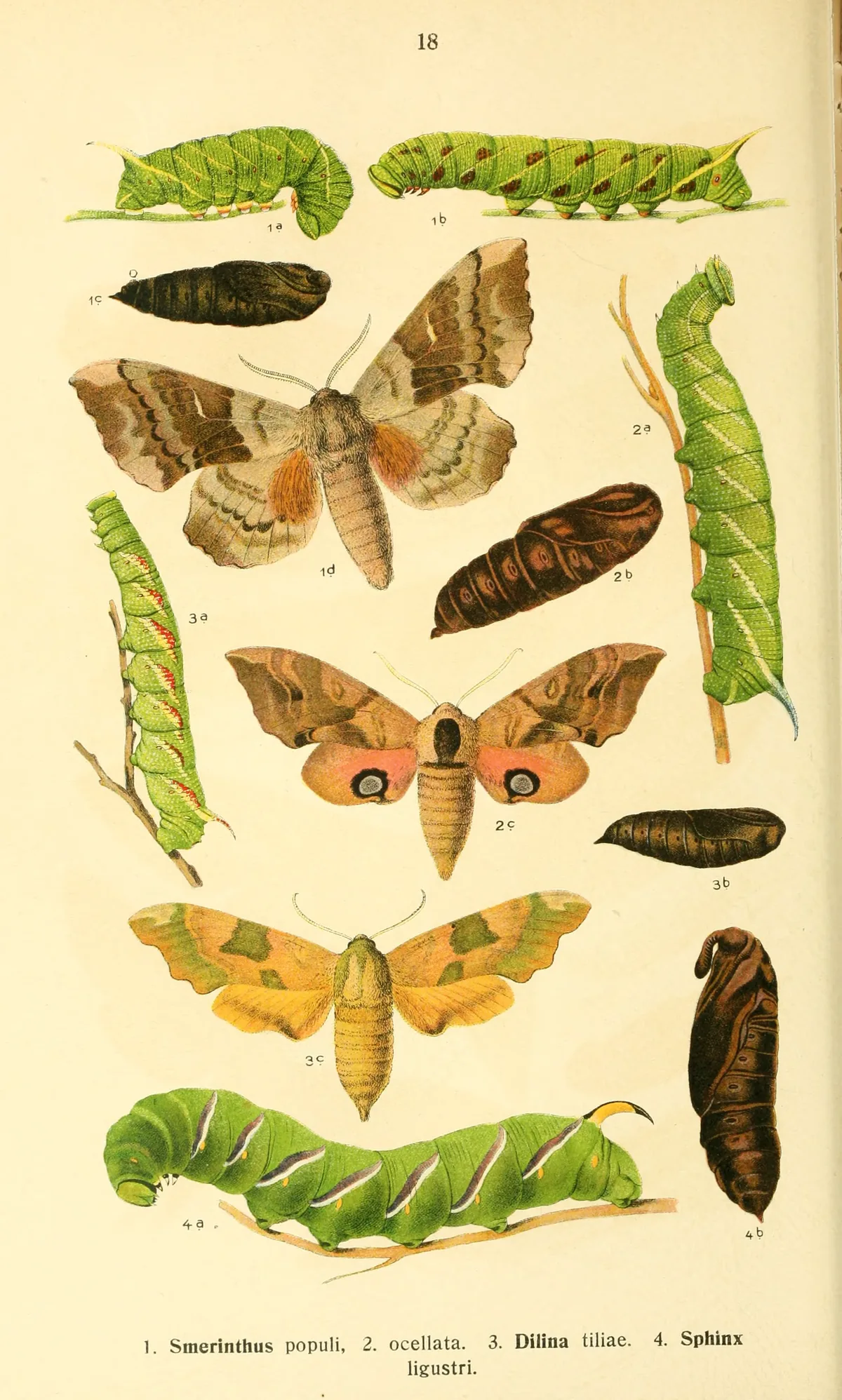
The Eyed Hawk-moth in The Quiet Cabinet is figure 2c of this plate, which also holds the Privet Hawk-moth's caterpillar. On its Field Guide page it flies above sallow at an orchard's edge at dusk.
In The Quiet Cabinet
It's one of the thirteen species of the Night Wing, the game's fourth chapter, part of the Butterfly Collection. When its case is completed, a felt piano joins the plate's music.
Sources
- Butterfly Conservation, Eyed Hawk-moth
- UKMoths, Eyed Hawk-moth
- Wikipedia, Smerinthus ocellata
More from the journal

Black-veined White: the butterfly Britain lost
A large white butterfly with black veins, lost from Britain around 1925 for reasons still unknown. Its story, its caterpillars' silk nests, its strange female.

Broad-bordered Yellow Underwing: orange hidden beneath
A brown late-summer moth that hides bright orange hindwings with a broad black border, showing them only in flight. How to know it, and its many forms.

Buff-tip moth: the moth that looks like a broken twig
A moth that rests looking just like a snapped birch twig, whose yellow-and-black caterpillars feed in crowds and strip branches bare. How to know the Buff-tip.