



 The Quiet Cabinet

Pyronia tithonus
Gatekeeper butterfly: the Hedge Brown of high summer
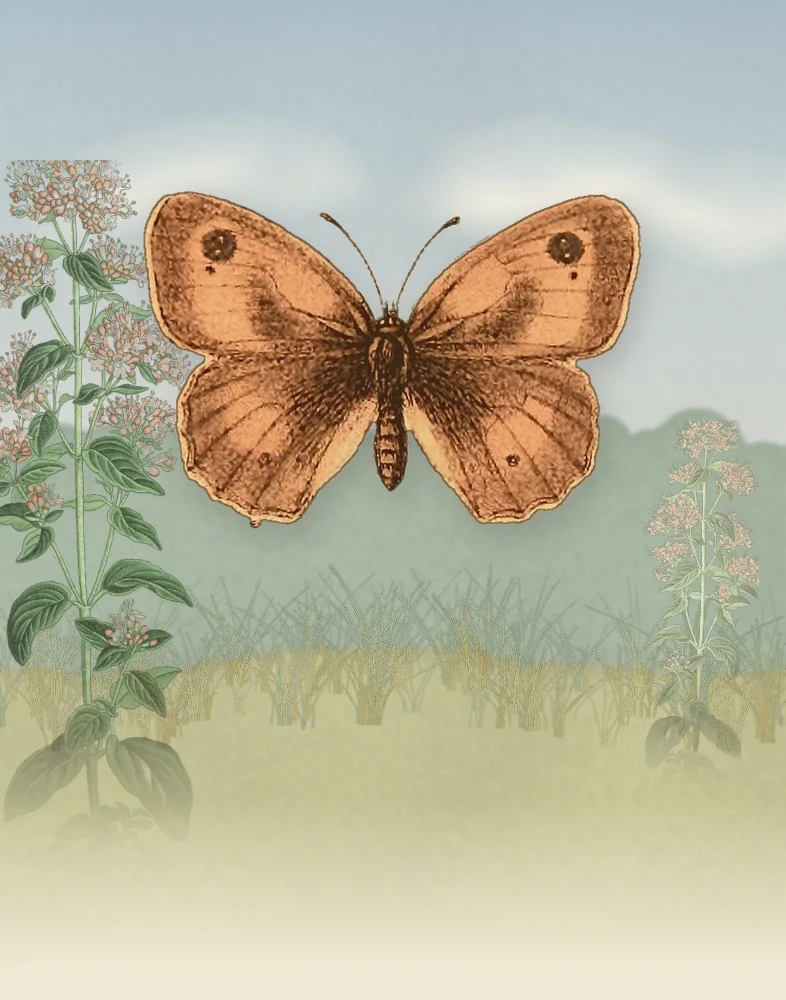
In late July, every bramble in flower along a hedge seems to have a small orange butterfly on it. It's the Gatekeeper, also called the Hedge Brown, named for the places it's found: field gates, hedgerows and the tall grass beside them.
How to recognise it
- Size: a wingspan of about 37 to 48 millimetres.
- Colour: orange, edged broadly in brown, with a dark eyespot near each forewing tip.
- The eyespot has two white pupils, which helps tell it from the Meadow Brown, a larger and duller butterfly that flies in the same places.
- The male has a dark band of scent scales across each forewing, so the sexes are easy to tell apart. It often basks with its wings open.
When and where to see it
The Gatekeeper has one generation a year, and a shorter season than the Meadow Brown. It comes out at the end of June in a good year, is at its peak in late July and early August, and few are left by the end of August. Bramble and ragwort flowers are its favourites; it takes wild marjoram and fleabane too, and sweet honeydew from leaves.
It lives where tall grass grows near hedges, trees or scrub, and the largest colonies are along field edges and hedgerows. It's found in England and Wales south of a line from Westmorland to south-east Yorkshire, and in Ireland only along the south and south-east coasts, and it has been spreading north. The males each defend a small territory, often around a shrub.
Its caterpillar and food plants
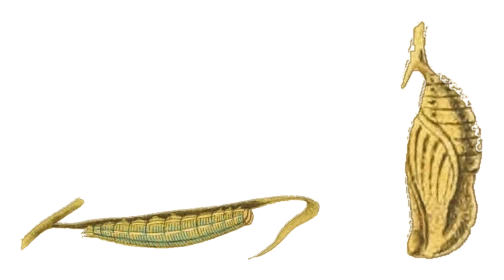
The female lays 100 to 200 eggs, one at a time, usually in the shade under a shrub. The caterpillar eats fine grasses, bents, fescues and meadow-grasses. After its first moult it spends the winter at the base of a grass clump, usually inside a withered blade, and in spring feeds only at night. It comes in light brown and green forms, and the chrysalis hangs head down low in the grass.
How it's faring
Still widespread, but less numerous: between 1976 and 2019 its numbers in Britain fell by about 42 per cent, though it was found in as many places as before.
The plate it comes from
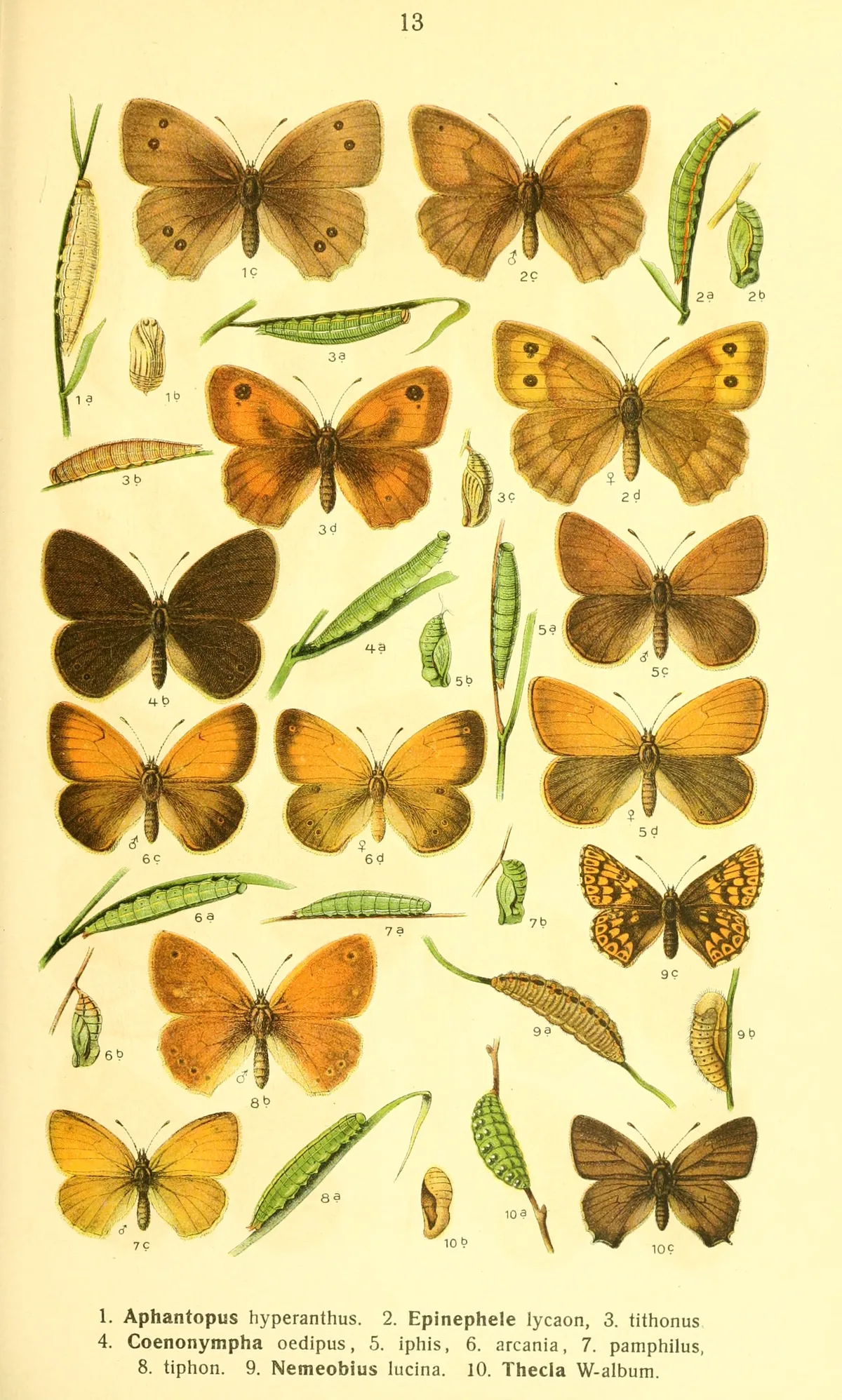
The Gatekeeper in The Quiet Cabinet is figure 3d of this plate, which it shares with the Ringlet, the Small Heath and the Duke of Burgundy. On its Field Guide page it flies above wild marjoram, drawn from Otto Wilhelm Thomé's Flora von Deutschland, Österreich und der Schweiz (1885).
In The Quiet Cabinet
It's one of the thirteen species of the Meadow, the game's second chapter, part of the Butterfly Collection. When its case is completed, a flute joins the plate's music.
Sources
- Butterfly Conservation, Gatekeeper
- UK Butterflies, Gatekeeper
- Wikipedia, Pyronia tithonus
More from the journal

Black-veined White: the butterfly Britain lost
A large white butterfly with black veins, lost from Britain around 1925 for reasons still unknown. Its story, its caterpillars' silk nests, its strange female.

Broad-bordered Yellow Underwing: orange hidden beneath
A brown late-summer moth that hides bright orange hindwings with a broad black border, showing them only in flight. How to know it, and its many forms.

Buff-tip moth: the moth that looks like a broken twig
A moth that rests looking just like a snapped birch twig, whose yellow-and-black caterpillars feed in crowds and strip branches bare. How to know the Buff-tip.