



 The Quiet Cabinet

Hepialus humuli
Ghost Moth: the white males that dance at dusk
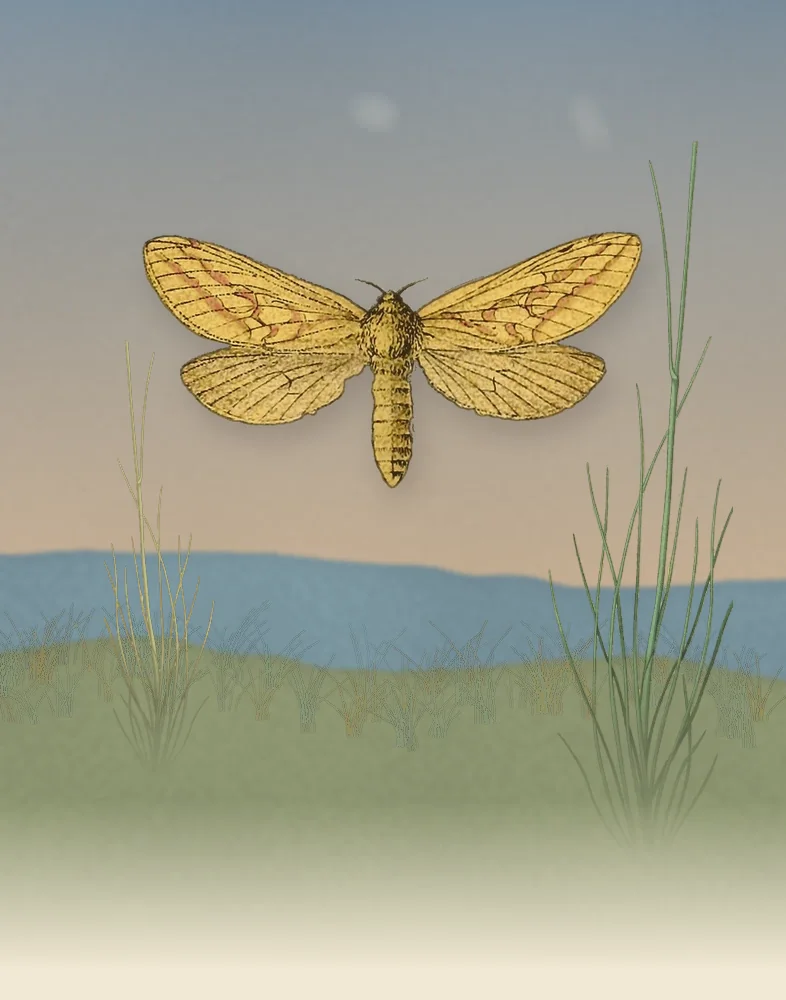
On a June evening, as the light fades over a rough meadow, small white shapes hang in the air above the grass, rising and falling slowly, swaying from side to side. They are male Ghost Moths, and their pale, silent dance has given the moth its name.
How to recognise it
- Size: a wingspan of about 42 to 70 millimetres; the female is the larger.
- The male is white all over, his wings shining in the half-light.
- The female, like the one in the game, is yellow with orange markings.
- At rest it holds its long wings almost upright against its body.
- The adults have short antennae and no working mouthparts: they can't feed.
A dance at dusk
The Ghost Moth flies in June and July. At dusk the males gather and hover over open ground, for 20 to 30 minutes, sometimes slowly rising and falling. In that dim light their silvery wings stand out against the grass, and they give off a scent, said to be goat-like. A female flies close past the male she chooses; he follows; she lands and beats her wings; and they mate. The short window at dusk is thought to help them avoid the bats that hunt them.
It lives in grassy and weedy places in woodland and open country, and is fairly common across much of Britain and Ireland. On Shetland it has its own form, smaller and creamy.
A caterpillar underground
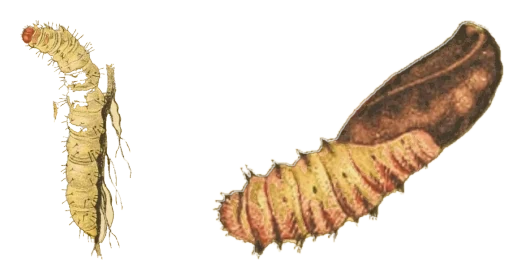
The female lays hundreds of eggs, about 600 on average. The white, grub-like caterpillars live underground, feeding on the roots of grasses and of low plants such as nettles, docks and wild strawberry. They often spend two winters as caterpillars, so the moth's life commonly takes two years. Linnaeus named it humuli, after the hop, believing wrongly that its caterpillars fed on hop roots.
The plate it comes from
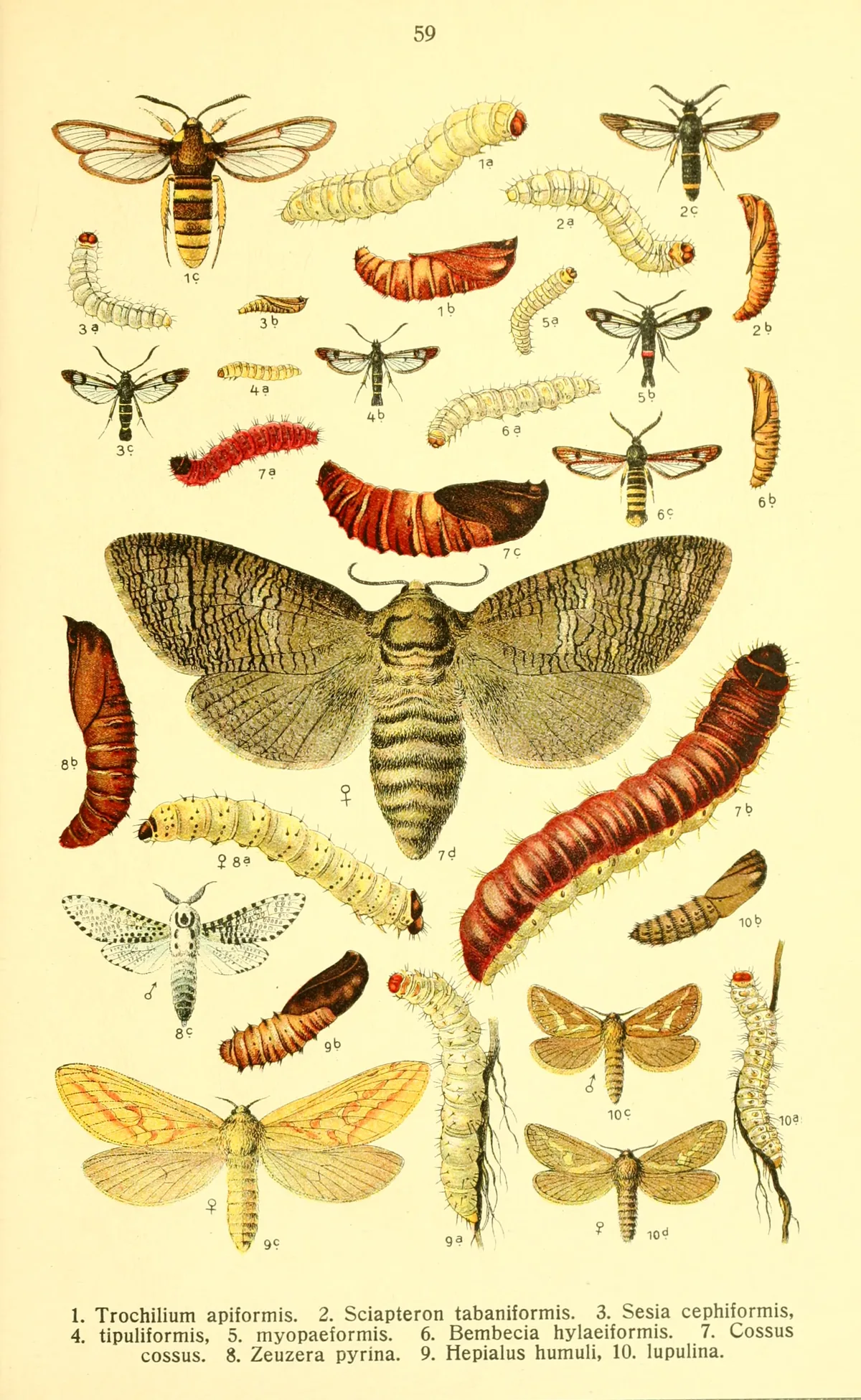
The Ghost Moth in The Quiet Cabinet is figure 9c, Eckstein's yellow female; the white male turns up in the game as a rare form. On its Field Guide page it flies above sheep's fescue at dusk.
In The Quiet Cabinet
It's one of the thirteen species of the Night Wing, the game's fourth chapter, part of the Butterfly Collection. When its case is completed, a music box joins the plate's music.
Sources
- Butterfly Conservation, Ghost Moth
- UKMoths, Ghost Moth
- Wikipedia, Hepialus humuli
More from the journal

Black-veined White: the butterfly Britain lost
A large white butterfly with black veins, lost from Britain around 1925 for reasons still unknown. Its story, its caterpillars' silk nests, its strange female.

Broad-bordered Yellow Underwing: orange hidden beneath
A brown late-summer moth that hides bright orange hindwings with a broad black border, showing them only in flight. How to know it, and its many forms.

Buff-tip moth: the moth that looks like a broken twig
A moth that rests looking just like a snapped birch twig, whose yellow-and-black caterpillars feed in crowds and strip branches bare. How to know the Buff-tip.