



 The Quiet Cabinet

Pyrgus malvae
Grizzled Skipper: the tiny chequered skipper of spring
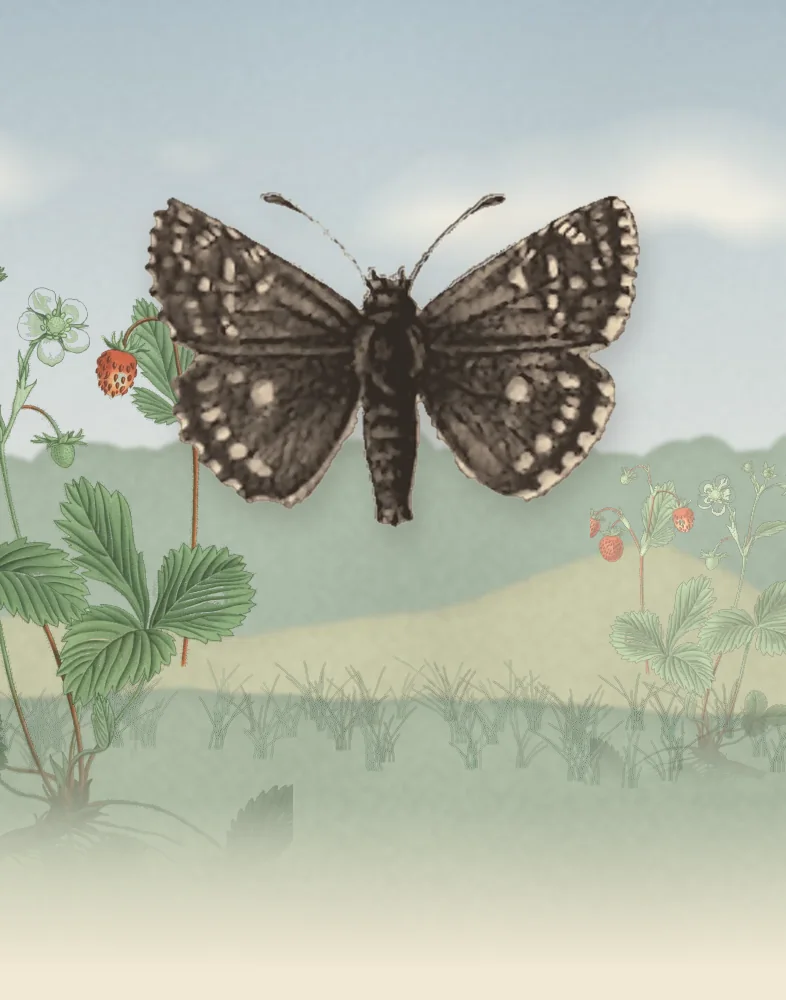
It's one of the smallest butterflies in Britain and one of the hardest to follow: a little chequered blur that buzzes low over the turf and is gone. The Grizzled Skipper is a butterfly of spring.
How to recognise it
- Size: tiny, with a wingspan of about 23 to 29 millimetres.
- Colour: black or dark brown, with a chequerboard of white spots: the "grizzled" pattern it is named for, and unmistakable once it settles.
- Flight: low, darting and fast, with a buzzing quality that makes it hard to keep in sight. It perches on twigs and feeds at bird's-foot trefoil and bugle.
When and where to see it
It comes out through April and flies until the end of June, in one generation, with sometimes a small second brood in a good year. Both sexes bask for long periods, and the males are territorial, chasing any butterfly that passes, whatever its size. At night and in cool weather they roost on flower heads and grasses.
It needs warm, sheltered places where the plants are sparse: woodland rides and clearings, chalk and other unimproved grassland, and old industrial sites such as quarries, spoil heaps and railway lines. Its colonies are small, usually fewer than 100 butterflies. It's found in England south of a line from Gloucestershire to Lincolnshire, with scattered colonies further north and in Wales, and isn't found in Scotland or Ireland.
Its caterpillar and food plants
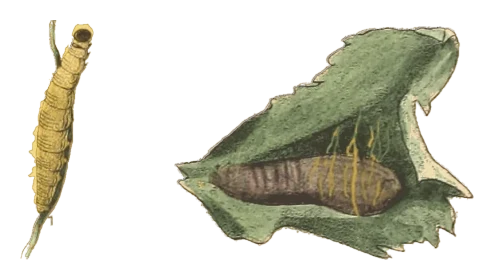
The female lays her eggs one at a time under a leaf, in a warm spot near bare ground. The caterpillar feeds on wild strawberry, agrimony and creeping cinquefoil, among others. It spins silk across a leaf, and later folds the leaf's edges together into a shelter; it feeds in the early morning and the evening. Then it becomes a chrysalis in a loose cocoon at the foot of the plants, dusted with white, and waits there through the autumn and winter, about nine months, until spring.
How it's faring
Between 1976 and 2019 the Grizzled Skipper's numbers in Britain fell by about half, and it was lost from about half the places it lived. It's listed as Vulnerable on Great Britain's Red List, and is a priority species for conservation in England and Wales.
The plate it comes from
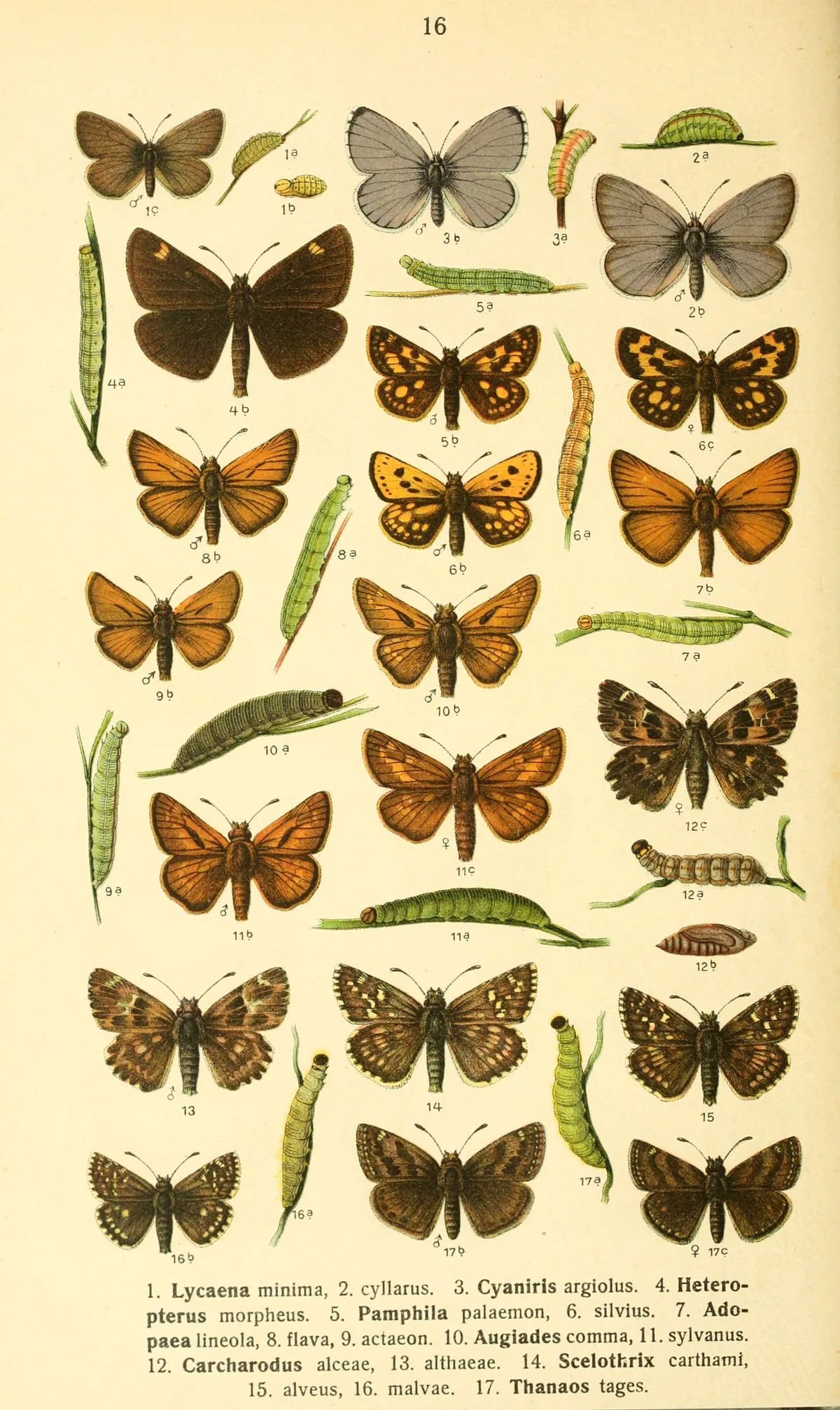
The Grizzled Skipper in The Quiet Cabinet is figure 16b of this plate of skippers, which it shares with the Large Skipper. On its Field Guide page it flies above wild strawberry, drawn from Otto Wilhelm Thomé's Flora von Deutschland, Österreich und der Schweiz (1885).
In The Quiet Cabinet
It's one of the thirteen species of the Meadow, the game's second chapter, part of the Butterfly Collection. When its case is completed, a celesta joins the plate's music.
Sources
- Butterfly Conservation, Grizzled Skipper
- UK Butterflies, Grizzled Skipper
More from the journal

Black-veined White: the butterfly Britain lost
A large white butterfly with black veins, lost from Britain around 1925 for reasons still unknown. Its story, its caterpillars' silk nests, its strange female.

Broad-bordered Yellow Underwing: orange hidden beneath
A brown late-summer moth that hides bright orange hindwings with a broad black border, showing them only in flight. How to know it, and its many forms.

Buff-tip moth: the moth that looks like a broken twig
A moth that rests looking just like a snapped birch twig, whose yellow-and-black caterpillars feed in crowds and strip branches bare. How to know the Buff-tip.