



 The Quiet Cabinet

Celastrina argiolus
Holly Blue butterfly: the blue of gardens, holly and ivy
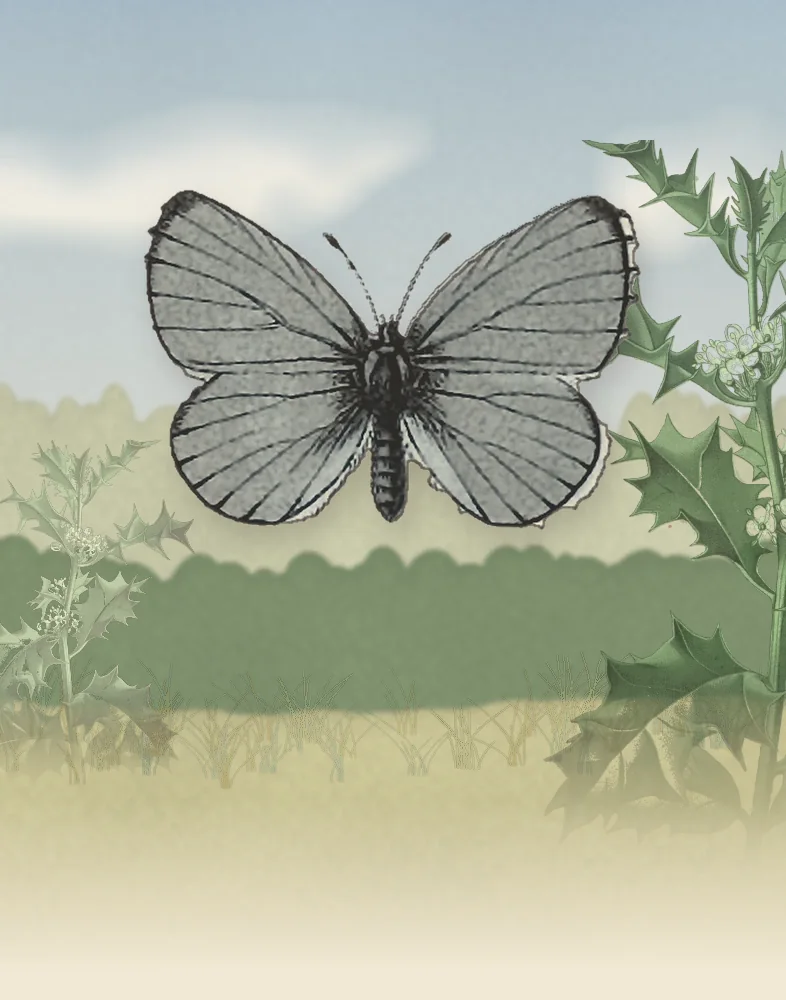
A small blue butterfly in a town garden in early April, fluttering up and over a hedge, is almost certainly a Holly Blue. It comes out well before the other blues, and it flies high, round bushes and trees, where the blues of grassland keep close to the ground.
How to recognise it
- Size: small, with a wingspan of about 26 to 35 millimetres.
- Above: bright blue. The female has black edges to her forewings, broader in the summer generation than in spring.
- Beneath: pale silvery blue with small black spots, quite unlike the Common Blue's orange-spotted underside. That is the easiest way to know it, as it opens its wings only in weak sunshine.
Holly in spring, ivy in summer
The Holly Blue usually has two generations a year. The spring butterflies come out in April from chrysalises that spent the winter; the second generation flies from the end of July into August. And each generation has its own plant. The female of spring lays her eggs at the base of holly flower buds, and the caterpillars eat the buds, berries and young leaves; the female of summer lays on ivy. No other British blue does this, which has led one writer to joke that it might as well be called the Ivy Blue.
It is a butterfly of gardens, parks, churchyards, hedgerows and woodland rides, and in towns it is much the commonest blue. Both sexes take honeydew more than nectar, and the males sip salts from damp mud.
Its caterpillar, and a wasp
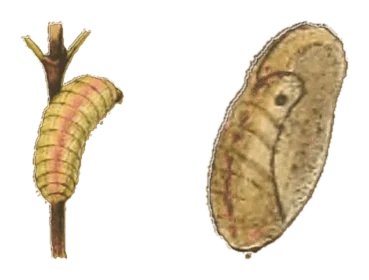
The green caterpillar bores into the flower buds, leaving a string of empty buds behind it. Its numbers rise and fall in a cycle over a few years, believed to follow a small parasitic wasp, Listrodromus nycthemerus, which lays its eggs in Holly Blue caterpillars and in no others; one wasp comes out of each chrysalis it takes. When the wasps are many, the butterflies are few, and then the wasps dwindle in turn.
How it's faring
Very well. Between 1976 and 2019 its numbers in Britain more than doubled, and it has spread north into the Midlands and northern England. It was voted fourth in the vote for Britain's favourite butterfly.
The plate it comes from
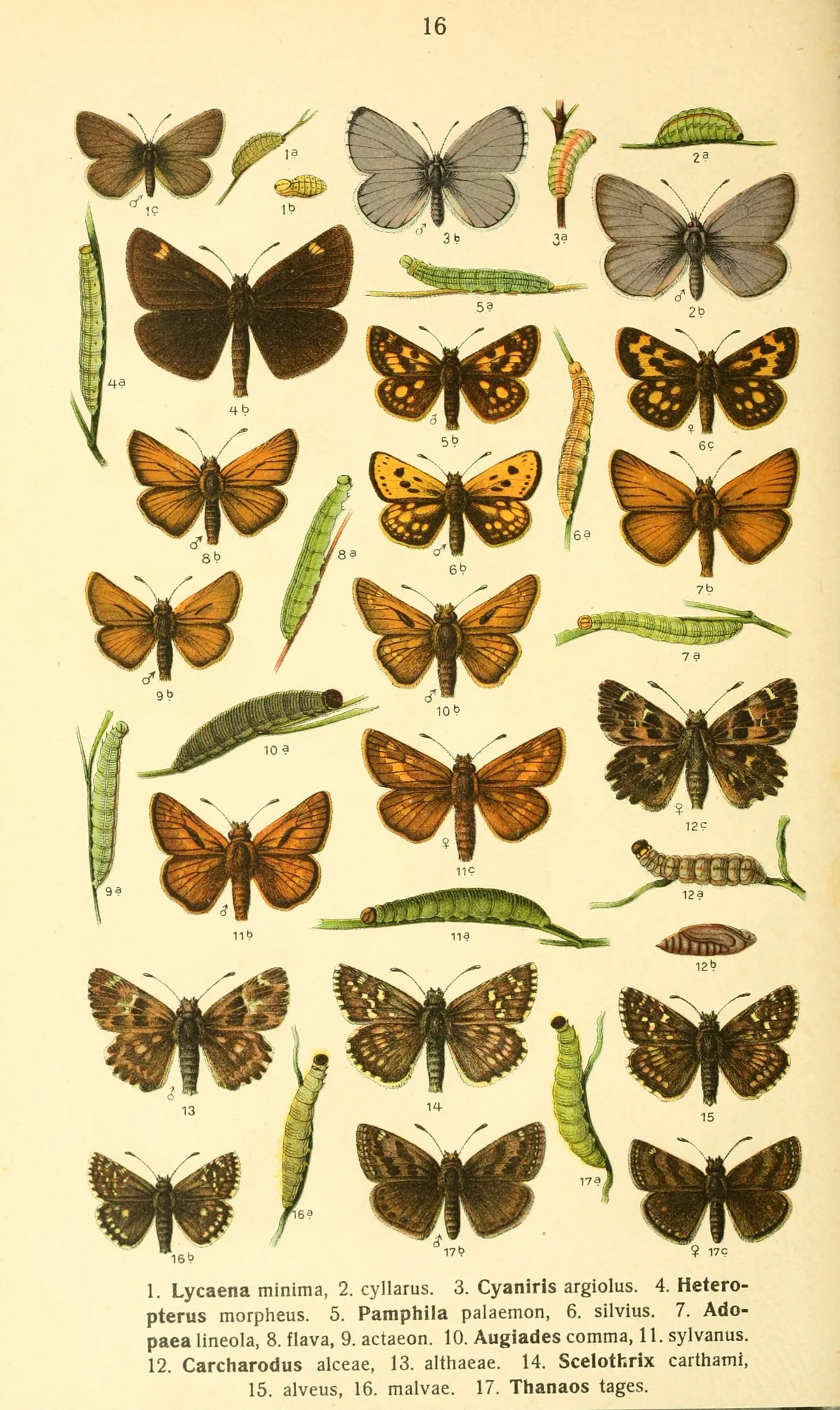
The Holly Blue in The Quiet Cabinet is figure 3b, Eckstein's male, from the same plate as the Large and Grizzled Skippers. On its Field Guide page it flies above holly, drawn from Otto Wilhelm Thomé's Flora von Deutschland, Österreich und der Schweiz (1885).
In The Quiet Cabinet
It's one of the thirteen species of the Forest, the game's third chapter, part of the Butterfly Collection. When its case is completed, a harp joins the plate's music.
Sources
- Butterfly Conservation, Holly Blue
- UK Butterflies, Holly Blue
More from the journal

Black-veined White: the butterfly Britain lost
A large white butterfly with black veins, lost from Britain around 1925 for reasons still unknown. Its story, its caterpillars' silk nests, its strange female.

Broad-bordered Yellow Underwing: orange hidden beneath
A brown late-summer moth that hides bright orange hindwings with a broad black border, showing them only in flight. How to know it, and its many forms.

Buff-tip moth: the moth that looks like a broken twig
A moth that rests looking just like a snapped birch twig, whose yellow-and-black caterpillars feed in crowds and strip branches bare. How to know the Buff-tip.