



 The Quiet Cabinet

Macroglossum stellatarum
Hummingbird hawk-moth: the moth that hovers like a bird
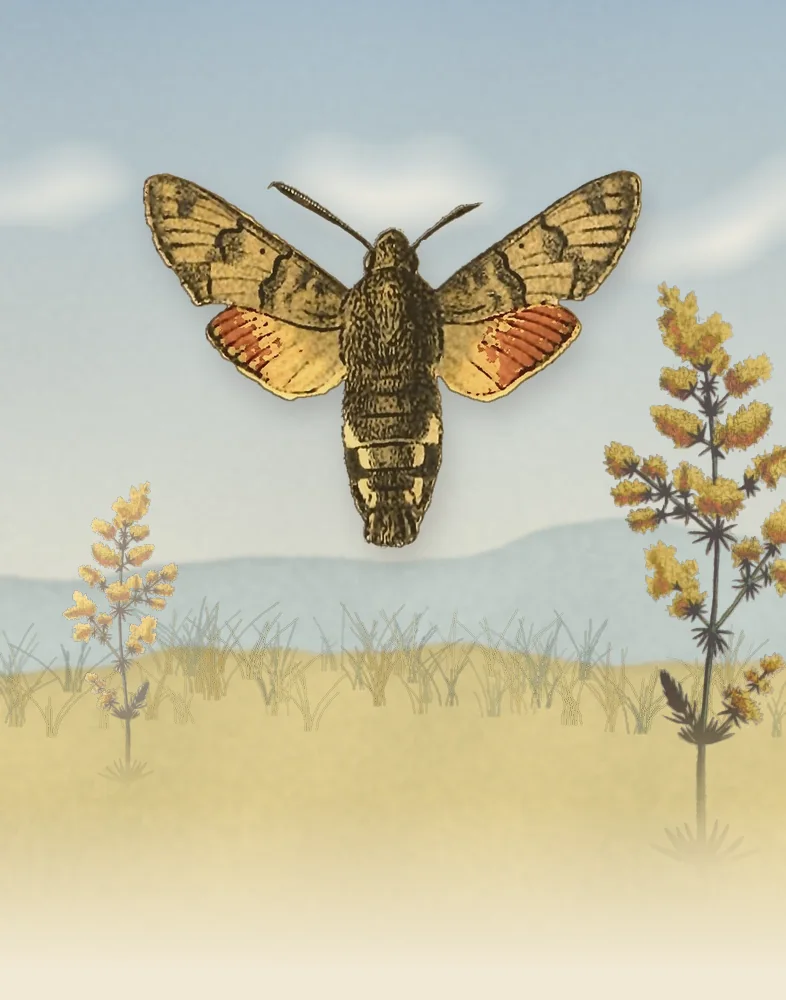
Every summer, someone in a European garden sees a hummingbird. It hovers in front of a flower, its wings a blur, its long tongue reaching in for nectar, then darts to the next one. But Europe has no hummingbirds. What they saw was a moth: the hummingbird hawk-moth.
A moth that flies by day
Most moths fly at night. The hummingbird hawk-moth flies in full sunshine, hovering at flowers the way a hummingbird does. Its wings beat about eighty times a second, fast enough to make a soft hum you can hear when it's close.
How to recognise it
- Size: a wingspan of 50 to 58 millimetres, about the width of a small butterfly, but with a thick, sturdy body.
- Forewings: greyish-brown.
- Hindwings: orange-brown, seen mostly as a flash of colour while it flies.
- Body: chequered black and white along its sides.
You'll usually see it moving: hovering, darting, hovering again.
When and where to see it
In Britain it's an immigrant from southern Europe and North Africa, seen mostly from May to September, with a few sightings in other months. It turns up in gardens, on coasts, along woodland rides and in towns, and it's most common in the south and east of England, South Wales and the Midlands. A few spend the winter as adult moths, tucked into unheated outbuildings or into cracks and holes in walls and trees.
Its caterpillar and food plants
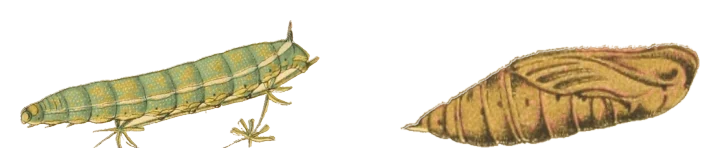
The caterpillar feeds on bedstraws: lady's bedstraw and hedge bedstraw, and wild madder too. Females have also been seen laying eggs on red valerian. The caterpillars are found from June to October, most often in August. When fully grown, each spins a loose cocoon near the ground, among the food plant's leaves or in leaf litter, and turns into a pupa there.
The plate it comes from
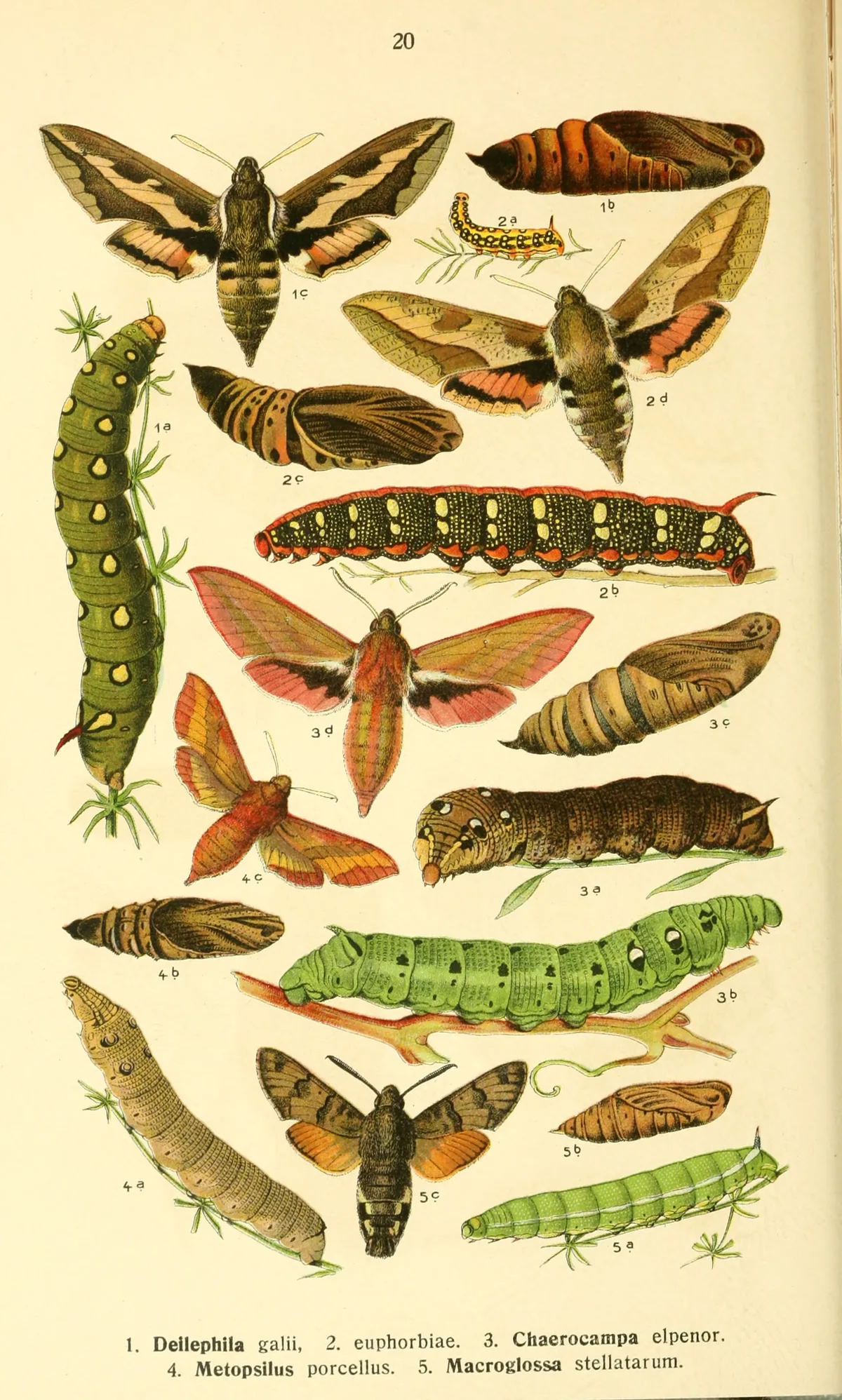
The hummingbird hawk-moth in The Quiet Cabinet is figure 5c of this plate, cut from the scan and brought to life. On its Field Guide page it hovers over a meadow of lady's bedstraw, drawn from the botanical plates of Flora Batava.
In The Quiet Cabinet
It's one of the twelve species of the Garden, the game's first chapter, which is free. When its case is completed, a low cello joins the plate's music.
Sources
- Butterfly Conservation, Humming-bird Hawk-moth
- Butterfly Conservation, Species of the month: Humming-bird Hawk-moth
More from the journal

Black-veined White: the butterfly Britain lost
A large white butterfly with black veins, lost from Britain around 1925 for reasons still unknown. Its story, its caterpillars' silk nests, its strange female.

Broad-bordered Yellow Underwing: orange hidden beneath
A brown late-summer moth that hides bright orange hindwings with a broad black border, showing them only in flight. How to know it, and its many forms.

Buff-tip moth: the moth that looks like a broken twig
A moth that rests looking just like a snapped birch twig, whose yellow-and-black caterpillars feed in crowds and strip branches bare. How to know the Buff-tip.