



 The Quiet Cabinet

Automeris io
Io Moth: two great eyes and a stinging caterpillar
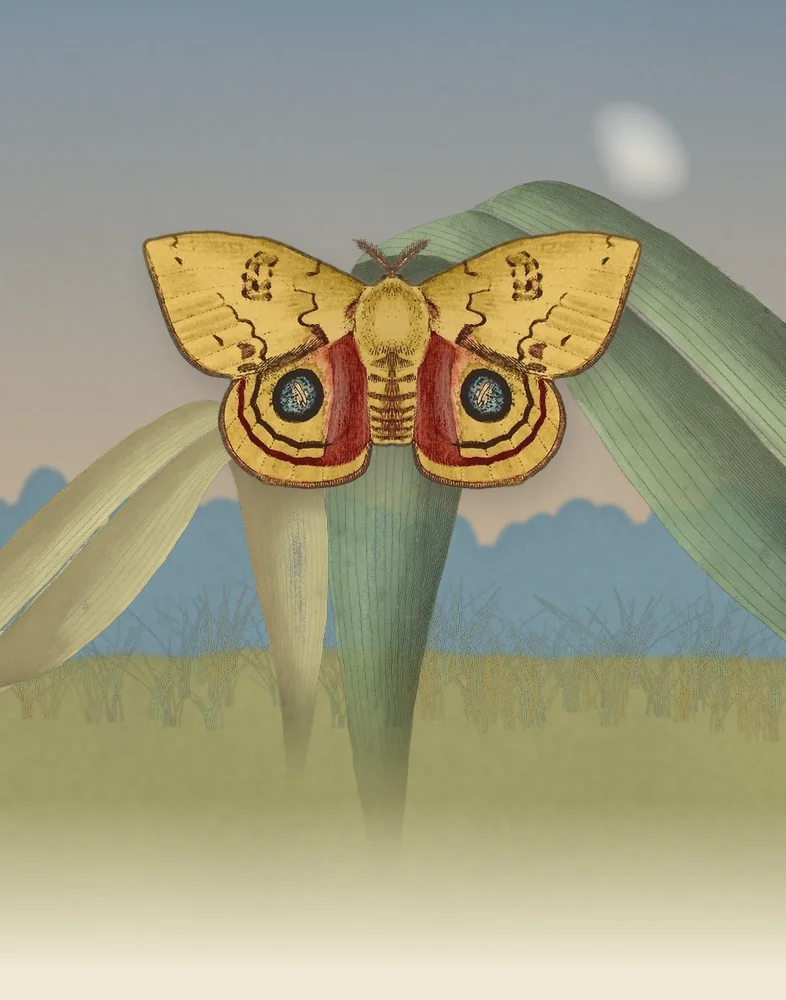
At rest, the Io Moth folds its forewings over its back and looks like any other moth. Disturb it, and it pulls them apart to show what they hide: on each hindwing, one huge eye, black and blue with a white centre, staring back.
How to recognise it
- Size: a wingspan of about 63 to 88 millimetres.
- The male is bright butter-yellow, with large feathery antennae.
- The female is red-brown to purplish.
- The eyes: one great eyespot on each hindwing, in both sexes, hidden at rest and flashed to startle a predator.
A moth of the night
The adults fly only at night. Like the Luna Moth, they have no working mouthparts and never feed, living one to two weeks. In the north there is one generation a year, out in June and July; in Florida and Texas, two to four.
It lives in woods, meadows, orchards and gardens, from southern Canada south to Florida and west to Montana and Texas, and into Mexico. Fabricius named it in 1775, after Io, a mortal loved by Zeus. It is still secure, though in the eastern United States it seems to be declining and growing more local.
Its caterpillar, and its sting
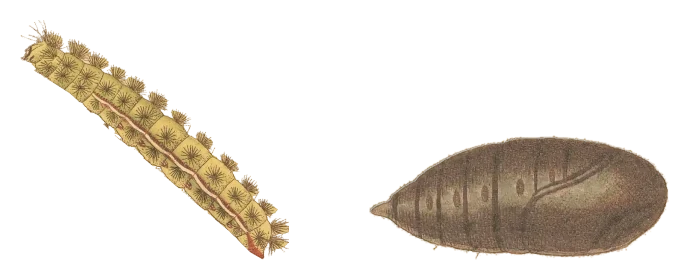
The female lays her eggs in clusters of 20 or more. The young caterpillars are orange and live together, marching in single file over their plant; later they turn bright green, with a red and white stripe along each side. Their spines carry venom, released at the slightest touch, and cause a painful, swollen rash, though not a dangerous one. They feed on a great range of plants, at least 60 kinds, among them willows, cherry, oak, maple, sweetgum and, on Abbot's plate, maize. The chrysalis forms in a flimsy cocoon in the leaf litter.
The plate it comes from
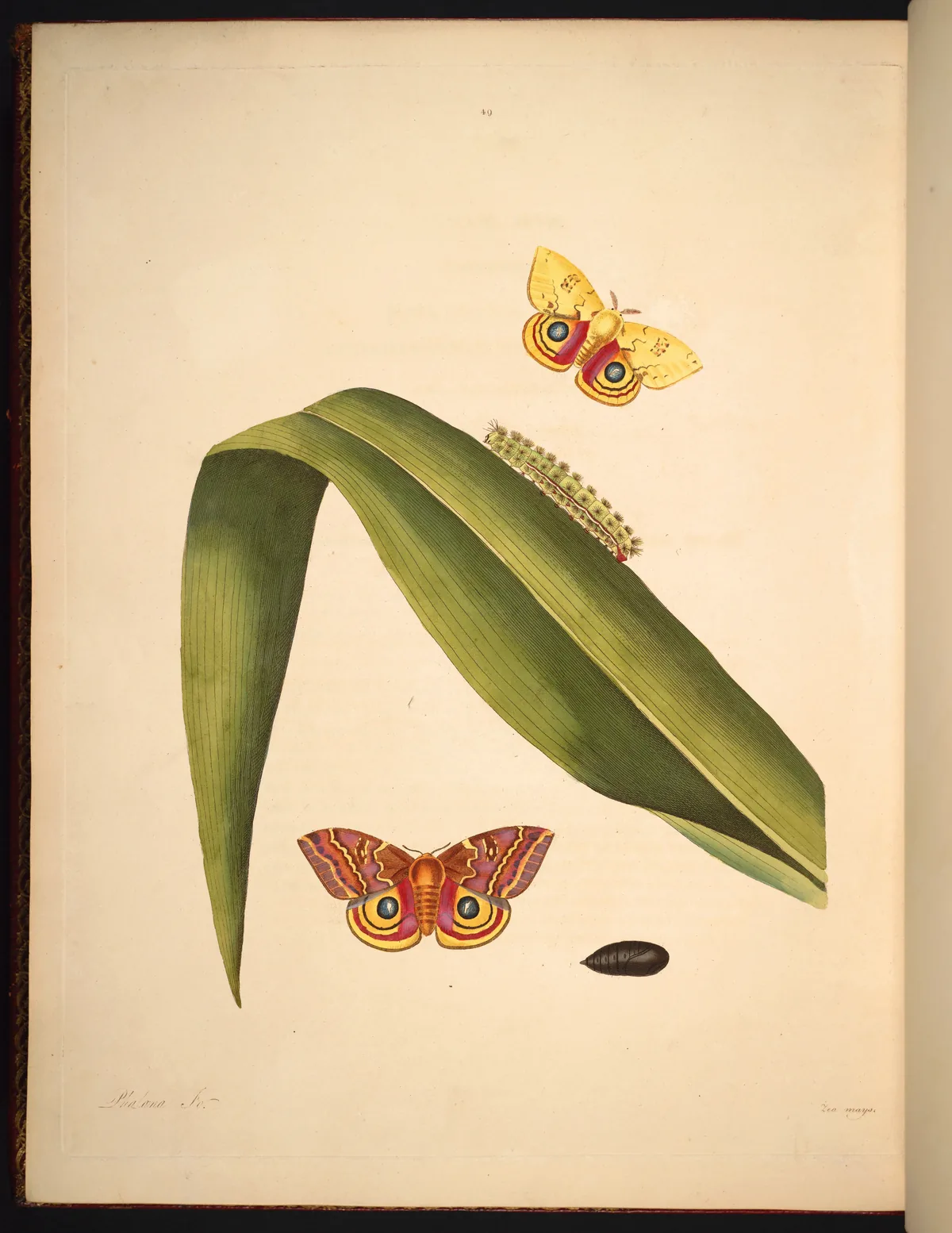
The Io Moth in The Quiet Cabinet is Abbot's yellow male, painted from life in Georgia; his red-brown female turns up in the game as a rare form. On its Field Guide page it flies above the maize leaf Abbot drew its caterpillar on.
In The Quiet Cabinet
It's one of the thirteen species of the Curiosity Cabinet, the game's last chapter, part of the Butterfly Collection. When its case is completed, a music box joins the plate's music.
Sources
- Wikipedia, Automeris io
- Animal Diversity Web, Automeris io
More from the journal

Black-veined White: the butterfly Britain lost
A large white butterfly with black veins, lost from Britain around 1925 for reasons still unknown. Its story, its caterpillars' silk nests, its strange female.

Broad-bordered Yellow Underwing: orange hidden beneath
A brown late-summer moth that hides bright orange hindwings with a broad black border, showing them only in flight. How to know it, and its many forms.

Buff-tip moth: the moth that looks like a broken twig
A moth that rests looking just like a snapped birch twig, whose yellow-and-black caterpillars feed in crowds and strip branches bare. How to know the Buff-tip.