



 The Quiet Cabinet

Endromis versicolora
Kentish Glory moth: named for Kent, now in the Highlands
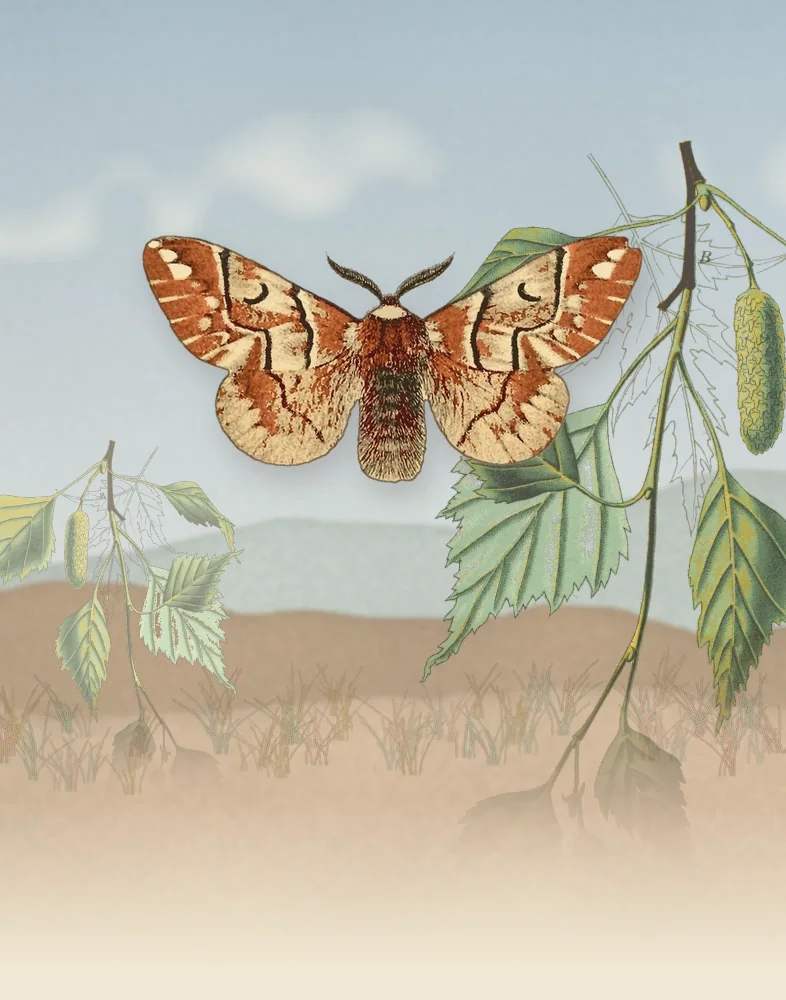
The Kentish Glory carries the name of a county it left long ago. It once flew in Kent, Sussex, Berkshire, East Anglia, Herefordshire, Worcestershire and Monmouthshire, and has vanished from all of them. Today, in Britain, you have to go to the birch woods of the Scottish Highlands to see it.
How to recognise it
- Size: large, with a wingspan of about 50 to 78 millimetres.
- The male is smaller and darker, with mostly orange-brown hindwings and feathery antennae.
- The female is much larger and paler, a brownish white.
A moth of early spring
It flies from March to early May, in one generation. The males are strong fliers, out by day in sunshine and in cloud, from mid-morning into the early afternoon, and at dusk; they can find a female by her scent from up to two kilometres away. The females fly at dusk and in the night, and by day rest on birch twigs.
It lives in open birch woodland and on moorland scattered with trees. In Britain it is now found only in the central and eastern Highlands of Scotland, in Perthshire, Inverness-shire, Morayshire, Aberdeenshire and Kincardineshire. It is classed as Nationally Scarce, and is on the Scottish Biodiversity List.
Its caterpillar and food plants
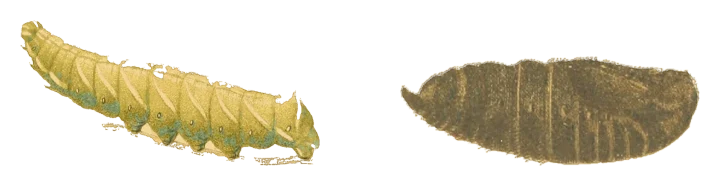
The female lays her eggs in two or three rows round a thin birch twig; they hatch in 10 to 14 days. The young caterpillars, green with paler stripes, feed together in groups of 15 to 30; older ones feed alone, and only at night. It feeds mostly on silver birch, sometimes downy birch and alder. It spends the winter as a chrysalis, in a loose cocoon in or on the ground.
The plate it comes from
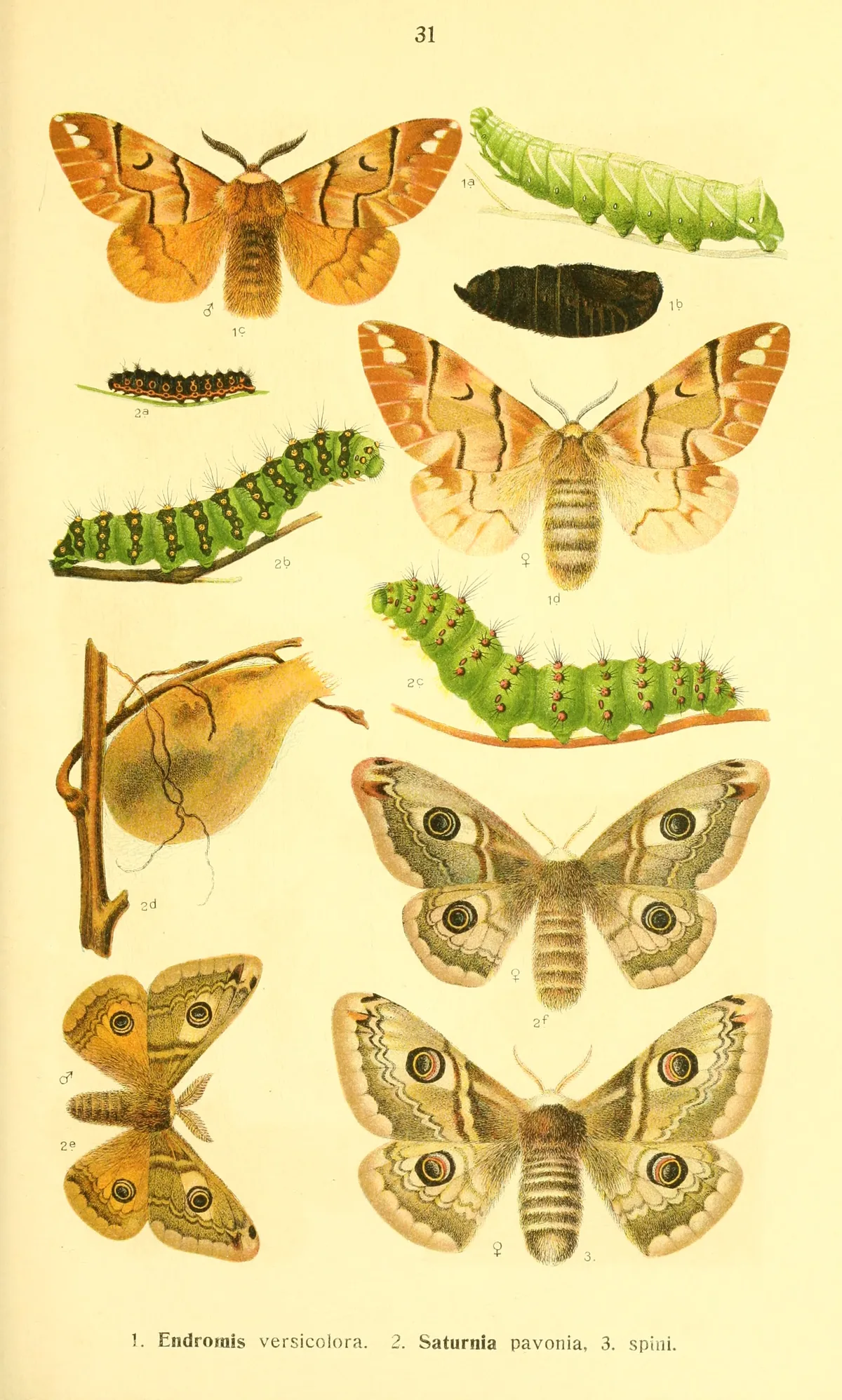
The Kentish Glory in The Quiet Cabinet is figure 1c, Eckstein's male, from the same plate as the Emperor Moth. Its pale female turns up in the game as a rare form. On its Field Guide page it flies above silver birch, drawn from Otto Wilhelm Thomé's Flora von Deutschland, Österreich und der Schweiz (1885).
In The Quiet Cabinet
It's one of the thirteen species of the Forest, the game's third chapter, part of the Butterfly Collection. When its case is completed, a flute joins the plate's music.
Sources
- Butterfly Conservation, Kentish Glory
- UKMoths, Kentish Glory
- Wikipedia, Endromis versicolora
More from the journal

Black-veined White: the butterfly Britain lost
A large white butterfly with black veins, lost from Britain around 1925 for reasons still unknown. Its story, its caterpillars' silk nests, its strange female.

Broad-bordered Yellow Underwing: orange hidden beneath
A brown late-summer moth that hides bright orange hindwings with a broad black border, showing them only in flight. How to know it, and its many forms.

Buff-tip moth: the moth that looks like a broken twig
A moth that rests looking just like a snapped birch twig, whose yellow-and-black caterpillars feed in crowds and strip branches bare. How to know the Buff-tip.