



 The Quiet Cabinet

Ochlodes sylvanus
Large Skipper butterfly: the little moth-like guardian
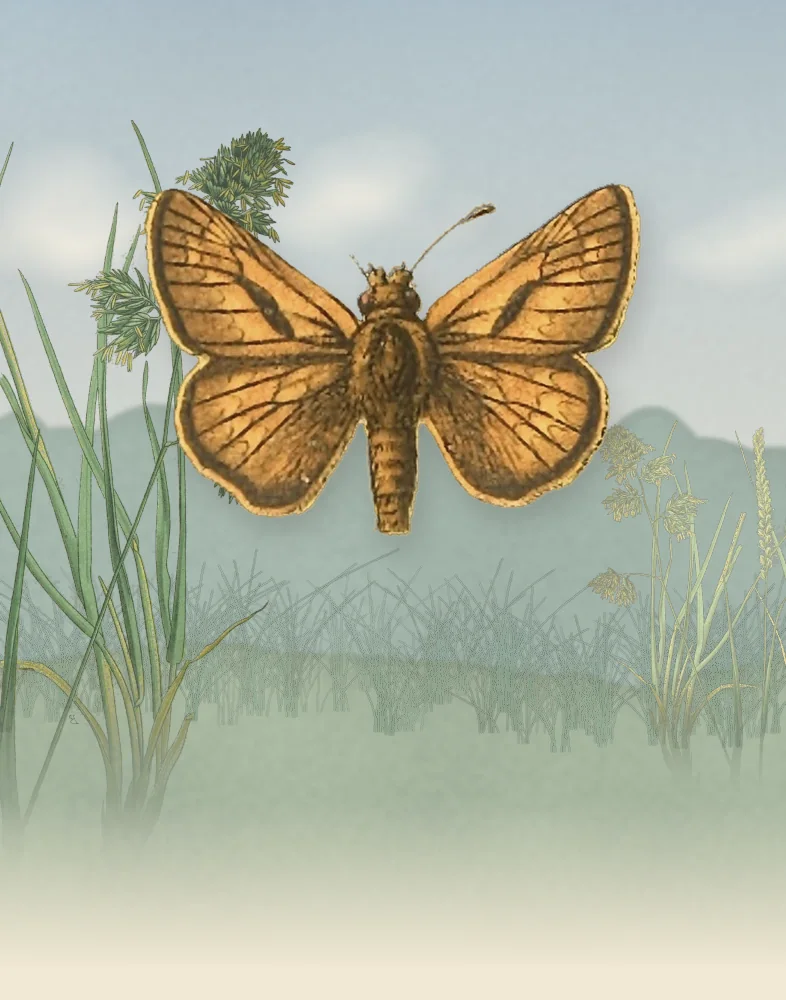
Skippers look half moth and half butterfly: thick-bodied, quick, holding their wings at odd angles. The Large Skipper is the one you'll most often meet in early summer, perched on a sunny leaf about a metre up, guarding its patch.
How to recognise it
- Size: a wingspan of about 29 to 36 millimetres. "Large" only beside other skippers.
- Colour: orange-brown, with paler spots and a darker border.
- The male has a thick black line through the middle of each forewing: a band of scent scales.
- Beneath: faint orange spots and a faint chequered pattern, which tell it from the Small and Essex Skippers that fly at the same time.
A small guardian
The male spends his day on a sunlit leaf, darting out at anything that passes and coming back to the same perch, defending his territory vigorously. Both sexes feed at bramble, thistles, knapweeds and clovers. There is one generation a year, flying in June and July, with a few into August.
It lives in tall, uncut grass, usually sheltered and often damp: woodland rides, hedgerows, verges, wet heath, and even urban parks and churchyards. It's found in England and Wales and in southern Scotland, and has spread north in north-east England since the 1960s; it isn't found in Ireland.
Its caterpillar and food plant

The female lays her eggs one at a time under a blade of grass, in a sheltered, sunny place where the grass is at least 30 centimetres tall. The caterpillar feeds mostly on cock's-foot. It spins the edges of a blade together into a tube to live in, and it has a small comb-like structure at its tail that flicks its droppings away, the naturalist F. W. Frohawk found, as far as two and a half or three feet. It spends the winter in a sealed tube, from mid-September to mid-March, and is a caterpillar for up to 330 days in all. The chrysalis forms inside a tent of grass blades.
The plate it comes from
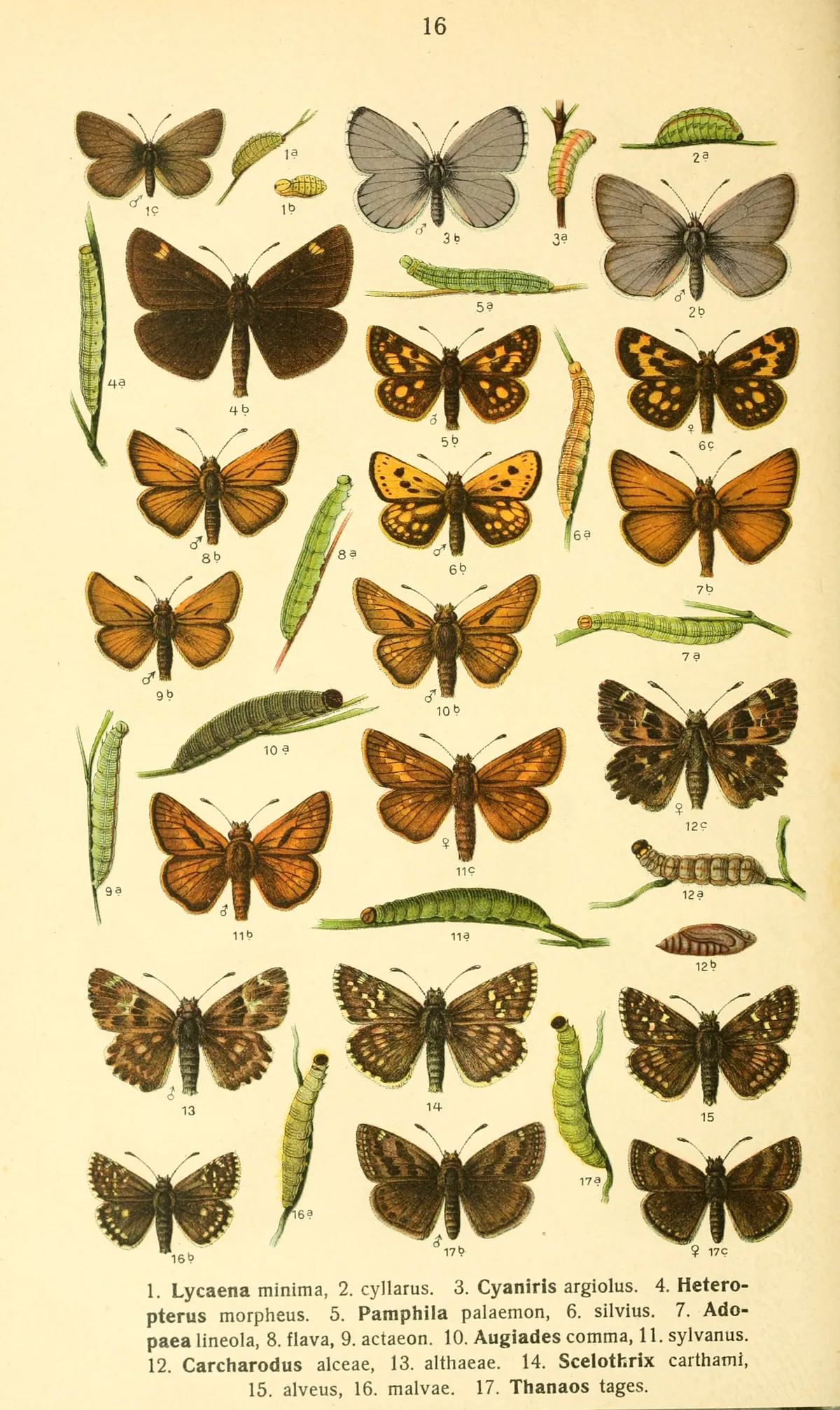
The Large Skipper in The Quiet Cabinet is figure 11b, Eckstein's male, from the same plate as the Grizzled Skipper. On its Field Guide page it flies above cock's-foot grass, drawn from Otto Wilhelm Thomé's Flora von Deutschland, Österreich und der Schweiz (1885).
In The Quiet Cabinet
It's one of the thirteen species of the Meadow, the game's second chapter, part of the Butterfly Collection. When its case is completed, a flute joins the plate's music.
Sources
- Butterfly Conservation, Large Skipper
- UK Butterflies, Large Skipper
More from the journal

Black-veined White: the butterfly Britain lost
A large white butterfly with black veins, lost from Britain around 1925 for reasons still unknown. Its story, its caterpillars' silk nests, its strange female.

Broad-bordered Yellow Underwing: orange hidden beneath
A brown late-summer moth that hides bright orange hindwings with a broad black border, showing them only in flight. How to know it, and its many forms.

Buff-tip moth: the moth that looks like a broken twig
A moth that rests looking just like a snapped birch twig, whose yellow-and-black caterpillars feed in crowds and strip branches bare. How to know the Buff-tip.