



 The Quiet Cabinet

Araschnia levana
Map butterfly: orange in spring, black in summer
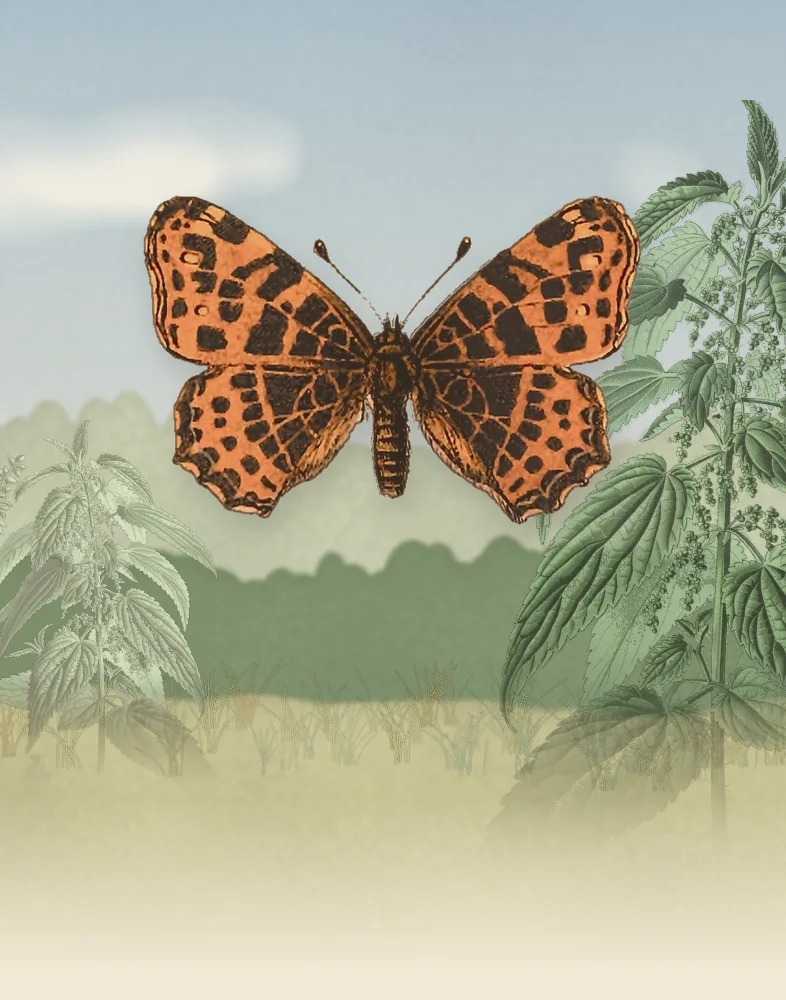
For a long time naturalists thought the Map was two butterflies. The one that flies in spring is orange, like a small fritillary; the one that flies in summer is black with white bands, like a tiny White Admiral. The summer one was even given its own name, prorsa. They are the same species.
Two forms in one year
- Spring form (levana): mainly orange, spotted with black.
- Summer form (prorsa): mainly black, with a white band across the wings.
- Size: small; the males' wingspan is about 24 to 38 millimetres, the females' 40 to 50.
Which form a butterfly becomes is decided while it is a caterpillar, by the temperature and the length of the days. In wet, cold summers, butterflies halfway between the two are common.
Eggs in towers
The Map's caterpillars eat only nettles, in damp, shady places: woodland edges, open forest and wet clearings. The female lays her eggs in a way no other butterfly of central Europe does: in little towers, one egg stacked on another, hanging under a nettle leaf. They are thought to look like the nettle's own flower spikes, and so to escape the notice of predators.
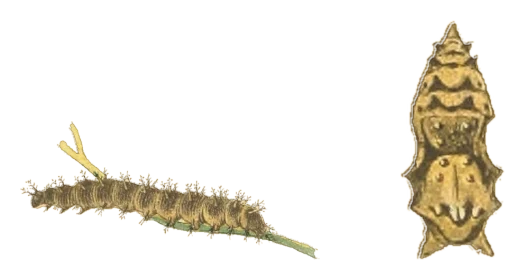
The caterpillars feed together, black or pale brown with dark stripes and short, branched spines. The last generation of the year spends the winter as a chrysalis.
It has two or three generations: in April and May, in July and August, and in warm years a third in late summer. It ranges from Spain across Europe and Asia to Japan, and has been spreading north, reaching Finland in 1973.
The butterfly that never settled in Britain
The Map has been brought to Britain several times. In 1912 it was deliberately released in the Wye Valley, and it bred in the Forest of Dean and at Symonds Yat, until an entomologist, A. B. Farn, collected and destroyed every one he could find. Other releases followed, in the Wyre Forest in the 1920s, South Devon in 1942 and elsewhere into the 1990s, and all failed. Only a handful of wild Maps have been seen since, and releasing it is now illegal. The English Channel seems to be a barrier it can't easily cross.
The plate it comes from
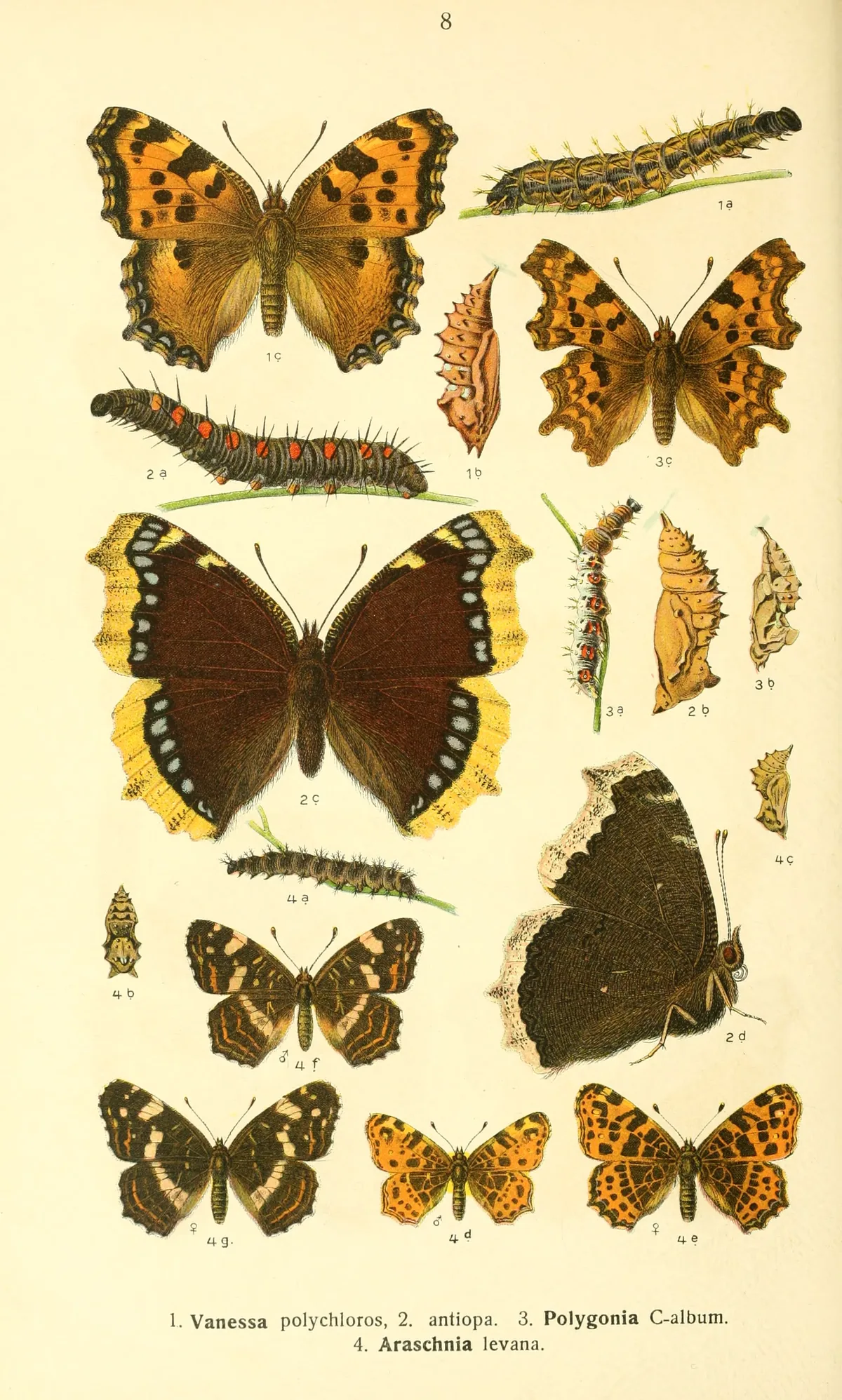
The Map in The Quiet Cabinet is figure 4e, Eckstein's spring female, and its black summer form turns up in the game as a rare form. The Large Tortoiseshell, on the same plate, is one of the Forest's two treasures. On its Field Guide page the Map flies above nettles, drawn from Otto Wilhelm Thomé's Flora von Deutschland, Österreich und der Schweiz (1885).
In The Quiet Cabinet
It's one of the thirteen species of the Forest, the game's third chapter, part of the Butterfly Collection. When its case is completed, a marimba joins the plate's music.
Sources
- Wikipedia, Araschnia levana
- Schmetterlinge und ihre Ökologie (pyrgus.de), Araschnia levana
- UK Butterflies, Map
More from the journal

Black-veined White: the butterfly Britain lost
A large white butterfly with black veins, lost from Britain around 1925 for reasons still unknown. Its story, its caterpillars' silk nests, its strange female.

Broad-bordered Yellow Underwing: orange hidden beneath
A brown late-summer moth that hides bright orange hindwings with a broad black border, showing them only in flight. How to know it, and its many forms.

Buff-tip moth: the moth that looks like a broken twig
A moth that rests looking just like a snapped birch twig, whose yellow-and-black caterpillars feed in crowds and strip branches bare. How to know the Buff-tip.