



 The Quiet Cabinet

Melanargia galathea
Marbled White butterfly: the white that is really a brown
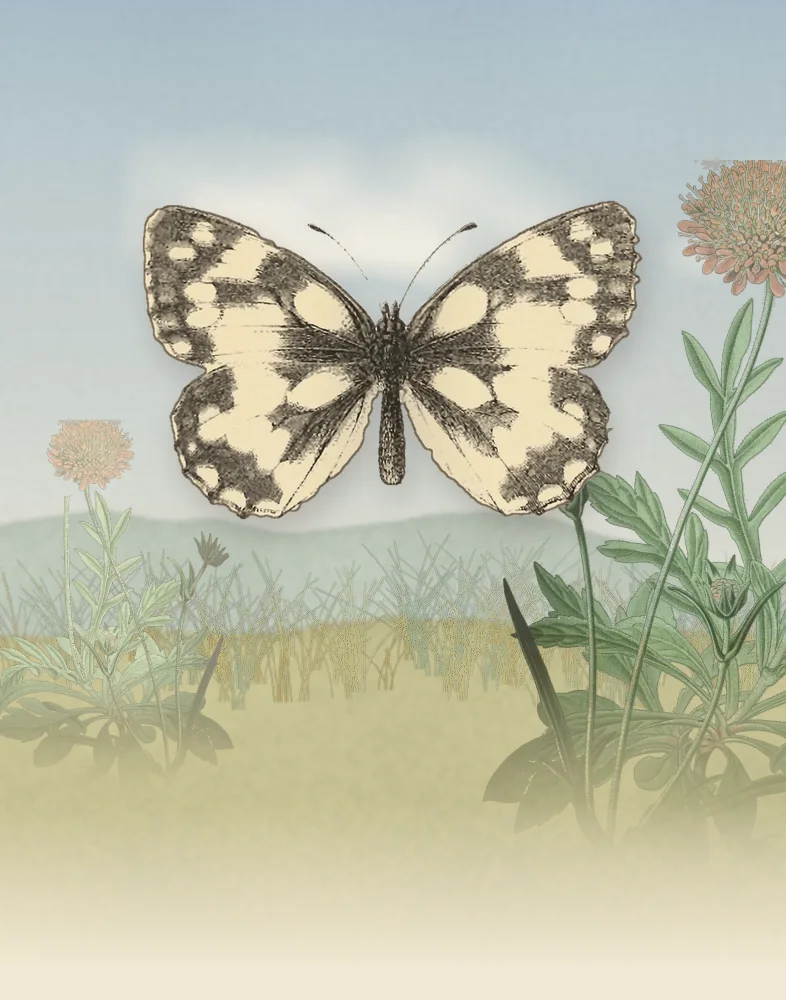
In July, on a chalk down where the grass has grown knee-high and full of flowers, black and white butterflies drift over it in dozens, and sometimes several crowd onto a single purple flower head. The Marbled White is one of high summer's loveliest sights, and unlike any other butterfly in Britain.
How to recognise it
- Size: medium, with a wingspan of about 53 to 58 millimetres.
- Colour: chequered black and white, or creamy white, like a marble floor or a page of lace.
- Beneath, the pattern is paler and softer, with a row of small eyespots near the edges.
Not a white at all
Despite its name and its colours, the Marbled White isn't one of the whites. It belongs with the browns, the family of the Meadow Brown and the Ringlet, and like them its caterpillar eats grass.
When and where to see it
The Marbled White has one generation a year. It comes out in the second half of June and is at its peak in early July. It lives in distinct colonies, often large ones, in unimproved grassland where the grass grows tall, as much as half a metre. The biggest are on chalk and limestone downland, but road verges, field edges, woodland clearings and old railway lines can hold smaller ones.
It loves purple flowers: knapweed, field scabious, wild marjoram and thistles. In the early morning it basks with its wings spread to the sun, and on dull days and at night it roosts on grass stems and flower heads. It often carries tiny red mites on its body, which don't seem to trouble it.
In Britain it lives south of a line from Glamorgan in Wales to north-east Yorkshire, and is absent from Scotland and Ireland. It has been spreading north and east.
Eggs dropped into the grass
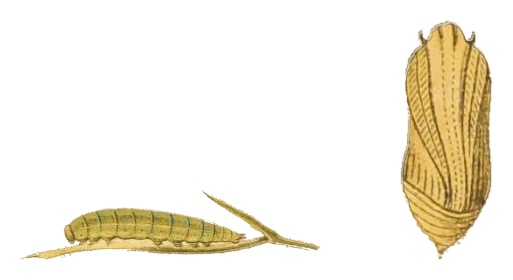
Most butterflies lay their eggs carefully on the right plant. The Marbled White doesn't. The female simply lets her eggs fall, perched on a grass stem or even in flight over the grassland, and they drop among the grass. Since the caterpillar eats several kinds of grass, wherever it lands there's food nearby.
What happens next is stranger still. The tiny caterpillar hatches in late summer, eats its eggshell, and then, without eating anything else, goes straight into hibernation, tucked deep in a clump of grass. It only begins to feed the following spring. It grows up green or light brown, and when it's older it hides at the foot of the grass by day and feeds at night. Red fescue is thought to be essential to it. The chrysalis lies loose on the ground, among moss or under the soil.
The plate it comes from
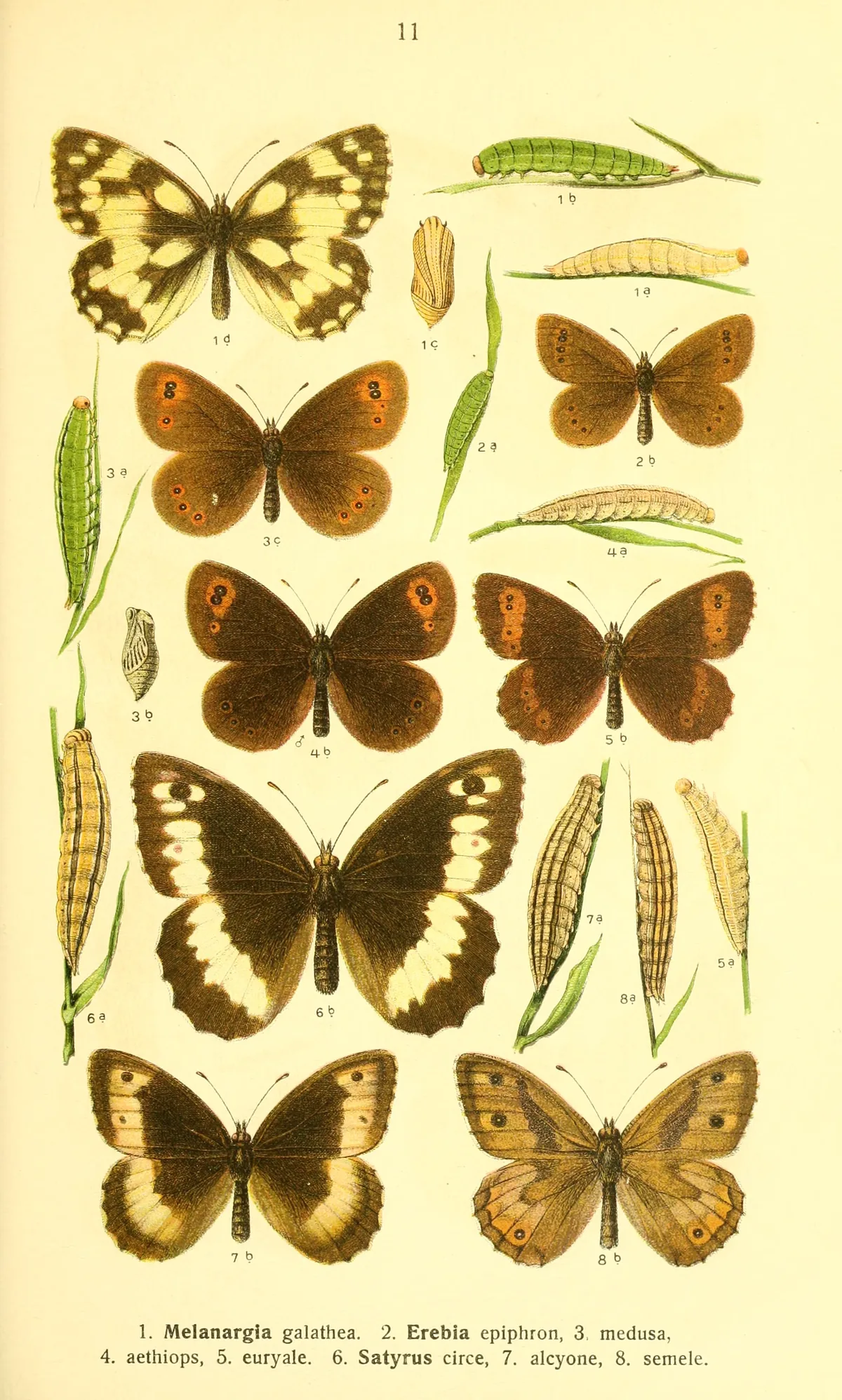
The Marbled White in The Quiet Cabinet is figure 1d of this plate, where Eckstein drew it beside its brown relatives. On its Field Guide page it flies above field scabious, drawn from Otto Wilhelm Thomé's Flora von Deutschland, Österreich und der Schweiz (1885).
In The Quiet Cabinet
It's one of the twelve species of the Garden, the game's first chapter, which is free. When its case is completed, a celesta joins the plate's music.
Sources
- Butterfly Conservation, Marbled White
- UK Butterflies, Marbled White
More from the journal

Black-veined White: the butterfly Britain lost
A large white butterfly with black veins, lost from Britain around 1925 for reasons still unknown. Its story, its caterpillars' silk nests, its strange female.

Broad-bordered Yellow Underwing: orange hidden beneath
A brown late-summer moth that hides bright orange hindwings with a broad black border, showing them only in flight. How to know it, and its many forms.

Buff-tip moth: the moth that looks like a broken twig
A moth that rests looking just like a snapped birch twig, whose yellow-and-black caterpillars feed in crowds and strip branches bare. How to know the Buff-tip.