



 The Quiet Cabinet

Danaus plexippus
Monarch butterfly: the long journey to Mexico's fir forests
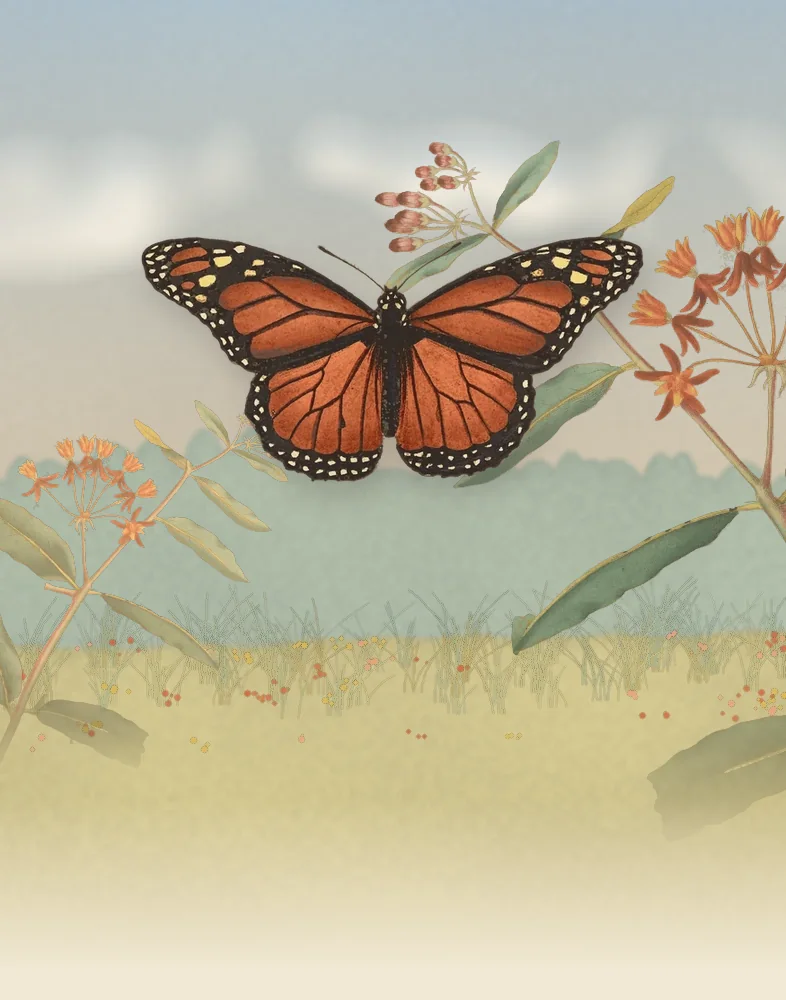
Every autumn, the Monarchs of eastern North America set off south. They fly thousands of kilometres, and gather on a handful of high mountains in central Mexico, where they cling in clusters to the fir trees through the winter. The US Fish and Wildlife Service calls it the most spectacular migration in the insect world.
How to recognise it
- Size: a wingspan of about 8.9 to 10.2 centimetres.
- Colour: tawny orange, with black veins, black borders and two rows of small white spots.
- The male is slightly larger, with a small black scent spot on a vein of each hindwing; the female's veins are thicker and darker.
- Its look-alike, the Viceroy, is smaller, with an extra black line across each hindwing.
The great migration
The eastern Monarchs travel roughly 1,900 to 4,500 kilometres to central Mexico, where they spend the winter, from early November to mid-March, roosting on oyamel firs. A separate western population winters mainly on the coast of California.
The migrating Monarchs are a generation unlike the others. Summer Monarchs live only two to five weeks; the last generation of the year, which makes the journey, can live up to eight or nine months, and doesn't mature until the winter is over. In spring they head north, and it takes their children and grandchildren, several generations, to reach the northern edge of the range again.
Poisoned by milkweed
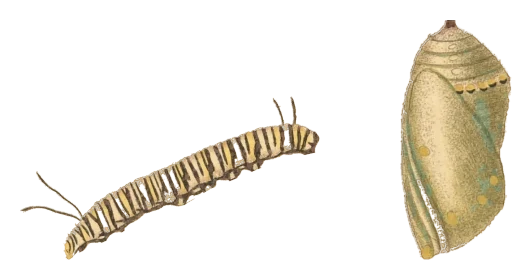
The caterpillar eats only milkweed, and stores the plant's poisons, so that the butterfly is toxic and foul-tasting; its bright colours warn birds away. The caterpillar is banded in white, yellow and black, and grows to about 4.5 centimetres. Its chrysalis is a small marvel: pale green, with a ring of gold and black near the top and tiny golden dots below.
A butterfly in trouble
Monarch numbers have been falling since the mid-1990s, through the loss of habitat and milkweed, insecticides and climate change. The area of forest the eastern Monarchs occupy in Mexico was about 18 hectares in the winter of 1996–97; in 2013–14 it was just 0.67. In December 2024 the US Fish and Wildlife Service proposed listing the Monarch as threatened.
The plate it comes from
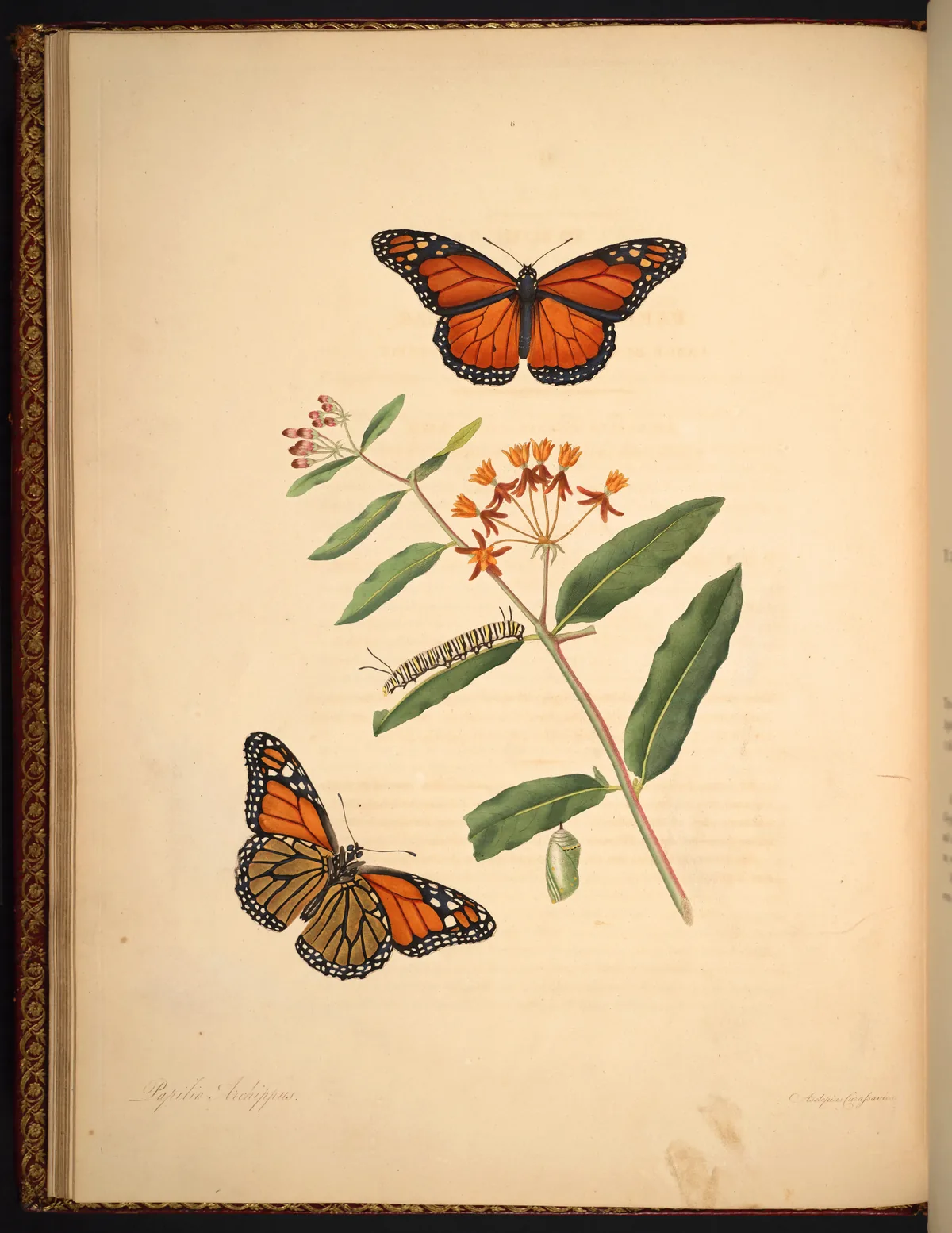
The Monarch in The Quiet Cabinet was painted from life in Georgia by John Abbot, with its caterpillar and chrysalis on the milkweed it fed on, Asclepias curassavica. On its Field Guide page it flies above that same milkweed.
In The Quiet Cabinet
It's one of the thirteen species of the Curiosity Cabinet, the game's last chapter, part of the Butterfly Collection. When its case is completed, a marimba joins the plate's music.
Sources
- Wikipedia, Monarch butterfly
- U.S. Fish and Wildlife Service, Monarchs
- Monarch Watch, Biology
More from the journal

Black-veined White: the butterfly Britain lost
A large white butterfly with black veins, lost from Britain around 1925 for reasons still unknown. Its story, its caterpillars' silk nests, its strange female.

Broad-bordered Yellow Underwing: orange hidden beneath
A brown late-summer moth that hides bright orange hindwings with a broad black border, showing them only in flight. How to know it, and its many forms.

Buff-tip moth: the moth that looks like a broken twig
A moth that rests looking just like a snapped birch twig, whose yellow-and-black caterpillars feed in crowds and strip branches bare. How to know the Buff-tip.