



 The Quiet Cabinet

Euclidia mi
Mother Shipton moth: the witch's face on its wings
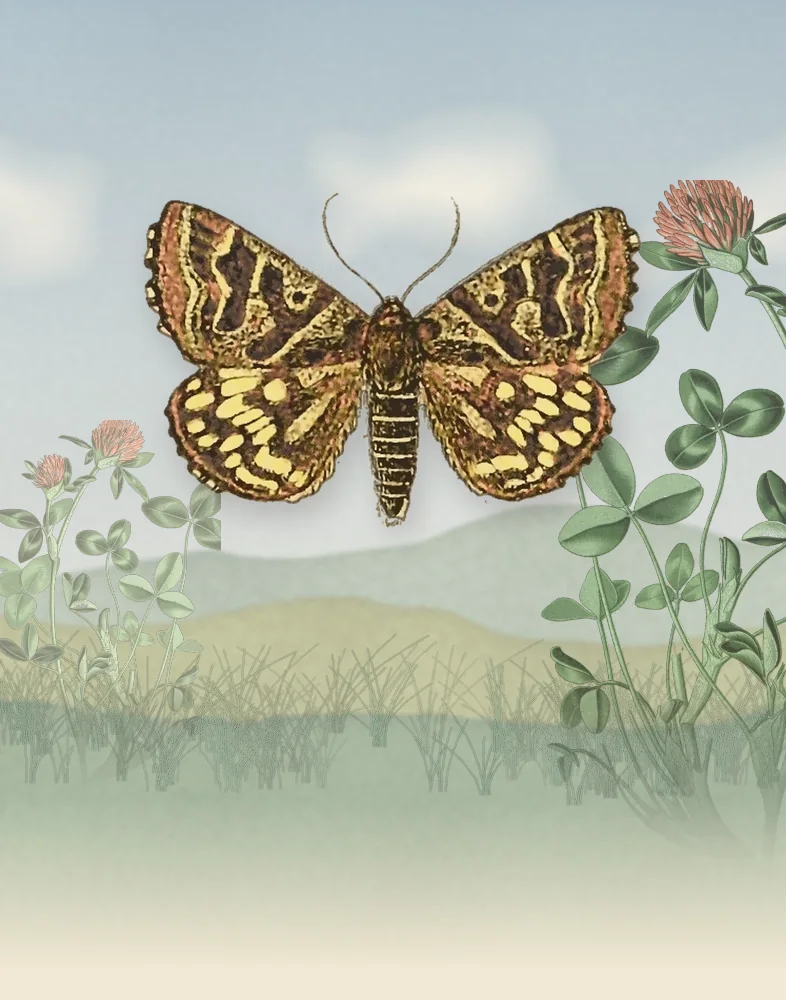
Look closely at the forewing of this small brown moth and you may see a face in profile. Naturalists saw it long ago, and named the moth the Mother Shipton.
A witch on its wings
Old Mother Shipton was a famous Yorkshire witch of the 1500s, and the creamy markings on each forewing outline a witch's head in profile, said to be hers. Beyond the face, the moth is a mottled brown and cream, with a wingspan of about 25 to 32 millimetres.
Today it is often called Callistege mi; Eckstein knew it as Euclidia mi.
A moth that flies by day
The Mother Shipton flies in sunshine, mostly in May and June. Its flights are short and quick, and it lands on flowers between them, very alert and easily disturbed again. That makes it one of the few moths most people can watch on a summer walk.
It's a characteristic grassland moth, found on downs and heaths, low moorland, flower-rich hay meadows, woodland rides, road verges and embankments. It's fairly well distributed in England, Wales and Ireland, and more local in Scotland, as far north as Ross-shire.
Its caterpillar and food plants
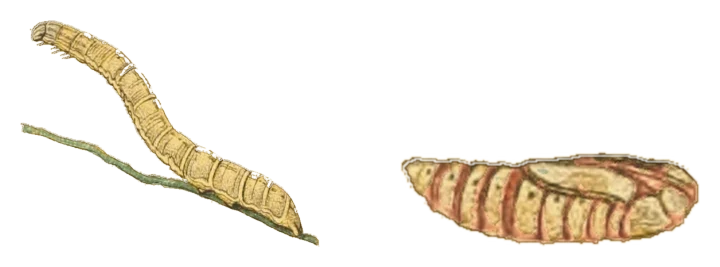
The caterpillar feeds on clovers, black medick, lucerne and bird's-foot trefoil, and on cock's-foot and other grasses: the plants of an unploughed meadow.
The plate it comes from
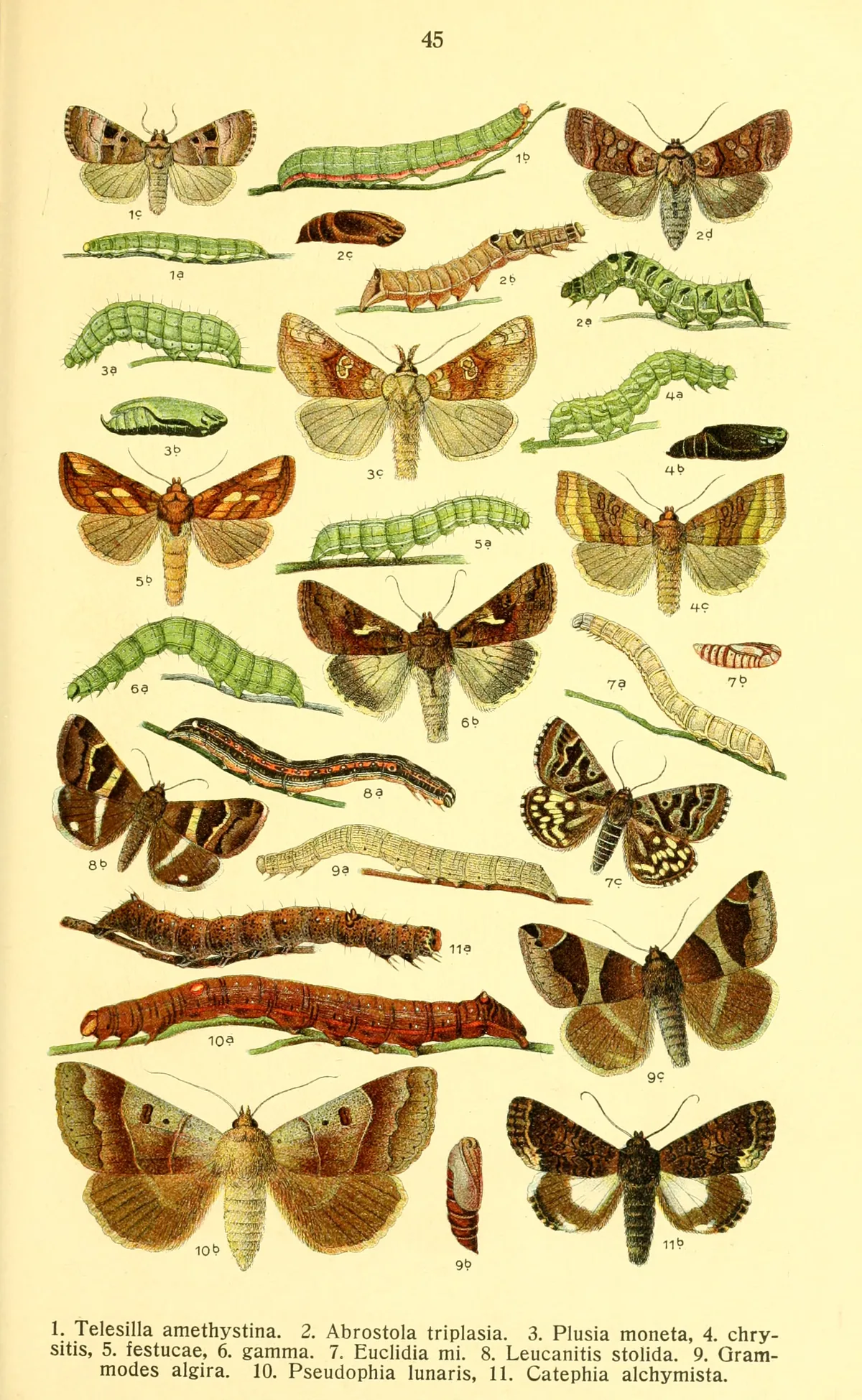
The Mother Shipton in The Quiet Cabinet is figure 7c of this plate, which it shares with the Silver Y and the Burnished Brass. On its Field Guide page it flies above red clover, drawn from Otto Wilhelm Thomé's Flora von Deutschland, Österreich und der Schweiz (1885).
In The Quiet Cabinet
It's one of the thirteen species of the Meadow, the game's second chapter, part of the Butterfly Collection. When its case is completed, a low cello joins the plate's music.
Sources
- Butterfly Conservation, Mother Shipton
- UKMoths, Mother Shipton
More from the journal

Black-veined White: the butterfly Britain lost
A large white butterfly with black veins, lost from Britain around 1925 for reasons still unknown. Its story, its caterpillars' silk nests, its strange female.

Broad-bordered Yellow Underwing: orange hidden beneath
A brown late-summer moth that hides bright orange hindwings with a broad black border, showing them only in flight. How to know it, and its many forms.

Buff-tip moth: the moth that looks like a broken twig
A moth that rests looking just like a snapped birch twig, whose yellow-and-black caterpillars feed in crowds and strip branches bare. How to know the Buff-tip.