



 The Quiet Cabinet

Lasiocampa quercus
Oak Eggar moth: named for its acorn, not the oak
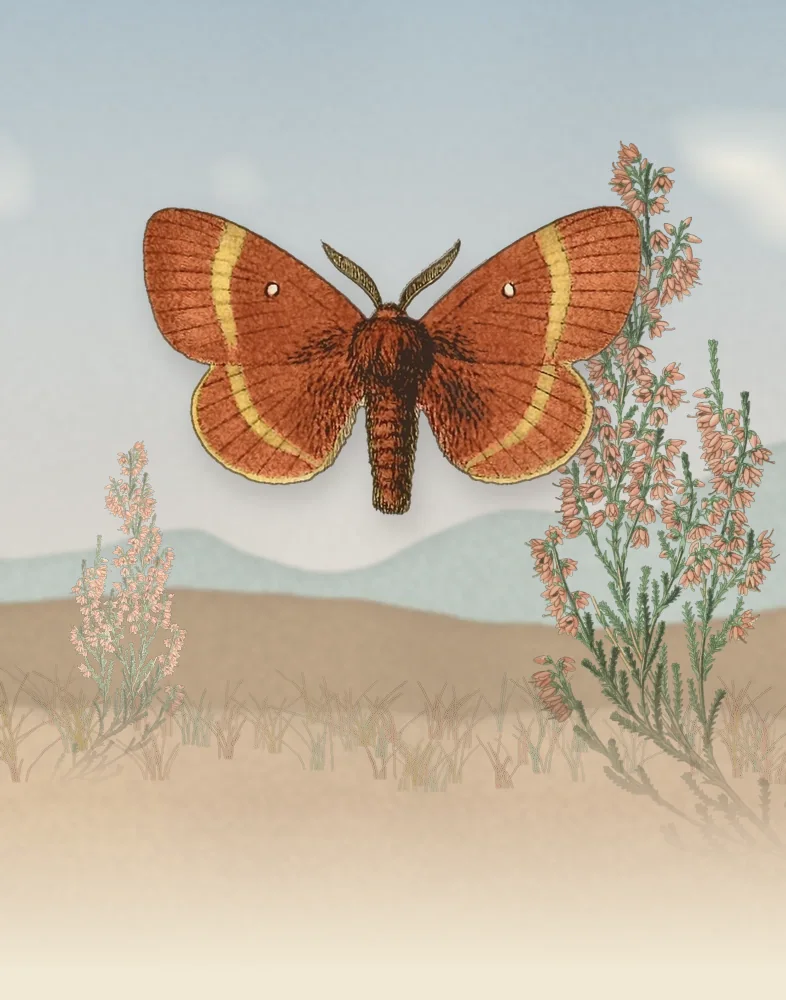
Its name is a small joke at the reader's expense. The Oak Eggar doesn't feed on oak. It's named for its cocoon, which is hard and shaped like an acorn: quercus, the oak, in its Latin name too.
How to recognise it
- Size: a wingspan of about 45 millimetres in the male to 75 in the female.
- The male is a rich red-brown.
- The female is larger and paler.
- In the north the moths, of the form called the Northern Eggar, are often larger and darker.
A moth that races by day
The males fly fast and wild in sunshine, searching for females, and it has been called Britain's largest day-flying moth. The females fly from dusk and come to light. A single female that hasn't yet mated can draw many males to her.
In southern lowland Britain the moths fly in July and August; in the north, from late May to early July. They live on heaths, moors, dunes and downland, in scrub and hedges and on sea cliffs, across Europe and northern and western Asia.
Its caterpillar, and a two-year life
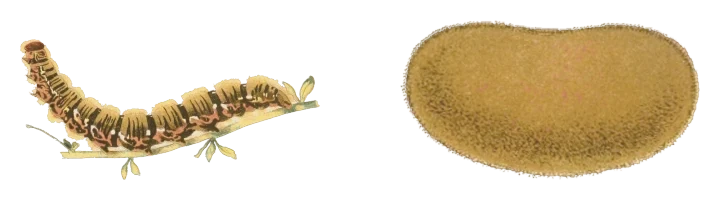
The female drops her eggs loosely into the undergrowth. The big furry caterpillar feeds mainly on heather and bilberry, and on bramble, sallows, broom, blackthorn, hawthorn, hazel and more. In the south it grows up in a single year; on the moors of the north it takes two, spending its first winter as a caterpillar and its second as a chrysalis inside that hard, yellowish, acorn-like cocoon on the ground.
The plate it comes from
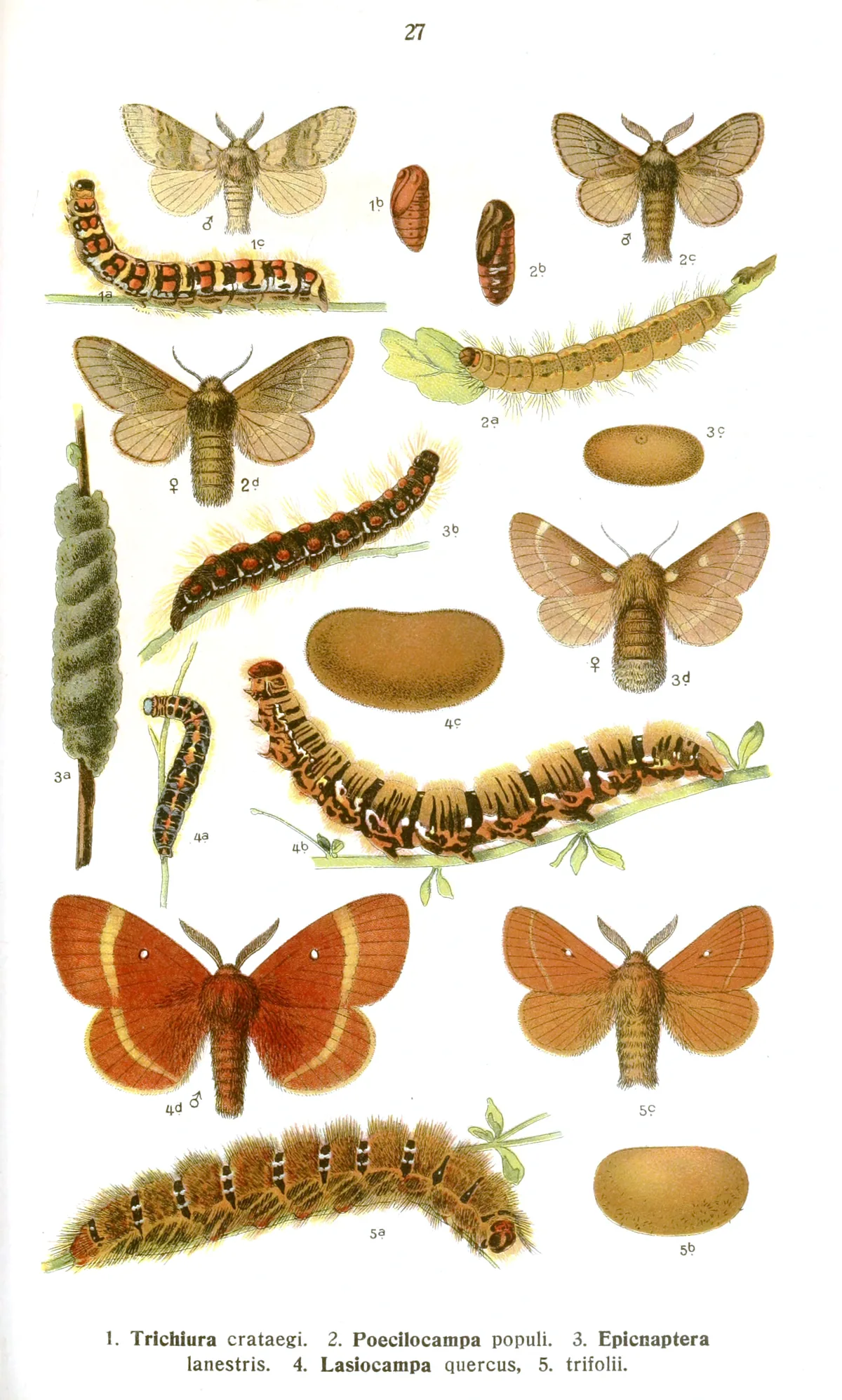
The Oak Eggar in The Quiet Cabinet is figure 4d, Eckstein's male. On its Field Guide page it flies above heather, drawn from Otto Wilhelm Thomé's Flora von Deutschland, Österreich und der Schweiz (1885).
In The Quiet Cabinet
It's one of the thirteen species of the Forest, the game's third chapter, part of the Butterfly Collection. When its case is completed, a flute joins the plate's music.
Sources
- UKMoths, Oak Eggar
- Wikipedia, Lasiocampa quercus
More from the journal

Black-veined White: the butterfly Britain lost
A large white butterfly with black veins, lost from Britain around 1925 for reasons still unknown. Its story, its caterpillars' silk nests, its strange female.

Broad-bordered Yellow Underwing: orange hidden beneath
A brown late-summer moth that hides bright orange hindwings with a broad black border, showing them only in flight. How to know it, and its many forms.

Buff-tip moth: the moth that looks like a broken twig
A moth that rests looking just like a snapped birch twig, whose yellow-and-black caterpillars feed in crowds and strip branches bare. How to know the Buff-tip.