



 The Quiet Cabinet

Anthocharis cardamines
Orange-tip butterfly: male, female, egg and caterpillar
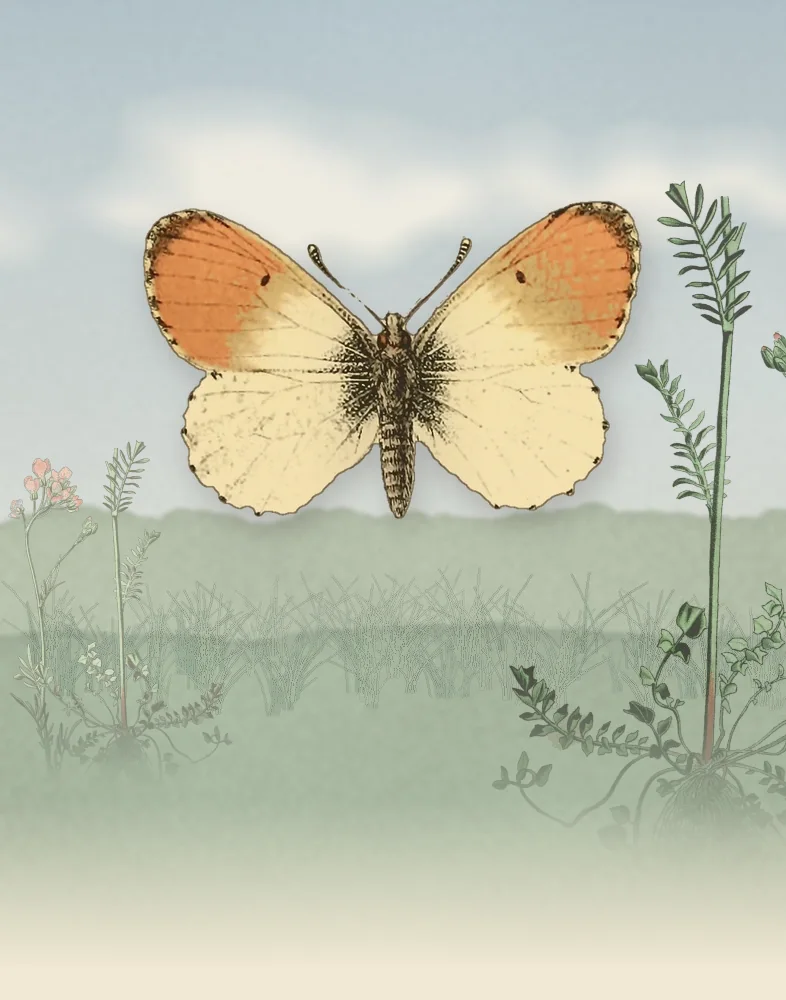
When the cuckooflower is out along the ditches and the hedgerows are white with blossom, a white butterfly with bright orange wingtips comes bobbing down the lane. The Orange-tip is one of the surest signs that spring has really arrived.
How to recognise it
- Size: medium, with a wingspan of about 45 to 50 millimetres.
- The male is white, with the outer half of each forewing a vivid orange. The colour is thought to warn birds that it tastes bad, from the mustard oils of the plants it ate as a caterpillar.
- The female has no orange at all. She's white with grey-black tips, and is often mistaken for a Small or Green-veined White.
- Beneath, both have hindwings mottled with green. The green is an illusion, made of yellow and black scales side by side, and when one rests on a flower head of cuckooflower or garlic mustard it almost vanishes.
When to see it
The Orange-tip has one generation a year. It flies from the beginning of April, through May and into June. The males are seen far more often: they patrol hedgerows and woodland edges all day looking for females, and can fly for long stretches without stopping. The females stay closer to the food plants, quietly laying their eggs.
One egg to a plant
The female finds a plant by sight, lands, and tastes it with her feet. If it suits her, she lays a single egg on a flower stalk. The egg is pale greenish-white at first, then turns a bright orange, which makes it one of the easiest butterfly eggs to find.
There's rarely more than one egg on a plant, and with reason: the caterpillars are cannibals. A newly hatched caterpillar eats its own eggshell and any other Orange-tip egg it comes across, and young caterpillars will eat each other.
Its caterpillar and food plants
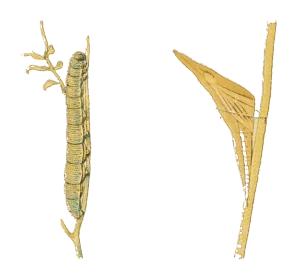
The caterpillar feeds mostly on the plant's young seed pods, and lying along a pod, green with a white stripe down its side, it is beautifully hidden. Its main food plants are cuckooflower, in damp meadows, and garlic mustard, along verges and ditches. In gardens females sometimes lay on honesty and dame's-violet, though few caterpillars survive on them.
Eleven months a chrysalis
In early summer the fully grown caterpillar wanders off to find a stem, and there it becomes a slender, curved chrysalis shaped like a thorn or a seed pod, green at first and later light brown. It stays that way through the rest of the summer, the autumn and the winter, and the butterfly comes out the following spring: about ten or eleven months as a chrysalis, most of the Orange-tip's life.
Where to see it
Damp meadows, country lanes, hedgerows, riverbanks, woodland edges and gardens, throughout England, Wales and Ireland, and more locally in Scotland, where it has spread a great deal in the last thirty years. It's one of the few butterflies whose numbers have been rising.
The plate it comes from
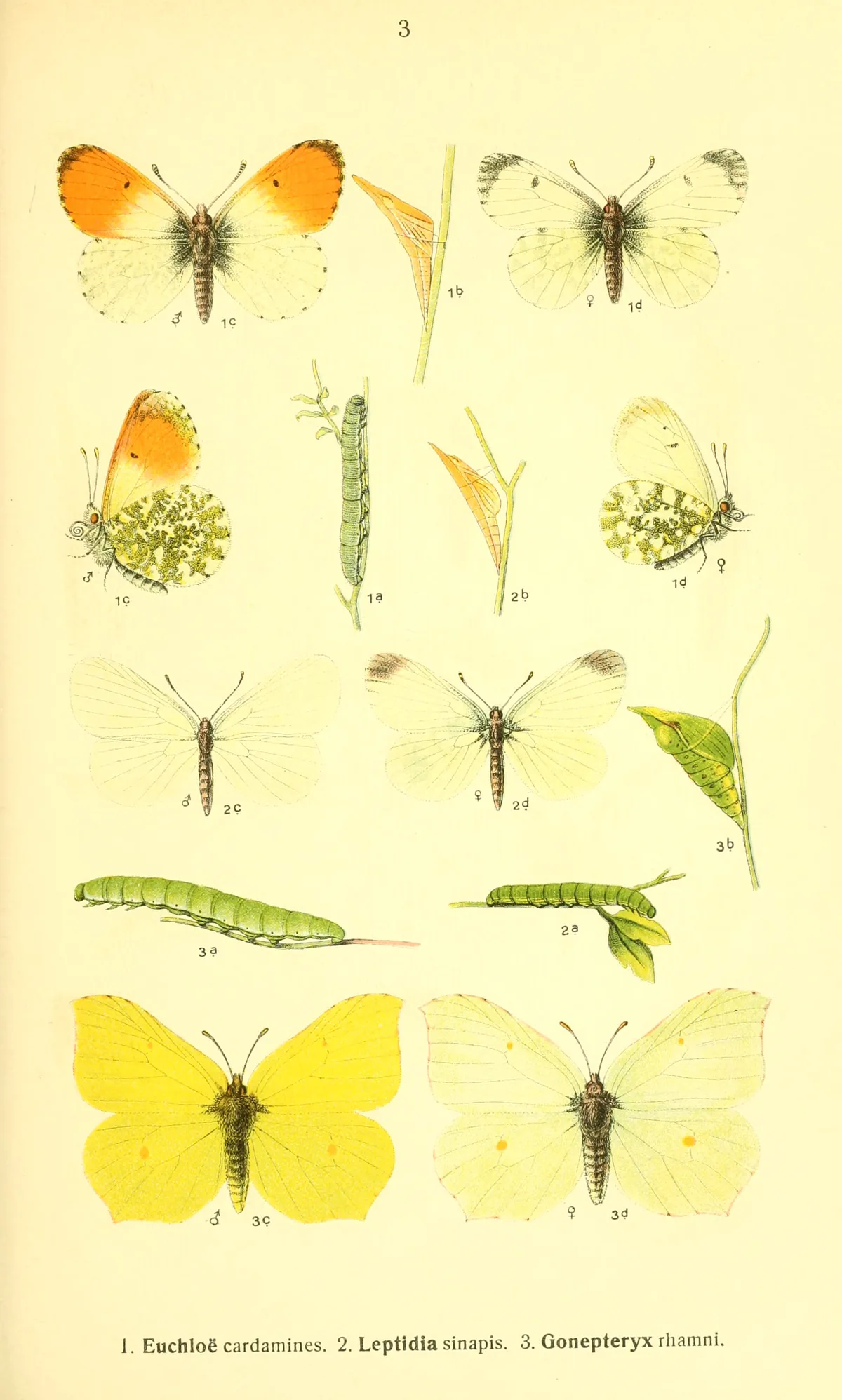
The Orange-tip in The Quiet Cabinet is figure 1c, Eckstein's male, from the same plate as the Brimstone. On its Field Guide page it flies above cuckooflower, drawn from Otto Wilhelm Thomé's Flora von Deutschland, Österreich und der Schweiz (1885). Its female, without the orange, turns up in the game as a rare form.
In The Quiet Cabinet
It's one of the twelve species of the Garden, the game's first chapter, which is free. When its case is completed, a celesta joins the plate's music.
Sources
- Butterfly Conservation, Orange-tip
- UK Butterflies, Orange-tip
More from the journal

Black-veined White: the butterfly Britain lost
A large white butterfly with black veins, lost from Britain around 1925 for reasons still unknown. Its story, its caterpillars' silk nests, its strange female.

Broad-bordered Yellow Underwing: orange hidden beneath
A brown late-summer moth that hides bright orange hindwings with a broad black border, showing them only in flight. How to know it, and its many forms.

Buff-tip moth: the moth that looks like a broken twig
A moth that rests looking just like a snapped birch twig, whose yellow-and-black caterpillars feed in crowds and strip branches bare. How to know the Buff-tip.