



 The Quiet Cabinet

Caligo eurilochus
Owl Butterfly: the great eyes of the dusk
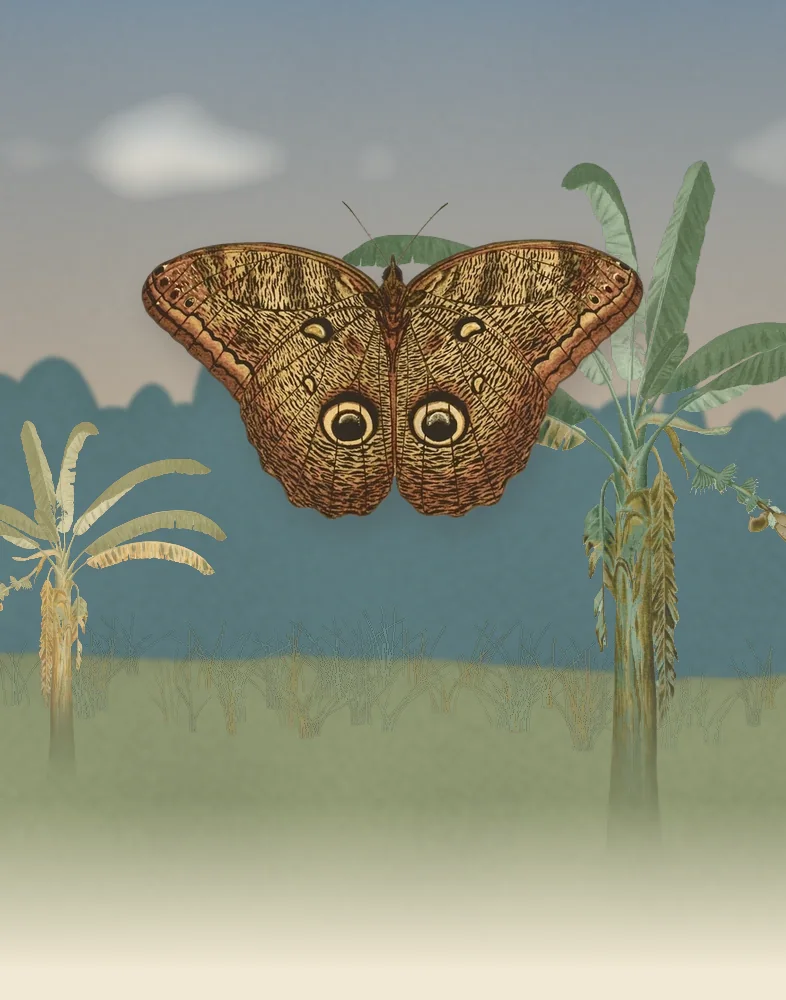
When the Owl Butterfly settles with its wings closed, two enormous round eyes appear, one on each hindwing, ringed and shining, like an owl's. They're painted on the underside, and they're the reason for the butterfly's name.
How to recognise it
- Size: a giant, with a wingspan of up to 17 centimetres, among the largest butterflies of its family.
- Beneath: finely marbled and cryptic, with one great eyespot on each hindwing.
- The eyes: naturalists still argue about what they are for. They may mimic the eyes of a predator, a lizard or an amphibian perhaps; or they may simply be bold enough to startle.
A butterfly of the twilight
Its genus is named Caligo, from the Latin for darkness, perhaps for the hours it keeps: it flies mostly at dusk, when few birds are about, and only a few metres at a time. It doesn't feed much at flowers; instead it drinks the juices of fermenting fruit.
It lives from Mexico through Central America to the Amazon. Pieter Cramer described it in 1775, from Suriname, and the plate in his book became the reference for the whole genus.
Its caterpillar and food plants
The female lays her eggs in a large clutch, and they hatch in three to five days. The caterpillars feed on plants such as heliconias and calatheas, and on bananas; older ones have a crown of four horns on the back of the head. When fully grown, each climbs to a high spot to become a chrysalis.
The plate it comes from
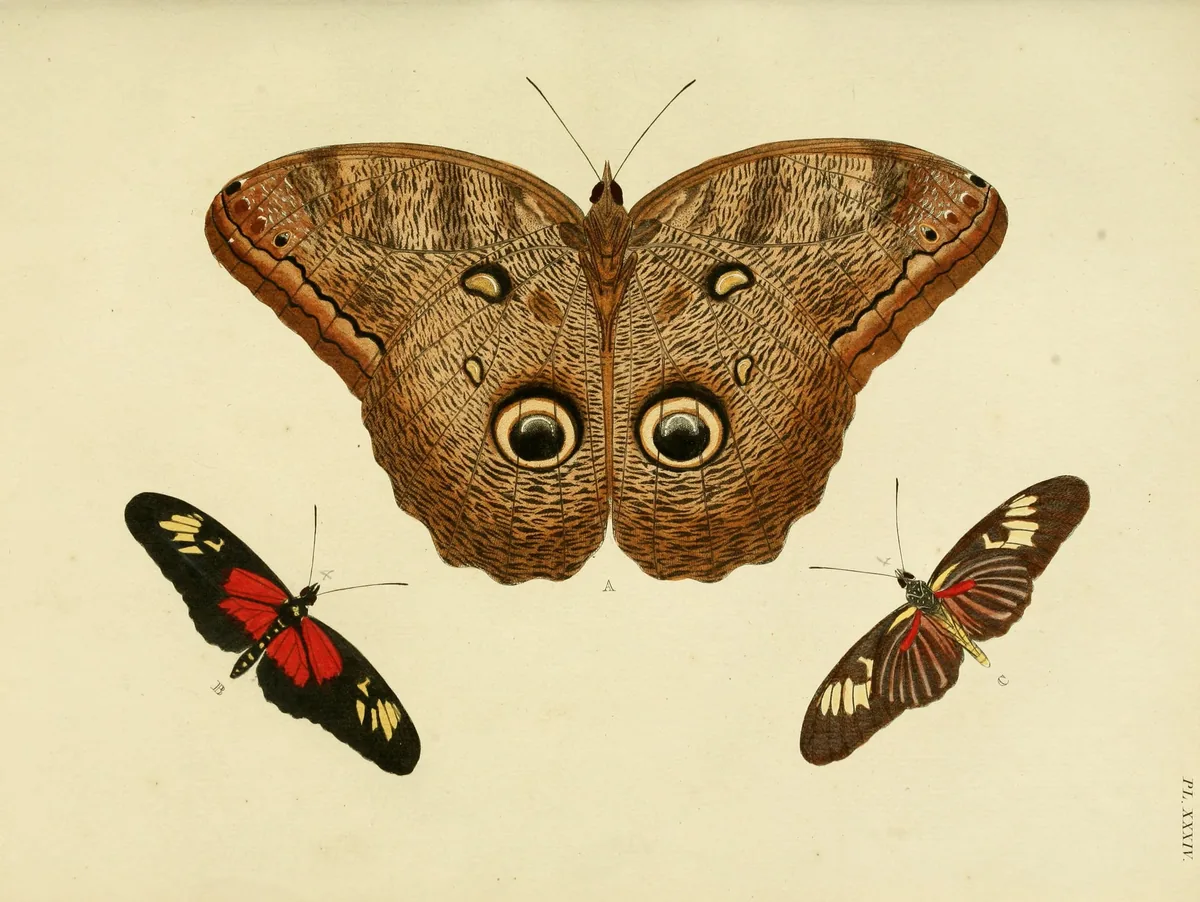
The Owl Butterfly in The Quiet Cabinet is Cramer's figure A, its eyes showing, engraved and coloured by hand in Amsterdam in the 1770s; Cramer drew adults only, so its Field Guide page has no caterpillar. It flies at dusk above banana, drawn from Francisco Manuel Blanco's Flora de Filipinas (1877–1883).
In The Quiet Cabinet
It's one of the thirteen species of the Curiosity Cabinet, the game's last chapter, part of the Butterfly Collection. When its case is completed, a low cello joins the plate's music.
Sources
- Wikipedia, Caligo eurilochus
- Wikipedia, Caligo
More from the journal

Black-veined White: the butterfly Britain lost
A large white butterfly with black veins, lost from Britain around 1925 for reasons still unknown. Its story, its caterpillars' silk nests, its strange female.

Broad-bordered Yellow Underwing: orange hidden beneath
A brown late-summer moth that hides bright orange hindwings with a broad black border, showing them only in flight. How to know it, and its many forms.

Buff-tip moth: the moth that looks like a broken twig
A moth that rests looking just like a snapped birch twig, whose yellow-and-black caterpillars feed in crowds and strip branches bare. How to know the Buff-tip.