



 The Quiet Cabinet

Vanessa cardui
Painted Lady butterfly: migration, facts and caterpillar
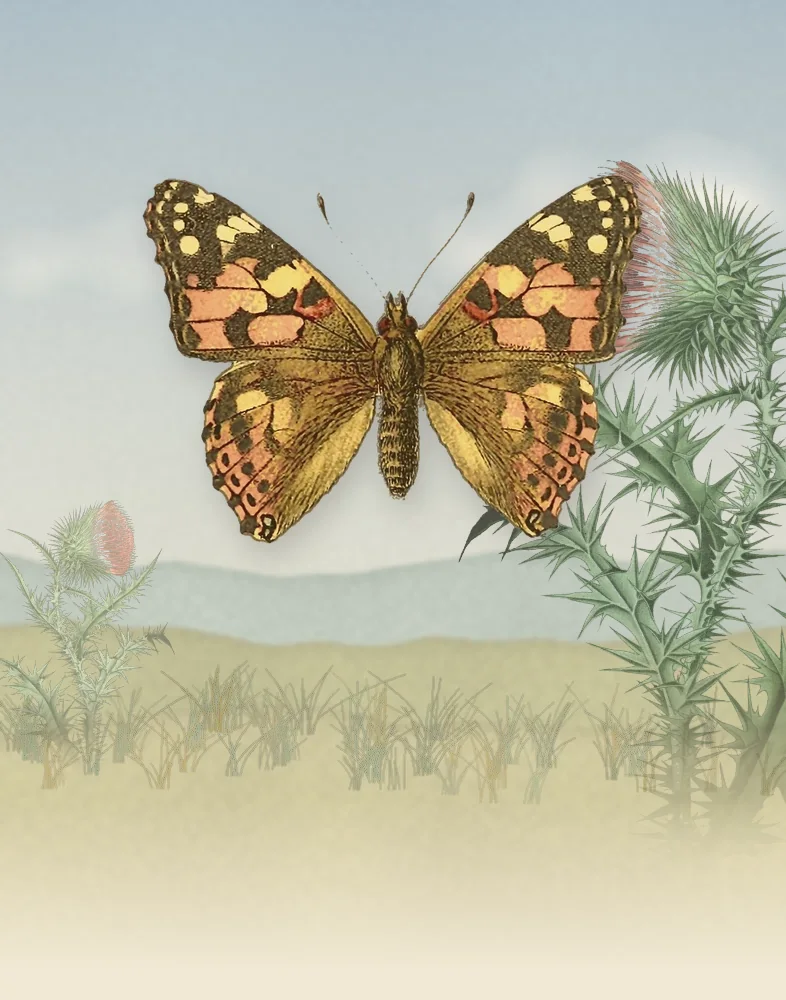
Every Painted Lady you see in a British summer has come from far away, or is the child of one that did. Not one of them survived the winter here. In spring they fly north out of Africa and Asia, and in some years they arrive in their millions.
How to recognise it
- Size: medium, with a wingspan of about 50 to 56 millimetres.
- Above: a warm orange-buff, patterned with black, and with black wingtips spotted with white.
- Beneath: a delicate marbling of grey, brown and olive, with a row of small eyespots along the hindwing.
- Newly emerged, it has a salmon-pink flush that soon fades. Older ones are often worn, with pieces missing from their wingtips.
It is, by most accounts, the most widespread butterfly in the world, found on every continent except Antarctica.
The great migration
Each spring Painted Ladies move north from the desert edges of North Africa, the Middle East and central Asia, first into mainland Europe and then on to Britain and Ireland. The first arrive in late March, and numbers build through May and June as more come in from the continent. Their children, born here, fly in late summer, and in a good year they're everywhere, on garden flowers and thistles alike.
No single butterfly makes the whole journey. The round trip from tropical Africa to the Arctic Circle and back is about 14,500 kilometres, made in stages by as many as six generations, one after another. The spring arrivals are easy to see, but the autumn return was long a mystery, because it happens out of sight: radar studies by Rothamsted Research showed that the butterflies fly south again high in the air.
No stage of its life, egg, caterpillar, chrysalis or butterfly, can survive a British winter, so every year's Painted Ladies are new arrivals. In some years, such as 2009, they came in enormous numbers, one of the greatest migrations ever recorded in Britain.
Its caterpillar and food plants
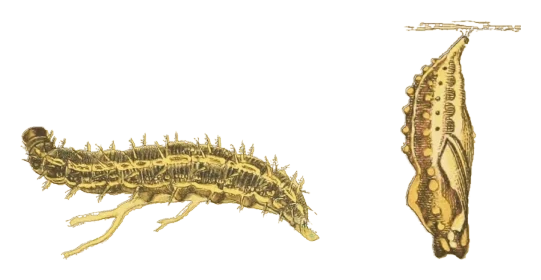
The female lays her pale green eggs one at a time on the upper side of a leaf, most often of a thistle; mallows, nettles, burdock and viper's-bugloss are used too. Each caterpillar lives alone, inside a silk tent it spins around one or more leaves, building bigger tents as it grows. It needs warmth, and dies in long spells of cold and wet. The chrysalis hangs head down inside a loose tent of leaves.
Because thistles grow almost anywhere, the Painted Lady is one of the few butterflies that can breed even on intensive farmland.
The plate it comes from
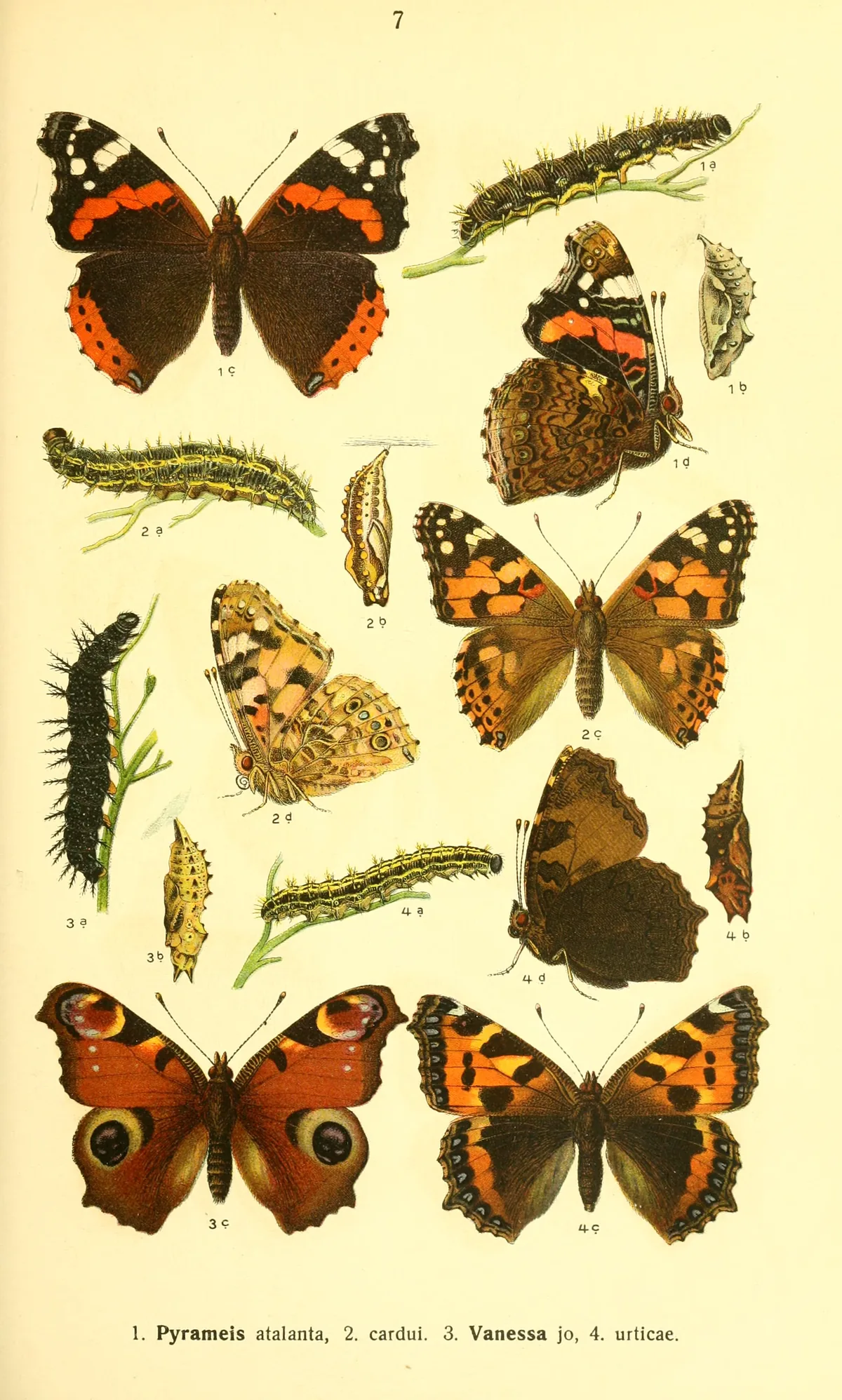
The Painted Lady in The Quiet Cabinet is figure 2c of this plate, which it shares with the Red Admiral, another migrant. On its Field Guide page it flies above musk thistle, drawn from Otto Wilhelm Thomé's Flora von Deutschland, Österreich und der Schweiz (1885).
In The Quiet Cabinet
It's one of the twelve species of the Garden, the game's first chapter, which is free. When its case is completed, a flute joins the plate's music.
Sources
- Butterfly Conservation, Painted Lady
- UK Butterflies, Painted Lady
- Wikipedia, Vanessa cardui
More from the journal

Black-veined White: the butterfly Britain lost
A large white butterfly with black veins, lost from Britain around 1925 for reasons still unknown. Its story, its caterpillars' silk nests, its strange female.

Broad-bordered Yellow Underwing: orange hidden beneath
A brown late-summer moth that hides bright orange hindwings with a broad black border, showing them only in flight. How to know it, and its many forms.

Buff-tip moth: the moth that looks like a broken twig
A moth that rests looking just like a snapped birch twig, whose yellow-and-black caterpillars feed in crowds and strip branches bare. How to know the Buff-tip.