



 The Quiet Cabinet

Aglais io
Peacock butterfly: eyespots, hissing and winter sleep

Open the door of a garden shed in winter and you may find what looks like a dead leaf on the wall. Disturbed, it can flick open into four great staring eyes, and hiss. It's a Peacock butterfly, asleep until spring, and best left that way.
How to recognise it
- Size: fairly large, with a wingspan of 63 to 69 millimetres.
- Upperside: rich red, with a large eyespot on each of its four wings, blue, yellow and black, like the eyes in a peacock's tail. That's where its name comes from.
- Underside: very dark, almost black, and shaped and veined like a dead leaf.
No other butterfly in Europe looks like it.
Eyes, and a hiss
The eyespots are a defence. Resting with its wings closed, the Peacock is a dark leaf; disturbed, it opens them suddenly, and the eyes startle or confuse a bird that was about to peck. It can also hiss, by rubbing its wings together, and the sound is loud enough for us to hear.
A winter asleep
The Peacock spends the winter as a butterfly. It hibernates in hollow trees and wood piles, and often in garages, sheds and barns, where its dark underside hides it. Warm days can wake it at any time of year, but most come out at the end of March and in early April. They mate and lay their eggs, and the new generation of butterflies appears at the end of July, feeds through the late summer, and then looks for somewhere to sleep.
Its caterpillar and food plants
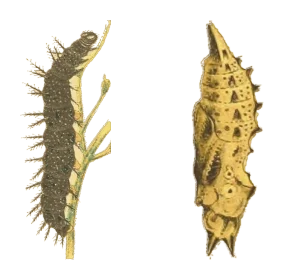
The female lays her eggs in untidy piles, sometimes up to 400 at once, on the underside of common nettle leaves in a sheltered patch. The caterpillars are jet black and spiny, and live together in a web they spin near the top of the nettles. Threatened, a whole group jerks at once. When they're fully grown they wander off alone to find somewhere to turn into a chrysalis, which hangs head down from a stem and may be yellow or dark grey.
Where to see it
Almost anywhere in Britain and Ireland, and especially along woodland clearings, rides and edges, and in gardens at buddleia in late summer. It ranges widely and has been spreading further north. It was recently voted Britain's favourite butterfly.
The plate it comes from
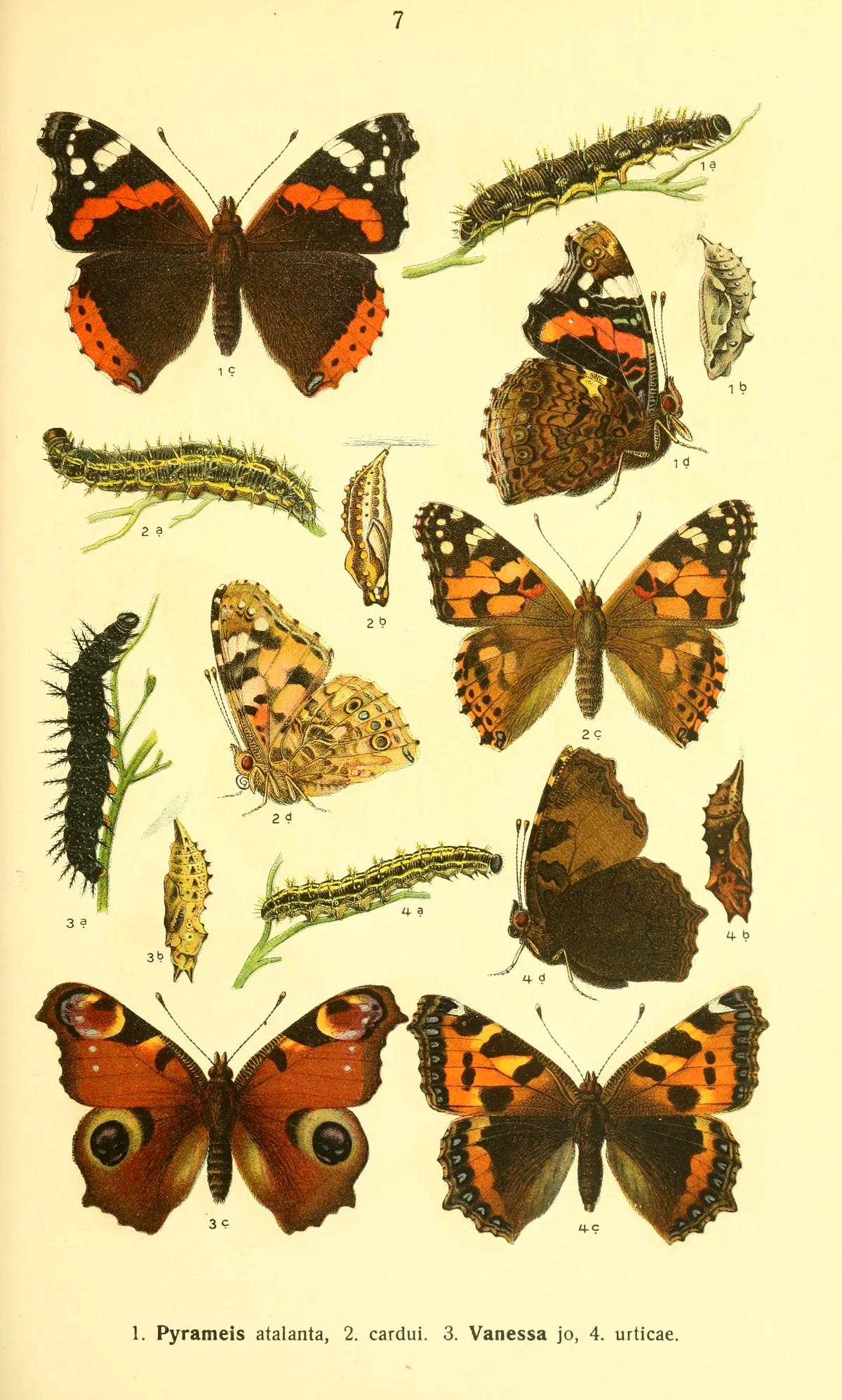
The Peacock in The Quiet Cabinet is figure 3c of this plate, the same plate as the Red Admiral: in Eckstein's book, as on a patch of nettles, the two live side by side.
In The Quiet Cabinet
It's one of the thirteen species of the Night Wing, the game's fourth chapter, part of the Butterfly Collection. When its case is completed, a marimba joins the plate's music.
More from the journal

Black-veined White: the butterfly Britain lost
A large white butterfly with black veins, lost from Britain around 1925 for reasons still unknown. Its story, its caterpillars' silk nests, its strange female.

Broad-bordered Yellow Underwing: orange hidden beneath
A brown late-summer moth that hides bright orange hindwings with a broad black border, showing them only in flight. How to know it, and its many forms.

Buff-tip moth: the moth that looks like a broken twig
A moth that rests looking just like a snapped birch twig, whose yellow-and-black caterpillars feed in crowds and strip branches bare. How to know the Buff-tip.