



 The Quiet Cabinet

Limenitis populi
Poplar Admiral: the great butterfly of Europe's aspen woods
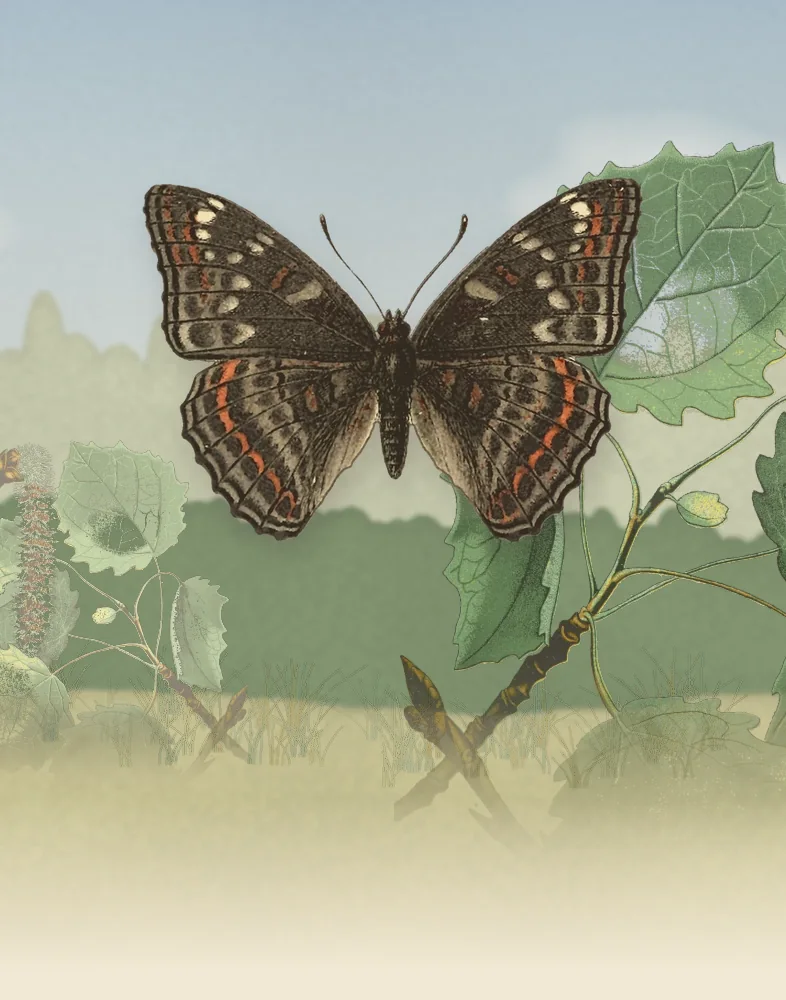
The Poplar Admiral has never lived in Britain. On the continent it is one of the great prizes of a summer morning in the forest: a large dark butterfly, banded with white, sitting on a woodland track where the ground is damp.
How to recognise it
- Size: one of Europe's largest butterflies.
- Colour: dark, banded with white.
- The female has broad white bands, much bolder than the male's.
A butterfly of the forest floor and the treetops
It has one generation a year, flying from late May to early August, most of all in June. It doesn't come to flowers: the males come down in the morning to feed on dung and other things on the ground, damp tracks and puddles among them. The females are much harder to see. Courtship happens up at prominent trees that rise above the forest canopy.
It needs light, damp, deciduous woods with plenty of aspen: coppice woodland in regions of cold winters, or mountain forests where aspen grows back among the conifers. It ranges from central Europe through the deciduous forest zone to Japan.
Its caterpillar and food plant
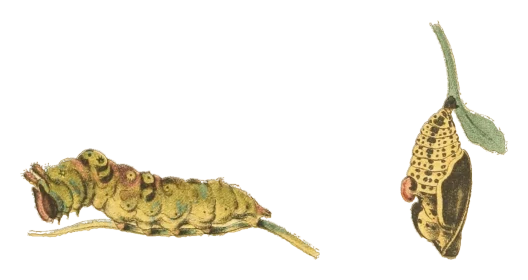
The female lays her eggs on the upper side of aspen leaves, often at the tip. The young caterpillar eats the leaf from the tip, leaving the midrib, and extends the rib with a thread of its own droppings, where it rests. In late July or early August it builds a winter shelter from part of a fresh leaf, and there it dries itself out to survive the frost, swelling again with water in late March. The chrysalis hangs from a leaf whose edges it has turned up, fixed to its twig.
Why it has grown rare
In central Europe the Poplar Admiral now lives in ever more isolated places, mostly mountain forests such as the Black Forest and the Bavarian Forest. Damp, open coppice woods have been lost, aspen is cut out as worthless timber, plantations grow dark and dense, and spraying against outbreaks of other moths has harmed it too. In Germany it is counted as strongly endangered.
The plate it comes from
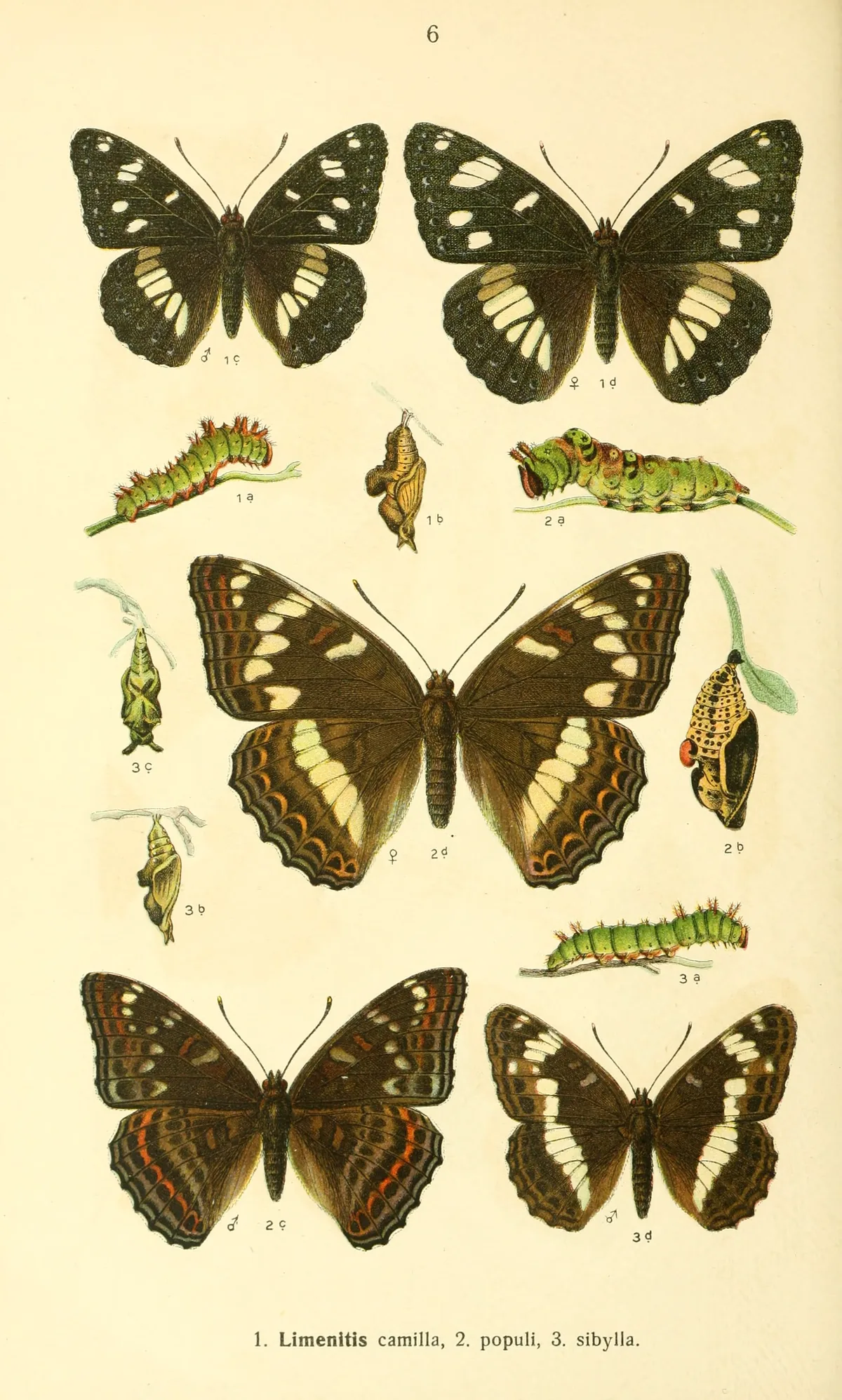
The Poplar Admiral in The Quiet Cabinet is figure 2c, Eckstein's male, from the same plate as the White Admiral. Its female, with broad white bands, turns up in the game as a rare form. On its Field Guide page it flies above aspen, drawn from Otto Wilhelm Thomé's Flora von Deutschland, Österreich und der Schweiz (1885).
In The Quiet Cabinet
It's one of the thirteen species of the Forest, the game's third chapter, part of the Butterfly Collection. When its case is completed, a celesta joins the plate's music.
Sources
- Schmetterlinge und ihre Ökologie (pyrgus.de), Limenitis populi
- Wikipedia, Limenitis populi
More from the journal

Black-veined White: the butterfly Britain lost
A large white butterfly with black veins, lost from Britain around 1925 for reasons still unknown. Its story, its caterpillars' silk nests, its strange female.

Broad-bordered Yellow Underwing: orange hidden beneath
A brown late-summer moth that hides bright orange hindwings with a broad black border, showing them only in flight. How to know it, and its many forms.

Buff-tip moth: the moth that looks like a broken twig
A moth that rests looking just like a snapped birch twig, whose yellow-and-black caterpillars feed in crowds and strip branches bare. How to know the Buff-tip.