



 The Quiet Cabinet

Apatura iris
Purple Emperor: the elusive emperor of the treetops
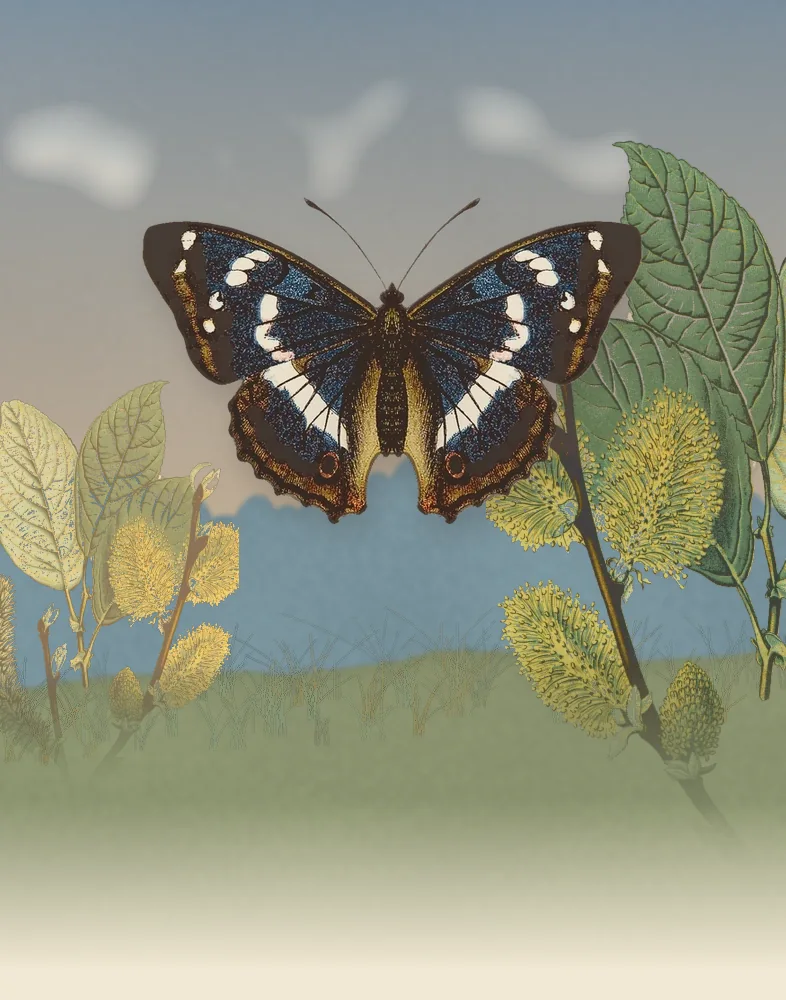
Few British butterflies have such a following as the Purple Emperor. It lives at low densities over large areas of woodland, spends most of its life high in the canopy, and is famously hard to see. Its admirers have been known to lure the males down with banana skins and shrimp paste.
How to recognise it
- Size: large, with a wingspan of about 70 to 92 millimetres.
- The male looks black with white bands, until the light catches his wings at the right angle and they flash a deep purple. The colour isn't a pigment: it comes from light breaking on the structure of the wing scales.
- The female is a deep brown, with no purple sheen. She can be mistaken for a White Admiral, but has an orange-ringed eyespot beneath each forewing.
Life in the canopy
The Purple Emperor has one generation a year, coming out in early July and at its peak in the second and third weeks of the month. It feeds on aphid honeydew and tree sap. In the late morning the males gather at "master trees", tall trees on high ground, to meet the females, and battle each other for the best perches.
Now and then, usually in the middle of the morning, a male comes down to take salts from damp ground, road surfaces, dung or carrion. Males have even settled on people for their sweat, and on the mud of parked cars.
It lives in large woods of broadleaved trees, usually oak, or clusters of smaller woods with dense scrub, where willow grows in plenty. In Britain it is found only in central southern England, from Wiltshire and Hampshire to Surrey and West Sussex and north to Oxfordshire and Hertfordshire. It declined through the 20th century but is spreading again: between 1976 and 2019 its numbers rose by about 110 per cent.
Its caterpillar and food plant
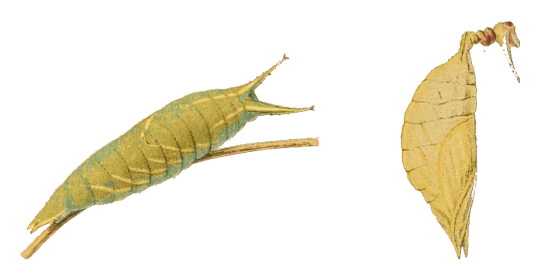
The female lays her eggs one at a time on the upper side of a goat willow leaf in half-shade, or sometimes grey willow. The caterpillar grows a pair of horns on its head, and pale yellow stripes along its sides that mimic the leaf's veins. It spends the winter small, on a pad of silk in the fork of a twig or beside a bud, and wakes in mid-April as the buds open. The chrysalis hangs beneath a willow leaf, and is very hard to find.
The pictures it comes from
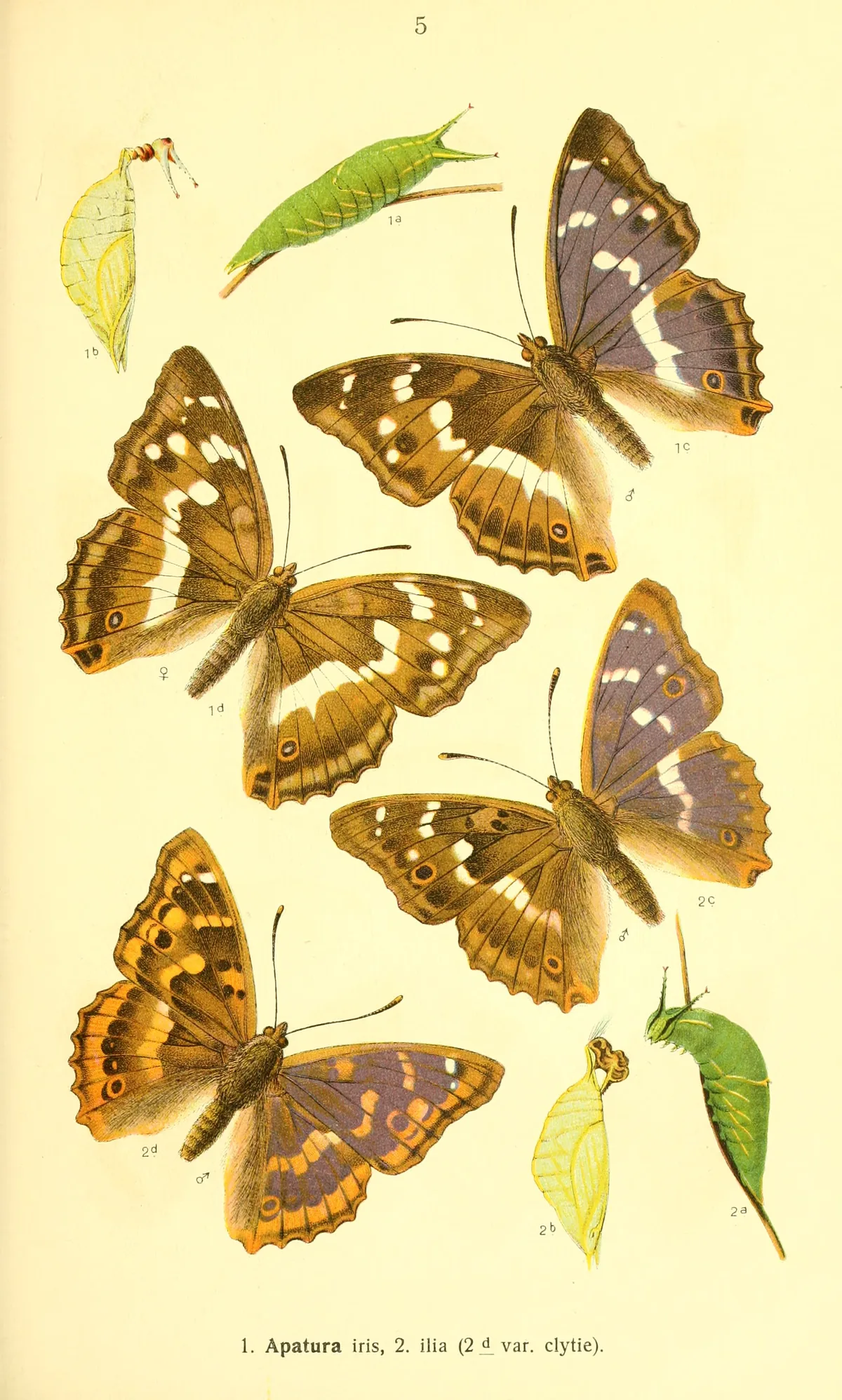
The male Purple Emperor in The Quiet Cabinet comes from an older picture: a plate by Jacob Hübner, painted in the early 1800s. Its caterpillar and chrysalis are Eckstein's, from the plate above, and its brown female turns up in the game as a rare form. On its Field Guide page it flies above goat willow at dusk.
In The Quiet Cabinet
It's one of the thirteen species of the Night Wing, the game's fourth chapter, part of the Butterfly Collection. When its case is completed, a harp joins the plate's music.
Sources
- Butterfly Conservation, Purple Emperor
- UK Butterflies, Purple Emperor
More from the journal

Black-veined White: the butterfly Britain lost
A large white butterfly with black veins, lost from Britain around 1925 for reasons still unknown. Its story, its caterpillars' silk nests, its strange female.

Broad-bordered Yellow Underwing: orange hidden beneath
A brown late-summer moth that hides bright orange hindwings with a broad black border, showing them only in flight. How to know it, and its many forms.

Buff-tip moth: the moth that looks like a broken twig
A moth that rests looking just like a snapped birch twig, whose yellow-and-black caterpillars feed in crowds and strip branches bare. How to know the Buff-tip.