



 The Quiet Cabinet

Favonius quercus
Purple Hairstreak: the butterfly in the tops of the oaks
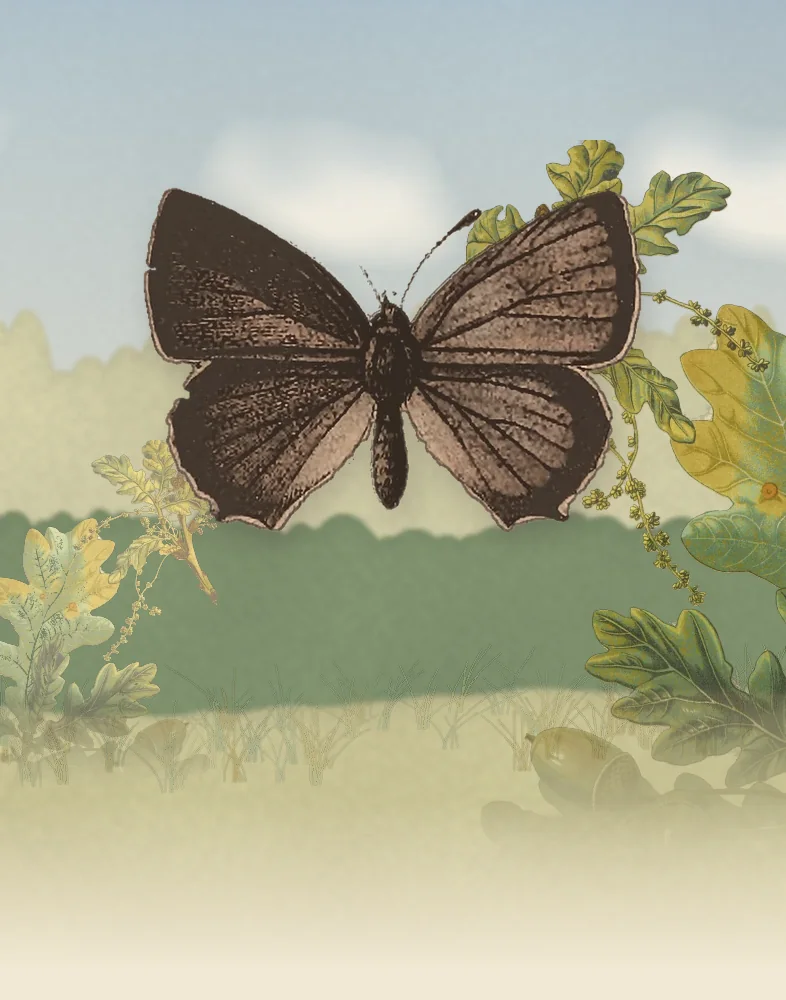
The Purple Hairstreak is the commonest hairstreak in Britain, and one of the least seen. It lives high in the crowns of oak trees, and it hardly ever comes down.
How to recognise it
- Size: a wingspan of about 31 to 40 millimetres.
- Colour: dark, with the purple sheen its name speaks of.
Life in the canopy
The Purple Hairstreak feeds not on flowers but on honeydew, the sweet liquid aphids leave on oak leaves, so it has little reason to come down. Only in a long drought, as in 1995 and 1996, does it descend for water and nectar. Sometimes it basks lower, on small trees, shrubs or bracken.
The best time to see it is a warm evening in July. Then large numbers may fly round the tops of the oaks, chasing one another. There is one generation a year: the butterflies come out in the last week of June and fly through July into August, most of all in late July and early August.
It lives wherever oaks grow, in woods, hedgerows, parks and towns, and a single tree can hold a colony. It is widespread in England and Wales, with scattered colonies further north and in Ireland, and it has spread recently in the Midlands and south-west Scotland, perhaps helped by cleaner air.
Its caterpillar and food plant
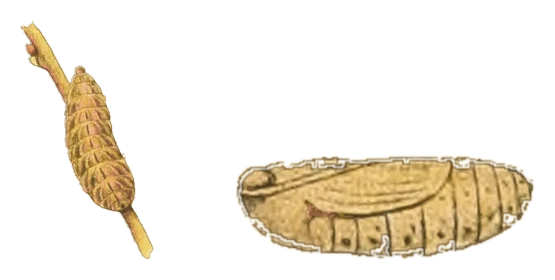
The female lays her white, bun-shaped eggs at the base of plump oak buds, often on gnarled old trees, and they spend the winter there: the caterpillar is fully formed inside within about three weeks but waits until spring. Then it burrows into an opening bud, later living under a web of silk, resting by day and feeding at night. The chrysalis forms in a loose cocoon just beneath the soil or leaf litter, and has even been found in ants' nests.
The plate it comes from
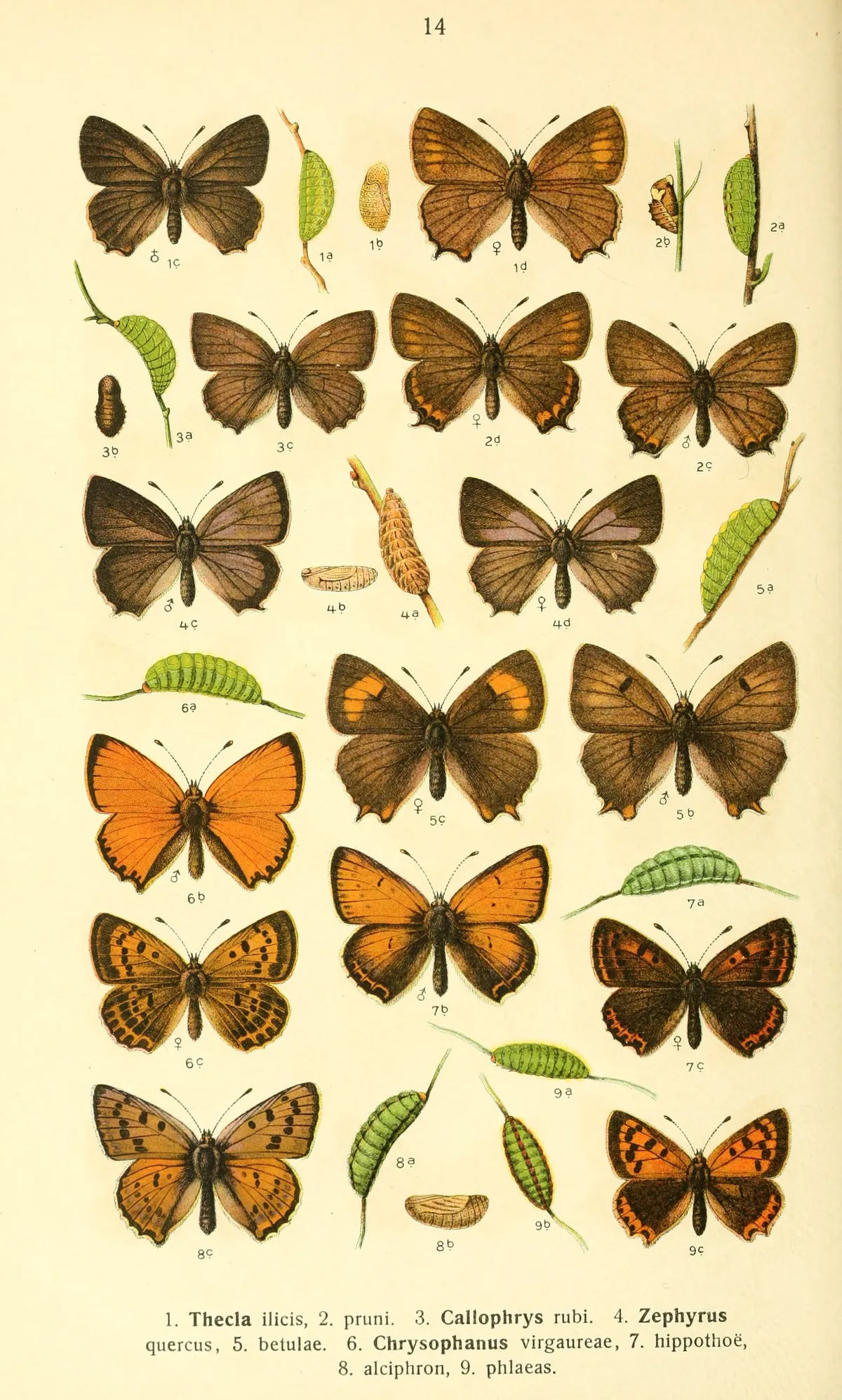
The Purple Hairstreak in The Quiet Cabinet is figure 4c, Eckstein's male, from the same plate as the Small Copper. On its Field Guide page it flies above pedunculate oak, drawn from Otto Wilhelm Thomé's Flora von Deutschland, Österreich und der Schweiz (1885).
In The Quiet Cabinet
It's one of the thirteen species of the Forest, the game's third chapter, part of the Butterfly Collection. When its case is completed, a harp joins the plate's music.
Sources
- Butterfly Conservation, Purple Hairstreak
- UK Butterflies, Purple Hairstreak
More from the journal

Black-veined White: the butterfly Britain lost
A large white butterfly with black veins, lost from Britain around 1925 for reasons still unknown. Its story, its caterpillars' silk nests, its strange female.

Broad-bordered Yellow Underwing: orange hidden beneath
A brown late-summer moth that hides bright orange hindwings with a broad black border, showing them only in flight. How to know it, and its many forms.

Buff-tip moth: the moth that looks like a broken twig
A moth that rests looking just like a snapped birch twig, whose yellow-and-black caterpillars feed in crowds and strip branches bare. How to know the Buff-tip.