



 The Quiet Cabinet

Cerura vinula
Puss Moth: a furry moth and its fierce caterpillar
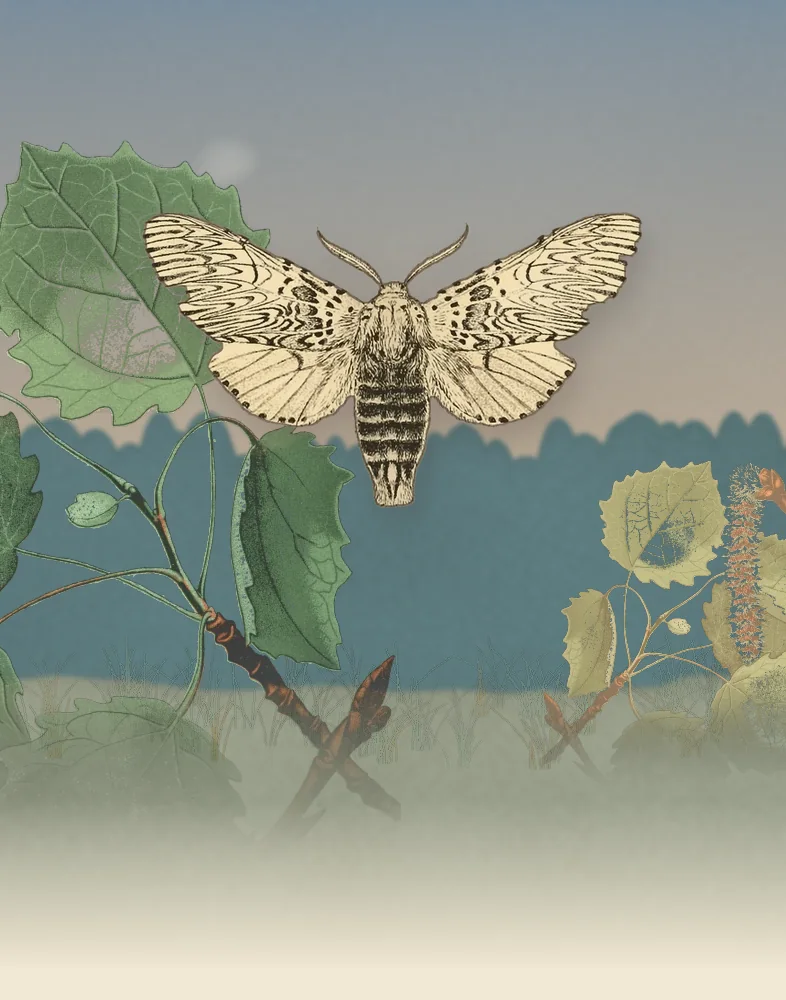
The Puss Moth is named for its soft, pale fur, which gives it the look of a cat. But the star of its story is its caterpillar, one of the strangest and most striking in Britain.
How to recognise it
- Size: a wingspan of about 45 to 75 millimetres.
- Colour: a large, furry moth, white or greyish-white.
- The female is generally larger, with grey hindwings and sometimes greyer forewings.
It flies at night from May to July, in one generation, and often comes to lights. It's found in gardens, hedgerows, open woodland, moorland and scrub, and is fairly common across most of Britain and Ireland.
A caterpillar that fights back
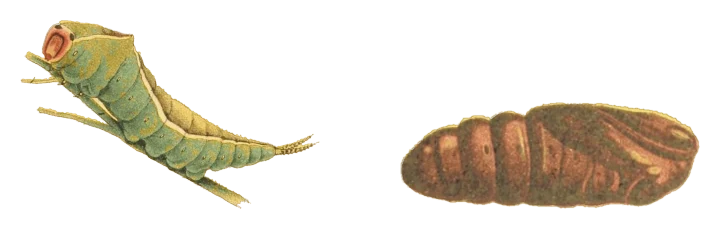
The caterpillar hatches black, then turns a bright green, with a dark saddle on its back edged in white or yellow, and grows to about 80 millimetres. At its tail end it has a fork of two long tails, which hold red threads that it can push out.
When it is disturbed, it rears up, raising its head to show a reddish face, and waves its two tails, the red threads lashing out. If that warning is ignored, it can squirt formic acid at its attacker.
It feeds on aspen, poplar and willow, especially young regrowth in sunny places, and caterpillars can strip a stem of its leaves. They are found from July to September.
A cocoon of wood
When it's fully grown, the caterpillar spins a cocoon on a tree trunk or a post, working in wood it has chewed, so that the cocoon is very hard. The moth spends the winter inside and comes out the following spring.
The plate it comes from
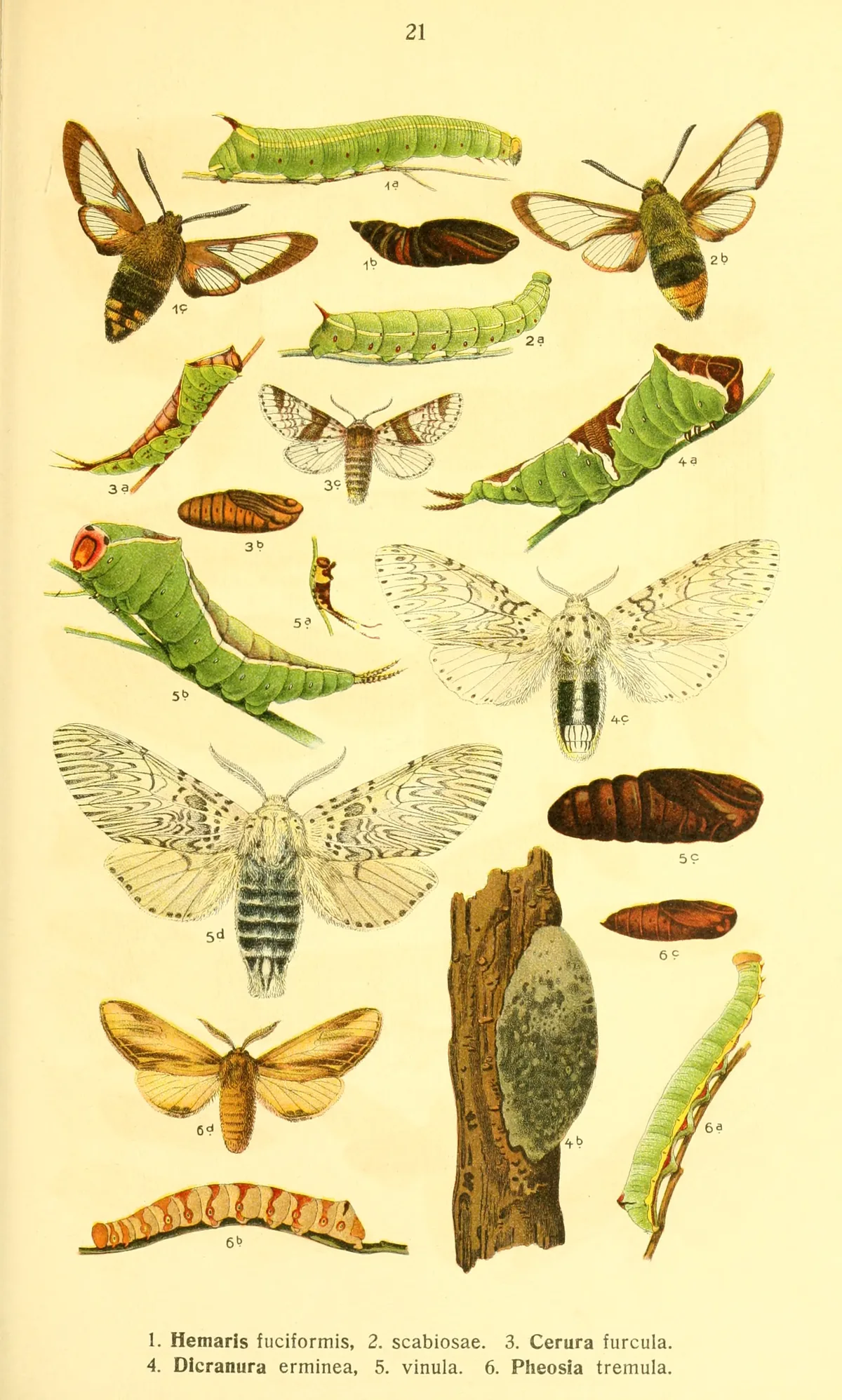
The Puss Moth in The Quiet Cabinet is figure 5d of this plate. On its Field Guide page it flies above aspen at dusk.
In The Quiet Cabinet
It's one of the thirteen species of the Night Wing, the game's fourth chapter, part of the Butterfly Collection. When its case is completed, a music box joins the plate's music.
Sources
- Butterfly Conservation, Puss Moth
- UKMoths, Puss Moth
- Wikipedia, Cerura vinula
More from the journal

Black-veined White: the butterfly Britain lost
A large white butterfly with black veins, lost from Britain around 1925 for reasons still unknown. Its story, its caterpillars' silk nests, its strange female.

Broad-bordered Yellow Underwing: orange hidden beneath
A brown late-summer moth that hides bright orange hindwings with a broad black border, showing them only in flight. How to know it, and its many forms.

Buff-tip moth: the moth that looks like a broken twig
A moth that rests looking just like a snapped birch twig, whose yellow-and-black caterpillars feed in crowds and strip branches bare. How to know the Buff-tip.