



 The Quiet Cabinet

Relaxing puzzle games with no timer: the 7 rules behind ours
Search the App Store for a relaxing puzzle game and you'll find hundreds of them. Many are relaxing for the first minute: then comes the timer on level 12, the "out of lives" screen, the seven-day streak you'll lose if you skip a day, the ad that plays the moment you finish.
None of those things are puzzles. They're pressure added around the puzzle, usually to sell relief from it.
When we started The Quiet Cabinet, a calm sorting game with butterflies and music, we wrote down seven rules first. Every feature has to pass all seven, and the rules have quietly decided far more of the game than any design document. Here they are, with what each one means in practice.
1. No pressure
No timers, move limits, countdowns, streaks or limited-time events.
This is the rule people notice first. A plate waits for you, however long you look at it. There's no clock on screen, no score and no level number: a plate is called "Garden · Plate III", not "Level 3 of 280". The Daily Specimen, a new plate each morning, keeps nothing from you if you miss a day, and the rare forms you can find are never time-limited.
2. No punishment
No fail states, no "wrong" sounds, no dead ends without a way out.
You can't lose a plate. A move that isn't allowed is answered with a soft wooden tap. If you do box yourself in, there's always a way out: a hint, undo, one spare case, Restart, and a gentle automatic rewind when the game is certain no useful move remains.
3. Slow senses
Slow motion, soft sound, low contrast, gentle haptics. Nothing flashes or shakes.
The butterflies breathe slowly while they rest. A completed case glows rather than exploding. The colours come from a palette of nine warm, muted tones, never pure black, pure white or neon. Reduce Motion on your phone is honoured throughout, and the breathing can be turned off.
4. Never monetize frustration
Charge for beauty and content, never for relief from stress.
This is the rule that shapes the business. Hints and undo are free and earned by playing, never sold. There are no ads to remove because there are no ads. What you can buy is more of the game: more chapters, and a new species each month. The first twenty plates are free, with everything in them.
5. Respect attention
No mid-level pop-ups, no red badges, no guilt reminders.
Nothing interrupts a plate. There's no "Your butterflies miss you!" notification. The one reminder in the game, an evening note, is off unless you turn it on.
6. Gentle endings
Help players stop at a good moment.
Most games are designed to make "one more level" irresistible. We'd rather you put the phone down feeling better than when you picked it up. Each plate ends with its piece of music finishing and a quiet moment before anything else. The next plate is something you choose, not something that starts by itself.
7. Stay honest
Calming and mindful, never therapy or medical claims.
A good game can be a pleasant, quiet half hour. That's all we claim. You won't see us promise to cure anxiety or help you sleep.
A puzzle game that makes music as you play
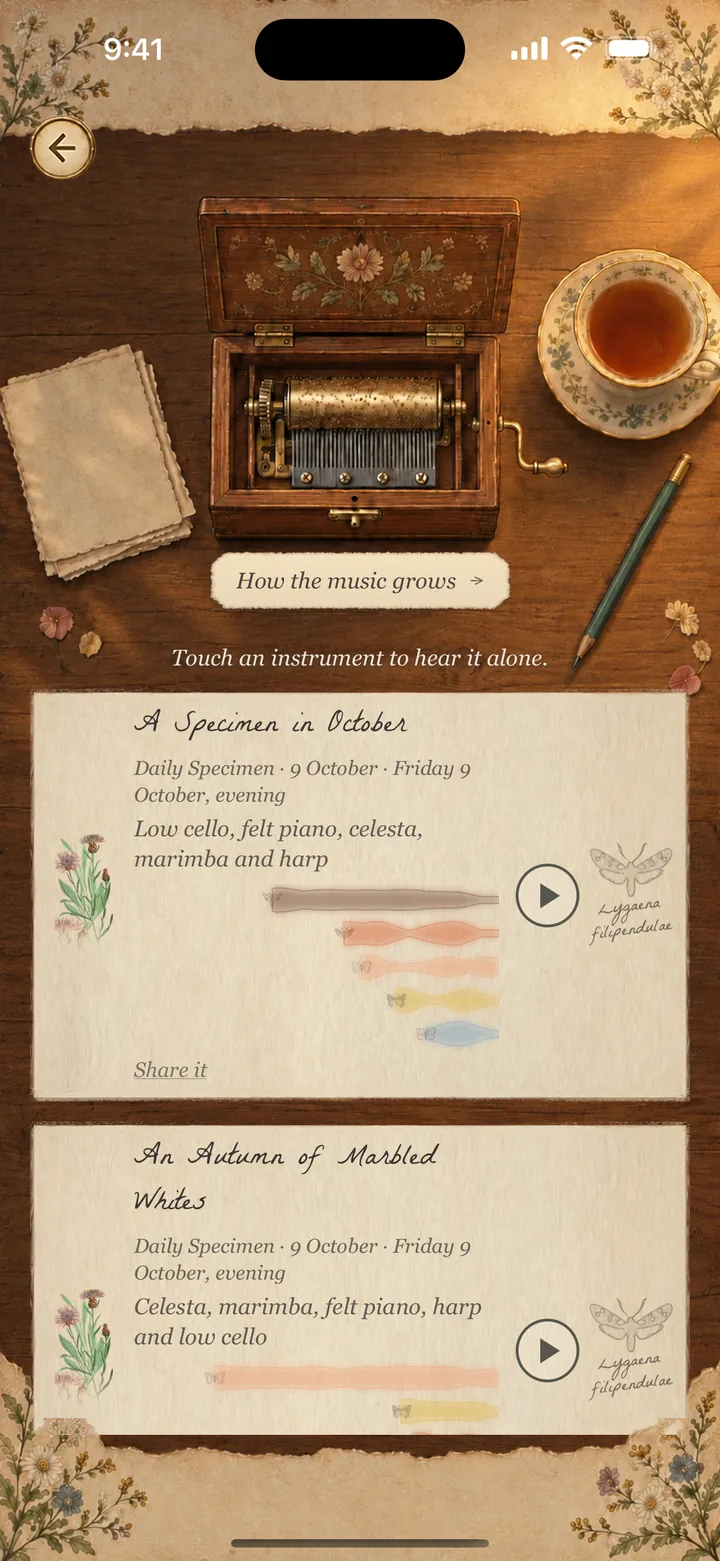
The rulebook also explains the game's strangest feature. Instead of rewarding you with points, each plate composes a piece of music as you play, and every case you complete adds an instrument to it.
The music is written to be impossible to get wrong. Every note comes from the current chord or its scale, so there are no wrong notes for a move to trigger. Each chapter has its own key and mood: the Garden is warm, in D major, the Meadow pastoral, in G Mixolydian, and the Forest a little wistful, in E Dorian. The whole piece moves at a slow 88 beats a minute, with one breath every four bars, about eleven seconds.
Every finished plate's piece is kept in the Listening Room. The game stores the seed and the moments each instrument joined, so a piece replays note for note, months later.
With VoiceOver on, each species in a plate has its own instrument, and a Listen action plays the top butterfly's. That means you can sort a plate by ear.
How to tell whether a puzzle game is really relaxing
Before you download one, a few minutes with its App Store page will usually tell you:
- Look at the screenshots for counters. Coins, lives, gems, energy and a level number in the corner usually mean the game is built around running out.
- Read the in-app purchase list. "Remove ads", "hint packs", "extra moves" and "coin bundles" are relief being sold back to you. Chapters, collections and cosmetics are content.
- Search the reviews for "timer" and "ads". Players are honest about both.
- Check whether the hints are free. If they cost coins or an ad, getting stuck is part of the business model.
- Notice whether it lets you stop. A game that ends each session with a cliffhanger, a daily streak or a countdown to the next reward isn't trying to let you go.
Where to find it
The Quiet Cabinet is on the App Store for iPhone. It's a sort puzzle at heart, like water sort or ball sort, with butterflies and moths from old natural history plates instead of coloured liquid. We wrote more about how the sorting works and what it costs.
More from the journal
Butterfly bush (buddleia): the butterflies it brings
Why buddleia is called the butterfly bush, which butterflies you'll see on it in late summer, and the catch: it feeds butterflies, never caterpillars.
Butterfly or moth? How to tell the difference
Antennae, bodies, wings at rest and the time of day: how to tell a butterfly from a moth, and the many moths that break the rules. With pictures from old plates.
What do butterflies eat? Nectar, fruit, mud and nothing
Butterflies drink, never chew: nectar, rotting fruit, honeydew, sap and salts from mud, while some moths never eat at all. What butterflies and caterpillars eat.