



 The Quiet Cabinet

Butterfly or moth? How to tell the difference
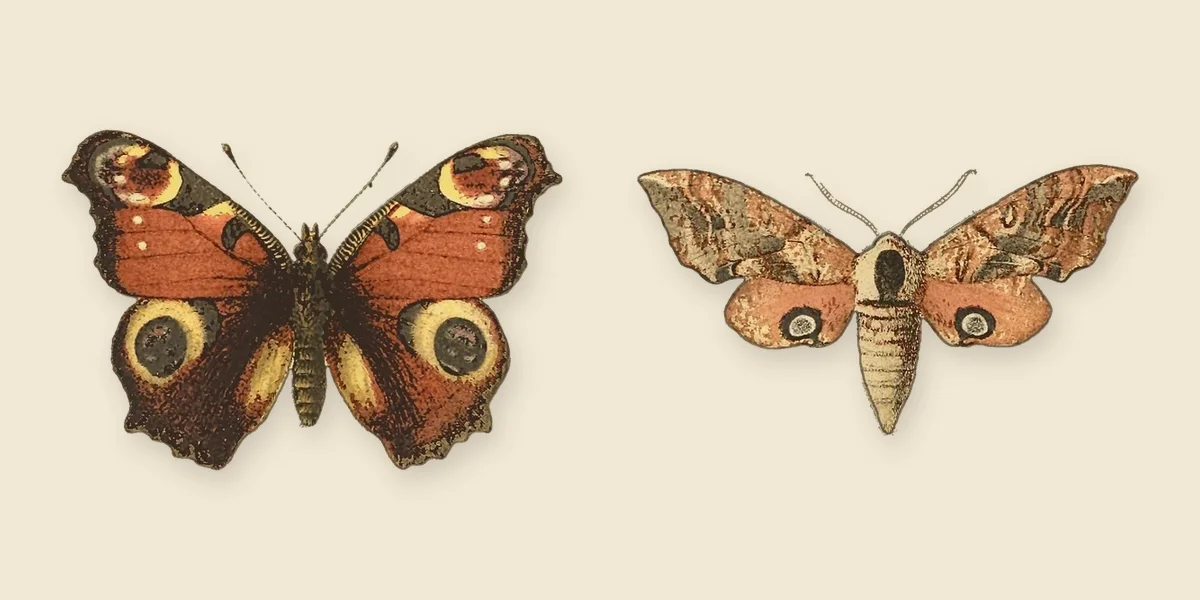
Butterflies and moths are close relatives: together they make up one great order of insects, the Lepidoptera, the "scale wings". There is no single rule that separates them, but there are a handful of clues, and together they nearly always give the answer. The picture above shows two of them at once: a Peacock, a butterfly, and an Eyed Hawk-moth, a moth. Both have eyespots; almost nothing else is alike.
1. Look at the antennae
This is the best single clue.
- Butterflies have thin antennae with a little club at the tip, like a matchstick.
- Moths have antennae that are feathery or comb-like, or thin and pointed, with no club.
The exceptions: a few moth families have clubbed antennae too, and skippers, usually counted as butterflies, have clubs that end in a small hook.
2. Look at the body
- Moths tend to have stout, furry bodies: think of the Puss Moth, named for its fur, or the big Oak Eggar.
- Butterflies usually have slimmer, smoother bodies.
3. Watch how it rests
- Butterflies often rest with their wings folded together above their backs, like the Clouded Yellow, which always settles with its wings closed.
- Moths usually rest with their wings spread flat or held like a roof over the body. The Buff-tip holds its wings almost upright, and looks like a broken twig.
But a butterfly basking in the sun opens its wings wide, and some moths fold theirs, so watch for a while.
4. Notice the time of day
Most butterflies fly by day, and most moths by night or at dusk. That's why a moth comes to a lit window and a butterfly to a sunny flower bed.
Plenty of moths fly in daylight, though: the Hummingbird Hawk-moth hovering at flowers, the red-spotted Six-spot Burnet, the Cinnabar, and the males of the Emperor Moth racing across the heather. There's a guide to them: moths that fly by day.
5. Look at the colours
Most butterflies are bright, and most night-flying moths are brown, grey, white or black, colours that hide them by day. But the day-flying moths are often brilliant, especially the poisonous ones, whose colours warn birds away: the burnets, the Cinnabar, the tiger moths. And some butterflies, the whites among them, are plain.
6. Cocoon or chrysalis?
Most moth caterpillars spin a silk cocoon to pupate in, like the Emperor Moth's pear-shaped one or the Puss Moth's, hardened with chewed wood. Most butterfly caterpillars form a bare chrysalis, hanging from a stem or girdled to it, like the Monarch's green and gold one. Again there are exceptions: hawk-moths pupate underground with no cocoon at all.
A hidden one, if you can look closely
Many moths have a tiny bristle, the frenulum, that hooks each forewing to its hindwing in flight. Butterflies don't, with just one known exception, an Australian skipper. It takes a magnifying glass to see.
So what's the real difference?
Scientists find that butterflies form one natural family tree, a single branch of the Lepidoptera, while "moths" is simply the name for all the rest. In a sense, butterflies are one special branch within the moths. That's why no single rule ever quite works, and why the clues are best used together.
Sources
- Wikipedia, Comparison of butterflies and moths
- Each species' page in the Journal, linked above, which names its own sources
More from the journal
Butterfly bush (buddleia): the butterflies it brings
Why buddleia is called the butterfly bush, which butterflies you'll see on it in late summer, and the catch: it feeds butterflies, never caterpillars.
What do butterflies eat? Nectar, fruit, mud and nothing
Butterflies drink, never chew: nectar, rotting fruit, honeydew, sap and salts from mud, while some moths never eat at all. What butterflies and caterpillars eat.
Relaxing puzzle games with no timer: the 7 rules behind ours
What makes a puzzle game truly relaxing? No timers, no fail states, no streaks. The seven-rule calm rulebook The Quiet Cabinet is built on.