



 The Quiet Cabinet

A sort puzzle game with no ads, no timer and no way to lose
Sort puzzles are one of the quietest ideas in games. You have a few containers, each holding a muddle of colours, and you move one piece at a time until every container holds just one colour. Water sort, ball sort, hexa sort, goods sort: the same small pleasure of putting things where they belong.
The trouble is everything sold around that pleasure. On most sort puzzle apps, an ad plays after every level. Hints and an extra tube cost a video ad, or coins, or both. There's a timer on some levels, a move limit on others, and a fee to remove the ads, after which the "watch an ad for a reward" buttons often stay. The puzzle is calm, but the game around it isn't.
The Quiet Cabinet is a sort puzzle for iPhone built the other way round: no ads at all, no timer, no move limit and no way to lose. Here's how it works, and what we left out on purpose.
How the sorting works
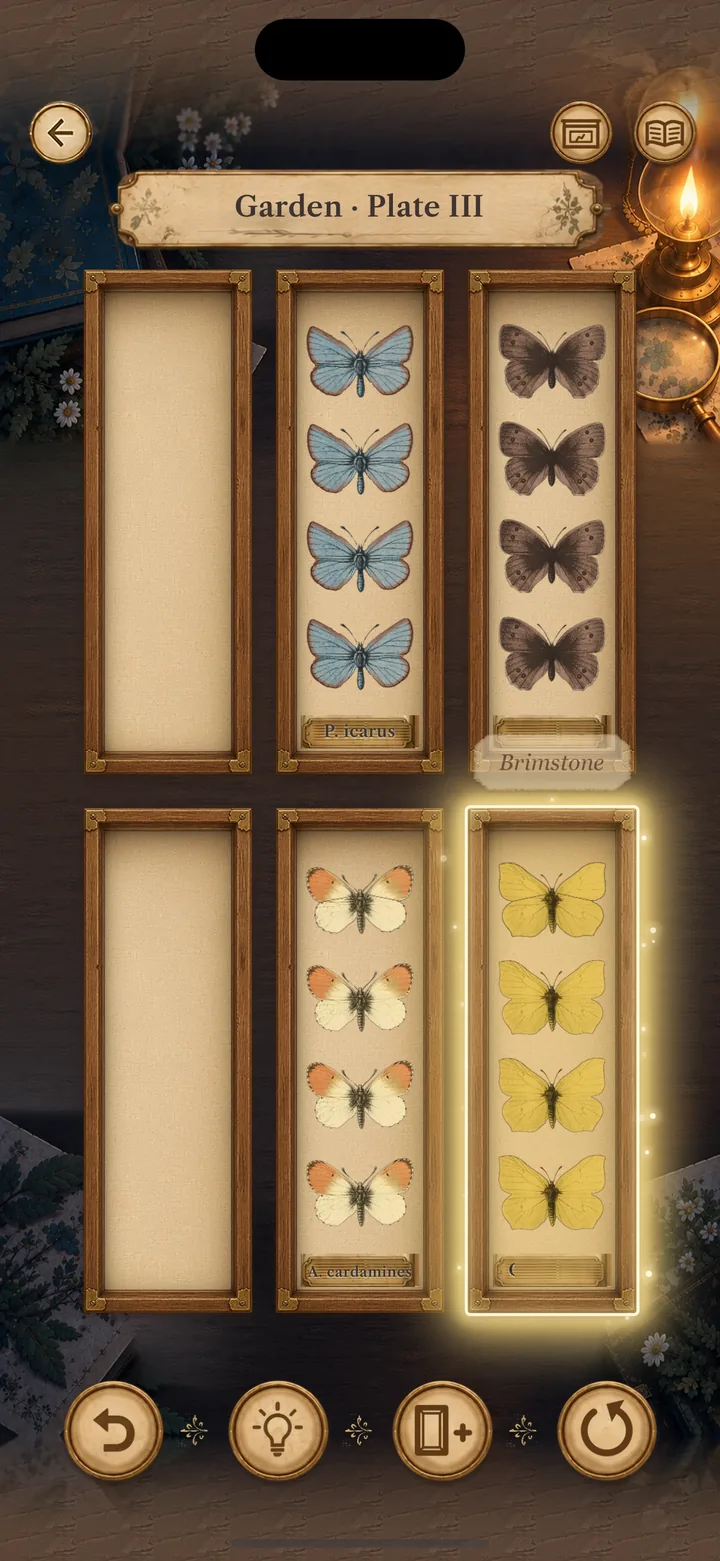
Instead of coloured water, you sort butterflies and moths. Each plate is a few wooden specimen cases on a naturalist's desk. A case holds four specimens in a column, filling from the bottom up.
- Only the top specimen moves. Touch a case to lift its top butterfly, then touch where it should go.
- It can go onto the same species, or into an empty case. A common blue goes on another common blue, never on a brimstone.
- Four of one species seal the case. A sealed case glows softly and stays put, and the plate is finished when every species has its own case.
If you've played water sort or ball sort, you already know the shape of it. What changes is everything around the puzzle.
What's missing, on purpose
The game is built on a seven-rule calm rulebook, and every feature has to pass all seven. In practice, that means:
- No ads. None between plates and none for rewards. There's no ad SDK in the app, no account and no tracking.
- No timers and no move limits. A plate waits for you. Put the phone down for a week and it's exactly where you left it.
- No fail state. You can't lose a plate, and there's no "Game over" screen.
- No coins, lives, energy or streaks. Nothing counts down, nothing runs out, and no daily login is needed to keep anything.
- No wrong-move buzzer. A move that isn't allowed is answered with a soft wooden tap, not an error sound.
When you get stuck
Sort puzzles have one genuinely stressful moment: realising you've boxed yourself in. Most games sell their way out of it. In The Quiet Cabinet, every way out is free, and none of them is ever sold:
- A hint is ready as each plate begins, and again each time you complete a case.
- Undo steps back up to three moves in a row.
- A spare case: once a plate, you can set out one extra empty case from the desk.
- Restart is always there.
- A gentle rewind: if no useful move is left, the game notices, says "Let's try that again," and steps the plate back for you. It only says so when it's certain, so it never tells you you're stuck by mistake.
Every case adds an instrument
The part that surprises people is the sound. Each plate composes a piece of music as you play, and every case you complete adds an instrument to it: a celesta, a felt piano, a harp, a marimba. By the last case the whole piece is playing. It's never a fanfare, just the music getting fuller.
Every finished plate's piece is kept in the Listening Room, so you can play it again note for note, or share it.
The butterflies are real
Every specimen is cut from a real natural history plate, some printed in 1913 and some in the 1770s, all in the public domain. None are generated. The Field Guide fills with each species' page as you find it: its plate, its caterpillar, its chrysalis and the plant it feeds on. We wrote about where the butterflies come from.
What it costs
The download is free, and the Garden's first twenty plates are free with everything in them: the music, the Field Guide, hints and undo. After that:
- The Butterfly Collection is a one-time purchase that opens the other four chapters (the Meadow, the Forest, the Night Wing and the Curiosity Cabinet), 260 more plates.
- The Membership is a subscription that opens every chapter too, and adds a new species each month with a letter from the naturalist.
That's all there is to buy. Hints, undo and the spare case aren't for sale, and there are no ads to remove.
Questions people ask
Is there a sort puzzle game without ads?
Yes. The Quiet Cabinet has no ads anywhere, including no "watch an ad for a hint" buttons. You pay for more chapters if you want them, never to remove ads or to get unstuck.
Is it like water sort or ball sort?
The rules are close: one piece moves at a time, onto its own kind or into an empty container, until each container holds one kind. Here the pieces are butterflies and moths, the containers are wooden cases, and each completed case adds to the music.
Can I lose or run out of moves?
No. There's no move limit and no fail state. If you do box yourself in, undo, Restart and the gentle rewind are always free.
Is it on Android?
The Quiet Cabinet is on iPhone today.
Do I need an account or an internet connection to play?
There's no account and no sign-in. Your progress, your Field Guide and your music are kept on your phone.
More from the journal
Butterfly bush (buddleia): the butterflies it brings
Why buddleia is called the butterfly bush, which butterflies you'll see on it in late summer, and the catch: it feeds butterflies, never caterpillars.
Butterfly or moth? How to tell the difference
Antennae, bodies, wings at rest and the time of day: how to tell a butterfly from a moth, and the many moths that break the rules. With pictures from old plates.
What do butterflies eat? Nectar, fruit, mud and nothing
Butterflies drink, never chew: nectar, rotting fruit, honeydew, sap and salts from mud, while some moths never eat at all. What butterflies and caterpillars eat.