



 The Quiet Cabinet

Aphantopus hyperantus
Ringlet butterfly: the brown that flies on cloudy days
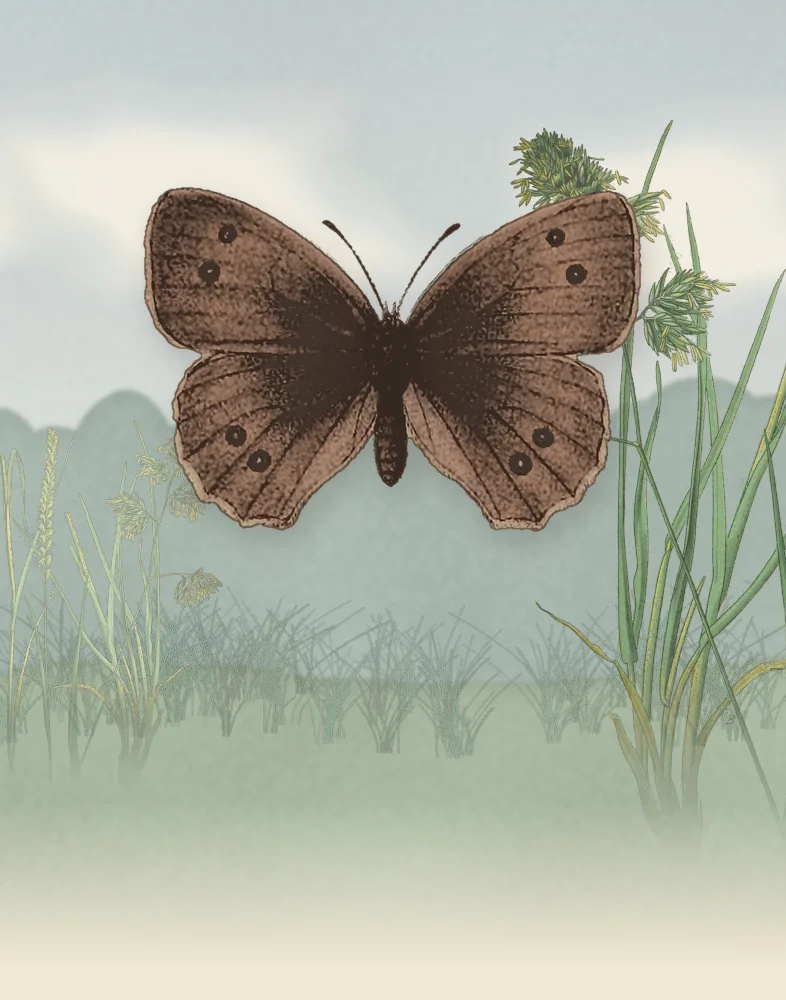
On a grey July afternoon, when the sun has gone in and the other butterflies have settled, one dark brown butterfly goes on bobbing along the edge of the wood. It's a Ringlet, one of the few butterflies that flies happily under cloud.
How to recognise it
- Size: medium, with a wingspan of about 48 to 52 millimetres.
- Above: a deep, even chocolate brown. Fresh from the chrysalis, it's almost black and velvety, with a fine white fringe around each wing.
- Beneath: the rings that give it its name, small black spots ringed with yellow and centred with white, on both wings. They vary: some butterflies have large rings stretched into teardrops, others only tiny white dots.
The Meadow Brown flies in the same places and is similar, but it has an orange patch on each forewing; the Ringlet is brown all over.
Why it flies on cloudy days
Butterflies need warmth to fly. The Ringlet's dark wings soak up what warmth there is quickly, so it can take off when paler butterflies can't. Its flight has a gentle, bobbing rhythm, and it feeds especially at bramble and wild privet flowers.
When and where to see it
The Ringlet has one generation a year. It comes out in the second half of June, is at its peak in mid-July, and a few fly into August. It prefers sheltered, damp places where the grass grows lush and tall, in partial shade: woodland rides and edges, clearings, hedgerows, meadows, verges and riverbanks. In the north it uses more open places.
It's found over most of Britain and Ireland, though not in the far north of Scotland. And it's thriving: between 1976 and 2019 its numbers in Britain more than quadrupled, and it has spread in England and Scotland.
Its caterpillar and food plants
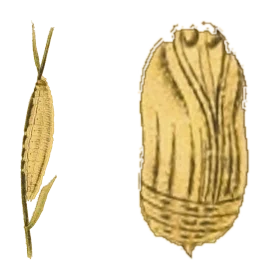
Like the Marbled White, the Ringlet doesn't place its eggs. The female perches on a grass stem and drops them one by one, sometimes flicking them into the air, and they fall to the foot of the grass.
The caterpillar feeds on coarse grasses such as cock's-foot, false brome and tufted hair-grass. It's a creature of the night: it hides at the base of a tussock by day and climbs up to feed after dark. It spends the winter as a small caterpillar, but on a mild winter evening it may wake and feed. In spring it finishes growing, and becomes a chrysalis in a flimsy shelter of a few silk threads at the base of the grass.
The plate it comes from
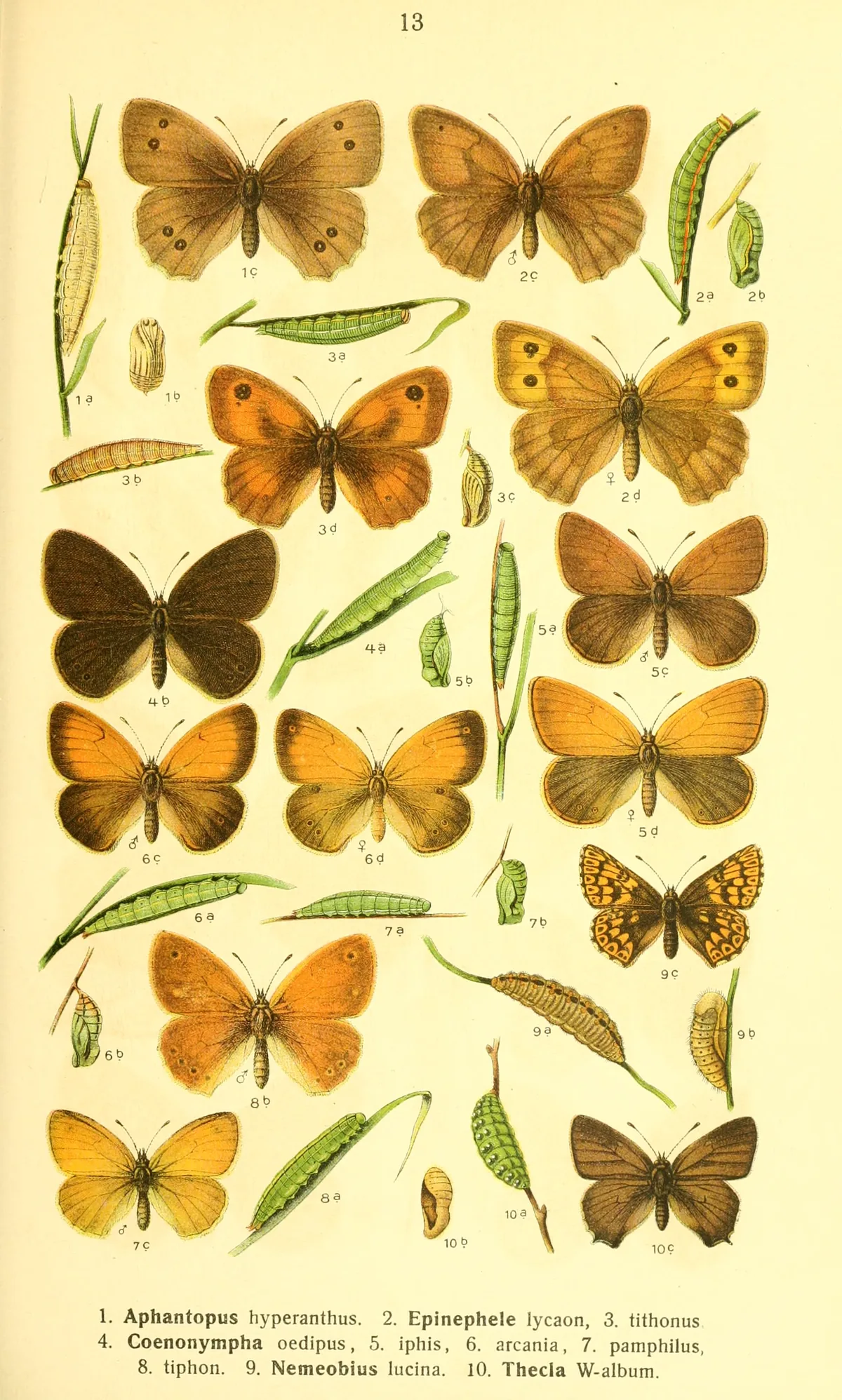
The Ringlet in The Quiet Cabinet is figure 1c of this plate. On its Field Guide page it flies above cock's-foot grass, drawn from Otto Wilhelm Thomé's Flora von Deutschland, Österreich und der Schweiz (1885), under a cloudy sky.
In The Quiet Cabinet
It's one of the twelve species of the Garden, the game's first chapter, which is free. When its case is completed, a felt piano joins the plate's music.
More from the journal

Black-veined White: the butterfly Britain lost
A large white butterfly with black veins, lost from Britain around 1925 for reasons still unknown. Its story, its caterpillars' silk nests, its strange female.

Broad-bordered Yellow Underwing: orange hidden beneath
A brown late-summer moth that hides bright orange hindwings with a broad black border, showing them only in flight. How to know it, and its many forms.

Buff-tip moth: the moth that looks like a broken twig
A moth that rests looking just like a snapped birch twig, whose yellow-and-black caterpillars feed in crowds and strip branches bare. How to know the Buff-tip.