



 The Quiet Cabinet

Argynnis paphia
Silver-washed Fritillary: Britain's largest fritillary
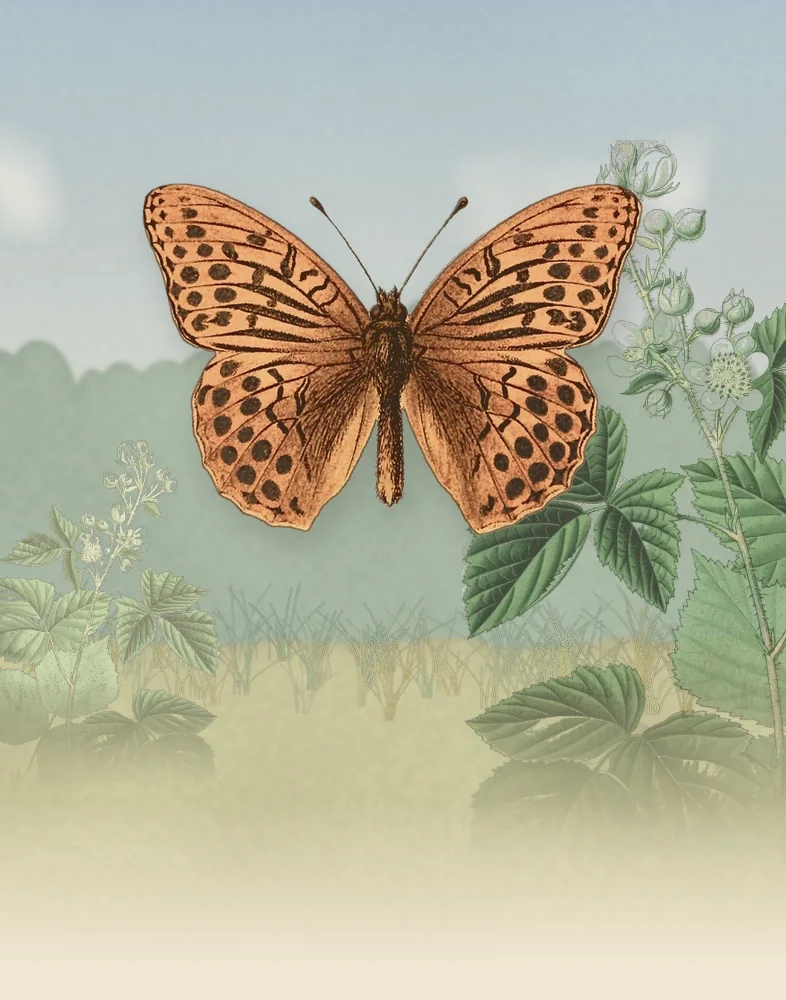
In July, on a sunny ride through an oakwood, a large orange butterfly swoops down out of the trees and settles on a bramble flower: the Silver-washed Fritillary, the largest fritillary in Britain.
How to recognise it
- Size: large, with a wingspan of about 69 to 80 millimetres.
- Shape: pointed forewings.
- The male is bright orange with black spots, and four black streaks along the veins of each forewing: bands of scent scales. The female is paler, with rounder wings and bolder spots.
- Beneath: the hindwing is washed with streaks of silver, which give it its name. You see them when it feeds on bramble.
- A green form: a few females, mostly in the larger colonies of southern England, are a deep olive-green instead of orange. They are called valezina.
When and where to see it
It has one generation a year, flying from late June to the end of August. The males fly powerfully along the rides; much of the butterflies' time is spent in the canopy, feeding on honeydew, and they come down to bramble and thistles. In courtship the female flies straight on while the male loops round and round her.
It lives in broadleaved woodland, especially oak, with sunny rides and glades, and in the wooded lanes of south-west England and Ireland. It's found in England and Wales south of Montgomeryshire, with scattered colonies further north, and widely in Ireland. It declined during the 20th century but has spread noticeably in recent decades: between 1976 and 2019 its numbers in Britain more than tripled.
Eggs in the bark
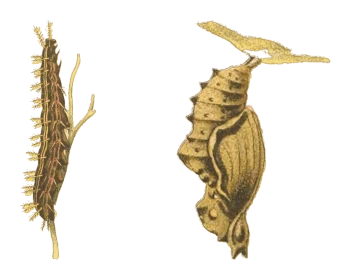
The female searches the woodland floor for common dog-violet, sometimes crawling among the plants. Then, instead of laying on the violets, she flies up and lays a single egg in a crevice in the bark of a tree, usually on the mossy, north-facing side of the trunk, a metre or two above the ground.
When the caterpillar hatches it eats part of its eggshell, moves into a bark crevice, spins a pad of silk and rests there, without eating, from about August until spring: some eight months. Then it climbs down the trunk to the violets below. The chrysalis hangs head down and looks like a shrivelled leaf, with small glittering metallic spines.
The plate it comes from
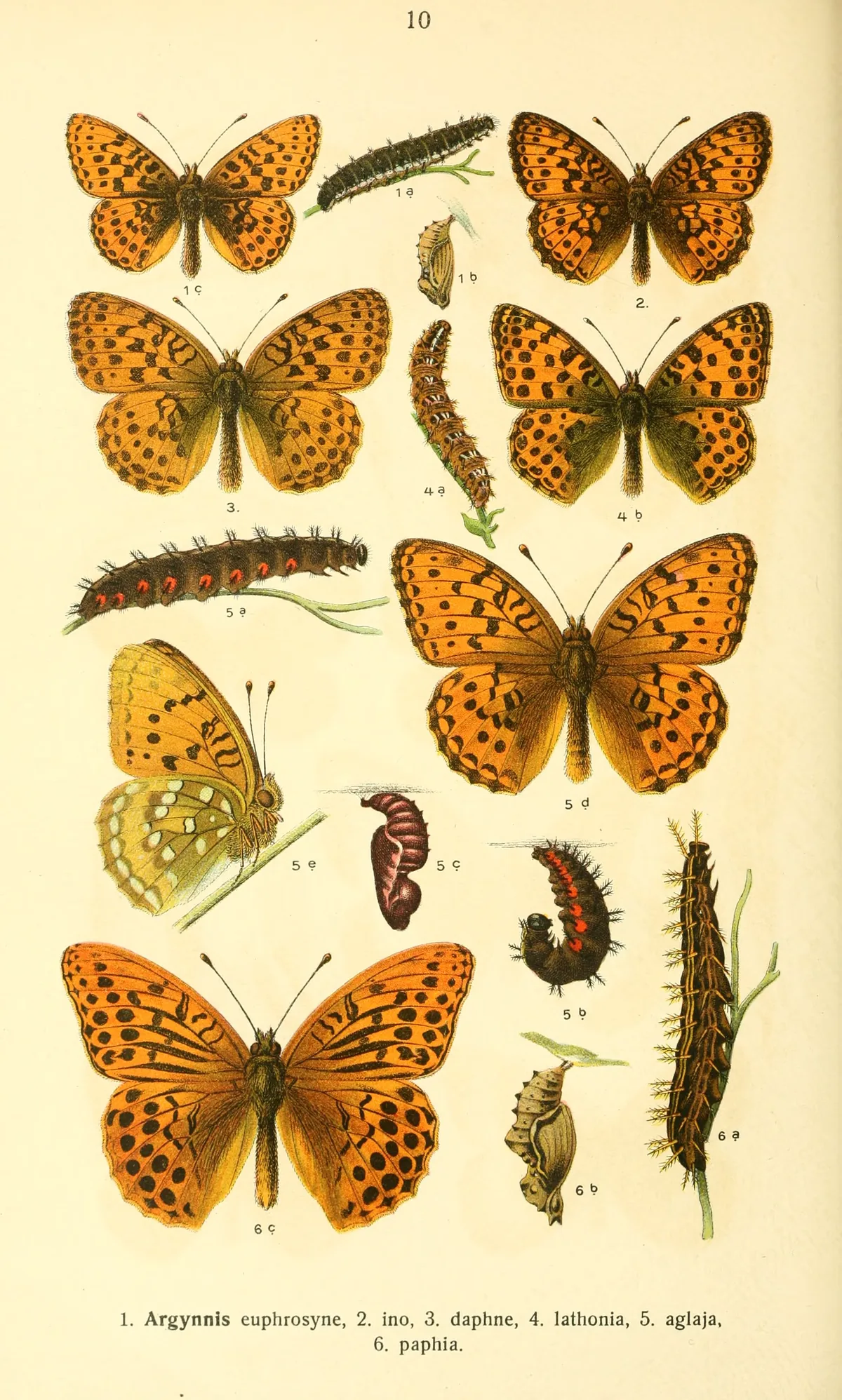
The Silver-washed Fritillary in The Quiet Cabinet is figure 6c of this plate of fritillaries, which it shares with the Dark Green Fritillary. On its Field Guide page it flies above dewberry, a bramble, drawn from Otto Wilhelm Thomé's Flora von Deutschland, Österreich und der Schweiz (1885).
In The Quiet Cabinet
It's one of the thirteen species of the Forest, the game's third chapter, part of the Butterfly Collection. When its case is completed, a marimba joins the plate's music.
Sources
- Butterfly Conservation, Silver-washed Fritillary
- UK Butterflies, Silver-washed Fritillary
More from the journal

Black-veined White: the butterfly Britain lost
A large white butterfly with black veins, lost from Britain around 1925 for reasons still unknown. Its story, its caterpillars' silk nests, its strange female.

Broad-bordered Yellow Underwing: orange hidden beneath
A brown late-summer moth that hides bright orange hindwings with a broad black border, showing them only in flight. How to know it, and its many forms.

Buff-tip moth: the moth that looks like a broken twig
A moth that rests looking just like a snapped birch twig, whose yellow-and-black caterpillars feed in crowds and strip branches bare. How to know the Buff-tip.