



 The Quiet Cabinet

Zygaena filipendulae
Six-spot Burnet: the red-spotted moth that flies by day
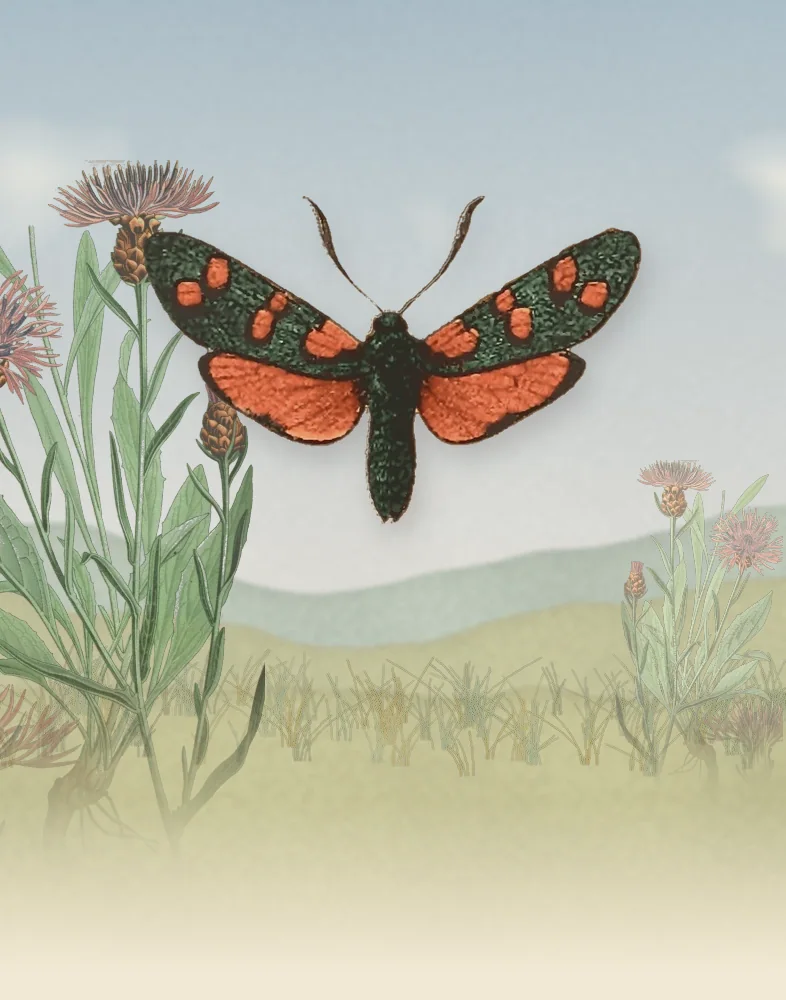
Not every moth flies at night. On a hot July day, over a flowery bank, you may see something buzzing slowly from knapweed to scabious, dark and glossy with bright red spots, in no hurry at all. It's a Six-spot Burnet, a moth, and it has nothing to fear from the birds.
How to recognise it
- Size: a wingspan of about 30 to 40 millimetres.
- The forewings are a dark, metallic green-black, with six red spots on each. It's the only burnet moth in Britain with six.
- The hindwings are red, edged in black.
The spots nearest the wingtip are sometimes joined together, and then it can look like one of the five-spot burnets, so count carefully. Very rarely the red is replaced by yellow.
A moth of the sunshine
The Six-spot Burnet flies by day, on hot, sunny days from June to August, with a slow, buzzing flight. It feeds at thistles, knapweeds and scabious, and lives in flowery grassland of every kind: downland, cliff tops, woodland rides, road verges and sand dunes. It's the commonest and most widespread burnet moth in the UK, found across England, Wales and Ireland, more on the coast in Scotland, and out to the Outer Hebrides. Beyond Britain it ranges across most of Europe and east into Anatolia, the Caucasus and the Levant, up to 2,000 metres in the mountains.
Bright colours, and poison
The burnet's colours are a warning, and the warning is true. At every stage of its life, egg, caterpillar, cocoon and moth, it contains cyanide, and when it's attacked it releases a drop of fluid containing it. Birds and lizards learn to leave the red and black alone, so the moth can afford to fly slowly in the open, where everyone can see it.
Its caterpillar and cocoon
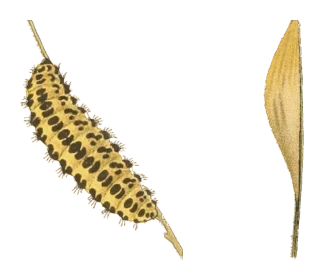
The caterpillar is plump and slightly hairy, usually pale green with rows of black spots. It feeds mostly on bird's-foot trefoil, the same plant as the Common Blue's caterpillar, and spends the winter as a caterpillar. In early summer it climbs a grass stem and spins a papery cocoon there, in which it turns into a pupa.
The plate it comes from
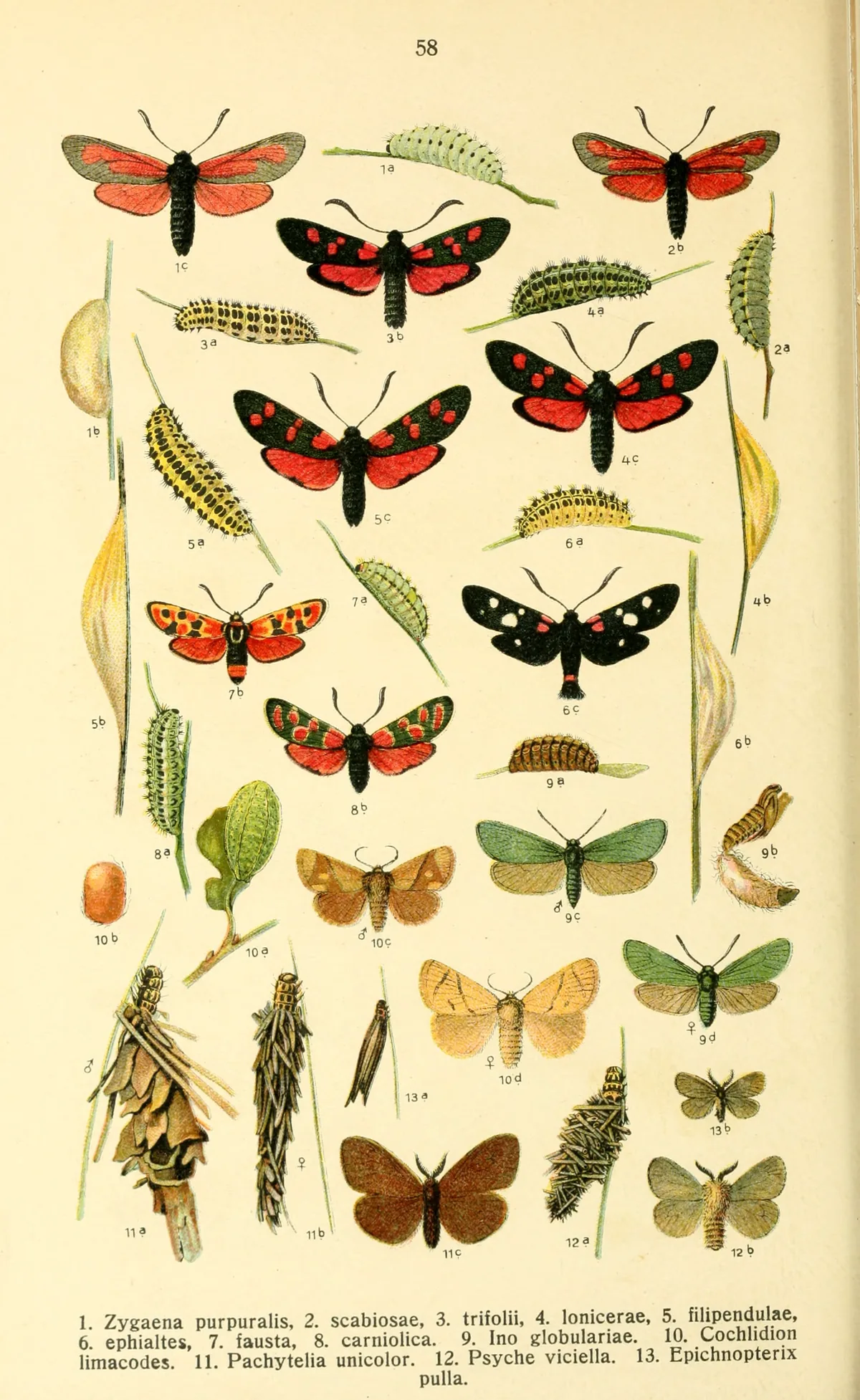
The Six-spot Burnet in The Quiet Cabinet is figure 5c of this plate of burnets and foresters. On its Field Guide page it flies above brown knapweed, drawn from Otto Wilhelm Thomé's Flora von Deutschland, Österreich und der Schweiz (1885).
In The Quiet Cabinet
It's one of the twelve species of the Garden, the game's first chapter, which is free, and with the Hummingbird Hawk-moth one of its two day-flying moths. When its case is completed, a felt piano joins the plate's music.
Sources
- Butterfly Conservation, Six-spot Burnet
- UKMoths, Six-spot Burnet
- Wikipedia, Zygaena filipendulae
More from the journal

Black-veined White: the butterfly Britain lost
A large white butterfly with black veins, lost from Britain around 1925 for reasons still unknown. Its story, its caterpillars' silk nests, its strange female.

Broad-bordered Yellow Underwing: orange hidden beneath
A brown late-summer moth that hides bright orange hindwings with a broad black border, showing them only in flight. How to know it, and its many forms.

Buff-tip moth: the moth that looks like a broken twig
A moth that rests looking just like a snapped birch twig, whose yellow-and-black caterpillars feed in crowds and strip branches bare. How to know the Buff-tip.