



 The Quiet Cabinet

Coenonympha pamphilus
Small Heath butterfly: the smallest of the browns
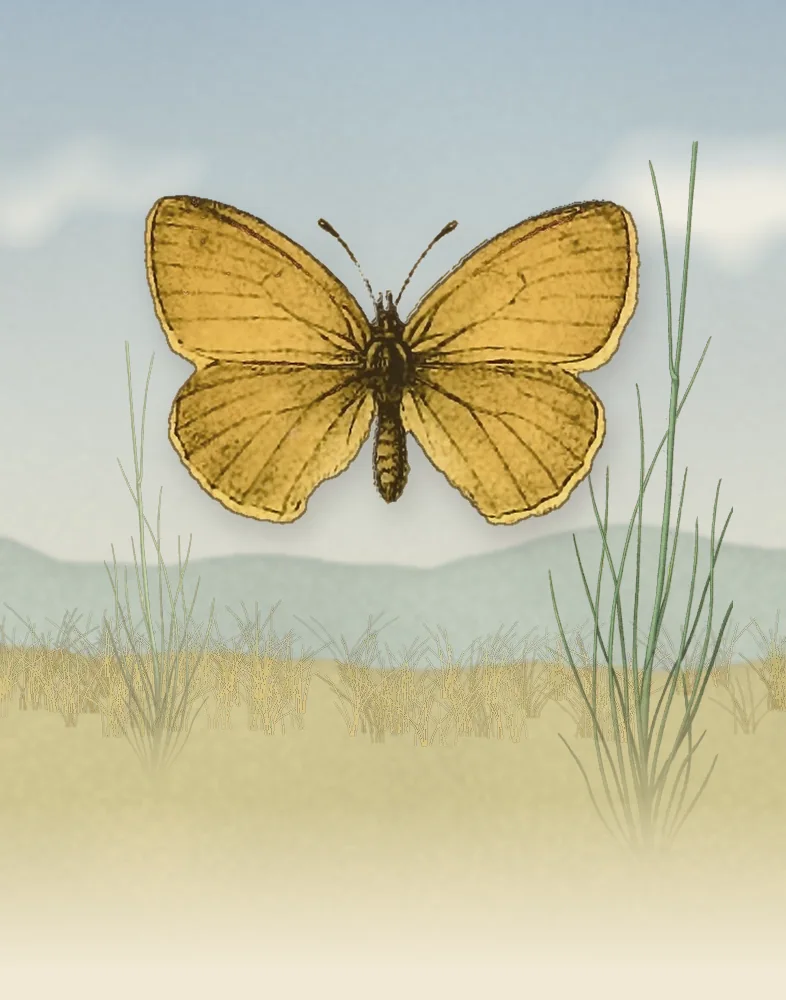
Walk through short, dry grass on a sunny day and a small orange-brown butterfly may flutter up at your feet, never rising more than a metre, and drop again a few steps on. It's a Small Heath, the smallest of Britain's browns.
How to recognise it
- Size: a wingspan of about 33 to 38 millimetres, closer to a Common Blue or a skipper than to its relative the Meadow Brown.
- At rest: it always settles with its wings closed. The forewing beneath has a small dark eyespot near the tip, which may serve as a decoy for a pecking bird; the hindwing is banded brown, grey and cream.
- Hiding: in dull weather and at night it tucks the forewings down behind the hindwings, and its greyish underside blends into the grass.
When and where to see it
The Small Heath flies only in sunshine. In the south it may be seen from late April or May until September, in two or sometimes three generations; in the north there is one. It lives in discrete colonies and rarely travels far.
It needs dry, well-drained grassland where the turf is short and sparse: heaths, downland, dunes, road verges, quarries and railway banks. It is found over most of Britain and Ireland, though not on Orkney, Shetland or the mountains.
The males hold territories, perching and patrolling. When two meet they fly up together a few metres, briefly, then part.
Its caterpillar and food plants
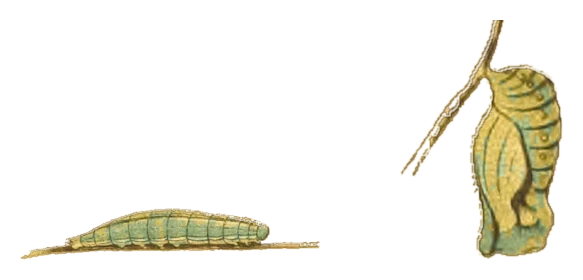
The female lays her eggs one at a time on a blade of grass; the egg is very large for such a small butterfly. The caterpillar feeds on fine grasses, fescues, bents and meadow-grasses. It hides at the foot of a tuft by day and climbs to the blade tips to feed at night, and it spends the winter as a caterpillar, still feeding in mild weather. The chrysalis hangs head down from a grass stem.
How it's faring
The Small Heath is still widespread, but many colonies have been lost. Between 1976 and 2019 its numbers in Britain fell by about half, and it was found in about two-thirds fewer places. It is now listed as Vulnerable on Great Britain's Red List.
The plate it comes from
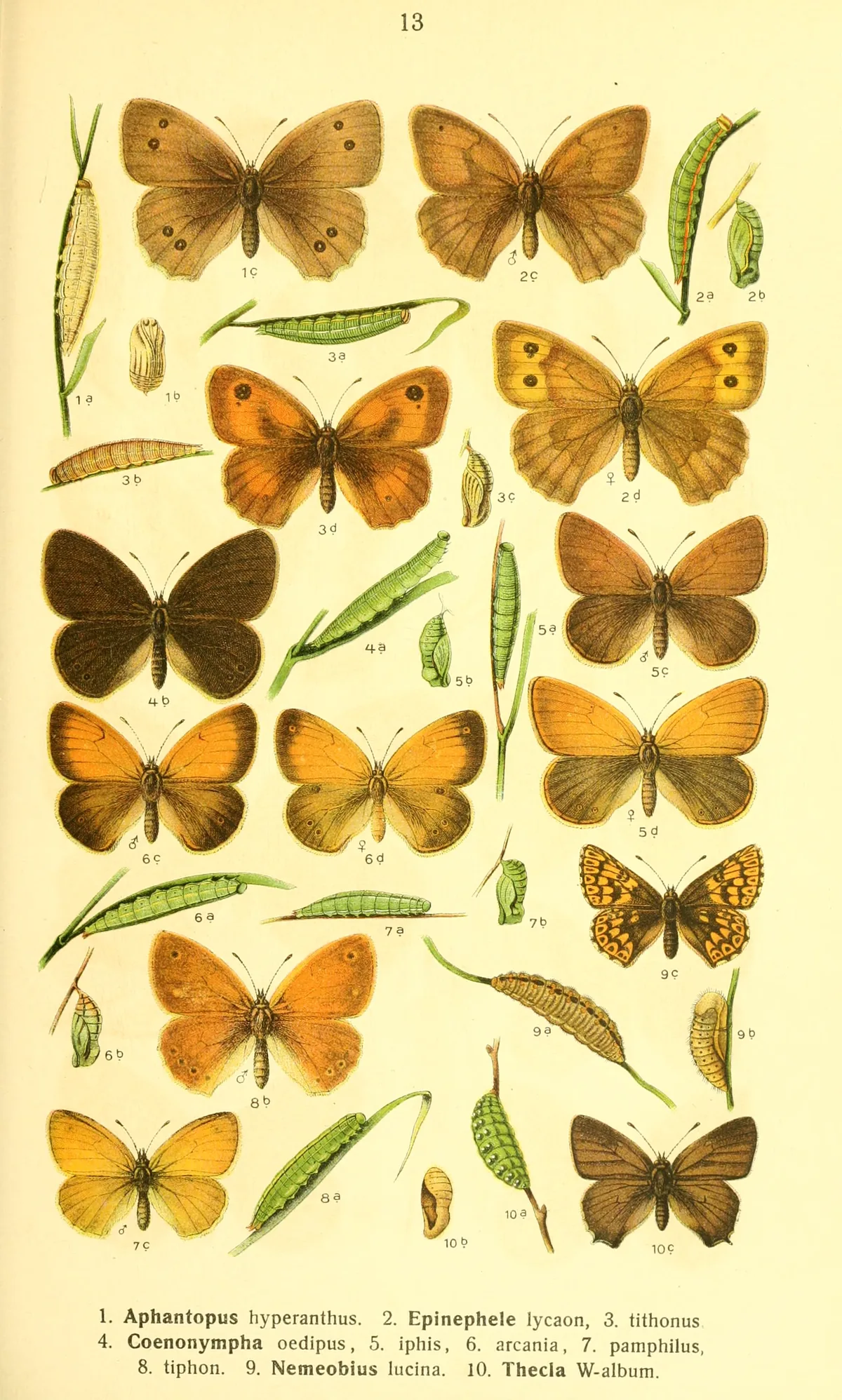
The Small Heath in The Quiet Cabinet is figure 7c, Eckstein's male, from the same plate as the Ringlet, the Gatekeeper and the Duke of Burgundy, one of the Meadow's two treasures. On its Field Guide page it flies above sheep's fescue, drawn from Otto Wilhelm Thomé's Flora von Deutschland, Österreich und der Schweiz (1885).
In The Quiet Cabinet
It's one of the thirteen species of the Meadow, the game's second chapter, part of the Butterfly Collection. When its case is completed, a music box joins the plate's music.
Sources
- Butterfly Conservation, Small Heath
- UK Butterflies, Small Heath
More from the journal

Black-veined White: the butterfly Britain lost
A large white butterfly with black veins, lost from Britain around 1925 for reasons still unknown. Its story, its caterpillars' silk nests, its strange female.

Broad-bordered Yellow Underwing: orange hidden beneath
A brown late-summer moth that hides bright orange hindwings with a broad black border, showing them only in flight. How to know it, and its many forms.

Buff-tip moth: the moth that looks like a broken twig
A moth that rests looking just like a snapped birch twig, whose yellow-and-black caterpillars feed in crowds and strip branches bare. How to know the Buff-tip.