



 The Quiet Cabinet

Aglais urticae
Small Tortoiseshell butterfly: nettles and winter sleep

For many people the Small Tortoiseshell is simply "the garden butterfly": the orange one on the buddleia in August, the one that wakes on the window sill on a sunny day in March. It's found from city centres to mountain tops, all over Britain and Ireland, as far north as Orkney and Shetland.
How to recognise it
- Size: medium, with a wingspan of about 50 to 56 millimetres.
- Above: bright orange, with black and yellow patches along the front of each forewing and a row of small blue crescents around the edges of all four wings.
- Beneath: dull, smoky brown, the colour of bark or a dead leaf. That's its disguise for the winter.
- The sexes look almost the same.
A winter asleep indoors
The Small Tortoiseshell spends the winter as a butterfly. In late summer it feeds hard on garden flowers to lay down fat, then finds a cool, dry place to sleep: often a shed, garage or barn, with others of its kind, or a hollow tree or a woodpile. Warmth can wake it at any time, even in late December, but most come out at the end of March or the start of April, which makes it one of the first butterflies of spring.
In the south there are usually two generations a year; in the north, one.
A courtship you can hear
In the afternoons the males wait in the sun near patches of nettles. When a female passes, a male follows close behind her and drums on her hindwings with his antennae, softly enough that, close by, you can just hear it. She may fly on a little, and he follows, again and again; a courtship can last for hours, and the pair often mate in the early evening and stay together until the next morning.
Its caterpillars and food plant
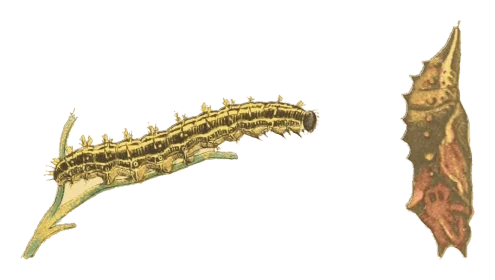
The female chooses a sunny patch of fresh, young nettles and lays her green eggs in a heap beneath a leaf near the top of a stem, up to 80 at a time. The caterpillars hatch together and spin a silk tent at the top of the nettle, where they feed and bask. As they grow they move on and build new tents, leaving a trail of old ones behind them. Threatened, a whole group jerks from side to side at once.
When fully grown, each one wanders off alone, sometimes a long way, to hang head down from a fence or a ledge and become a chrysalis, which may be gilded with a metallic sheen.
Why it has grown scarcer
The Small Tortoiseshell is still found almost everywhere it ever was, but there are far fewer of them: in Britain, its numbers fell by about 79 per cent between 1976 and 2019, most of all in the south. The cause isn't yet known. One idea under study is a parasitic fly, Sturmia bella, which lays its eggs on nettle leaves where the caterpillars will eat them. A sunny corner of nettles left uncut, and late-summer flowers for the butterflies to feed on before winter, both help.
The plate it comes from
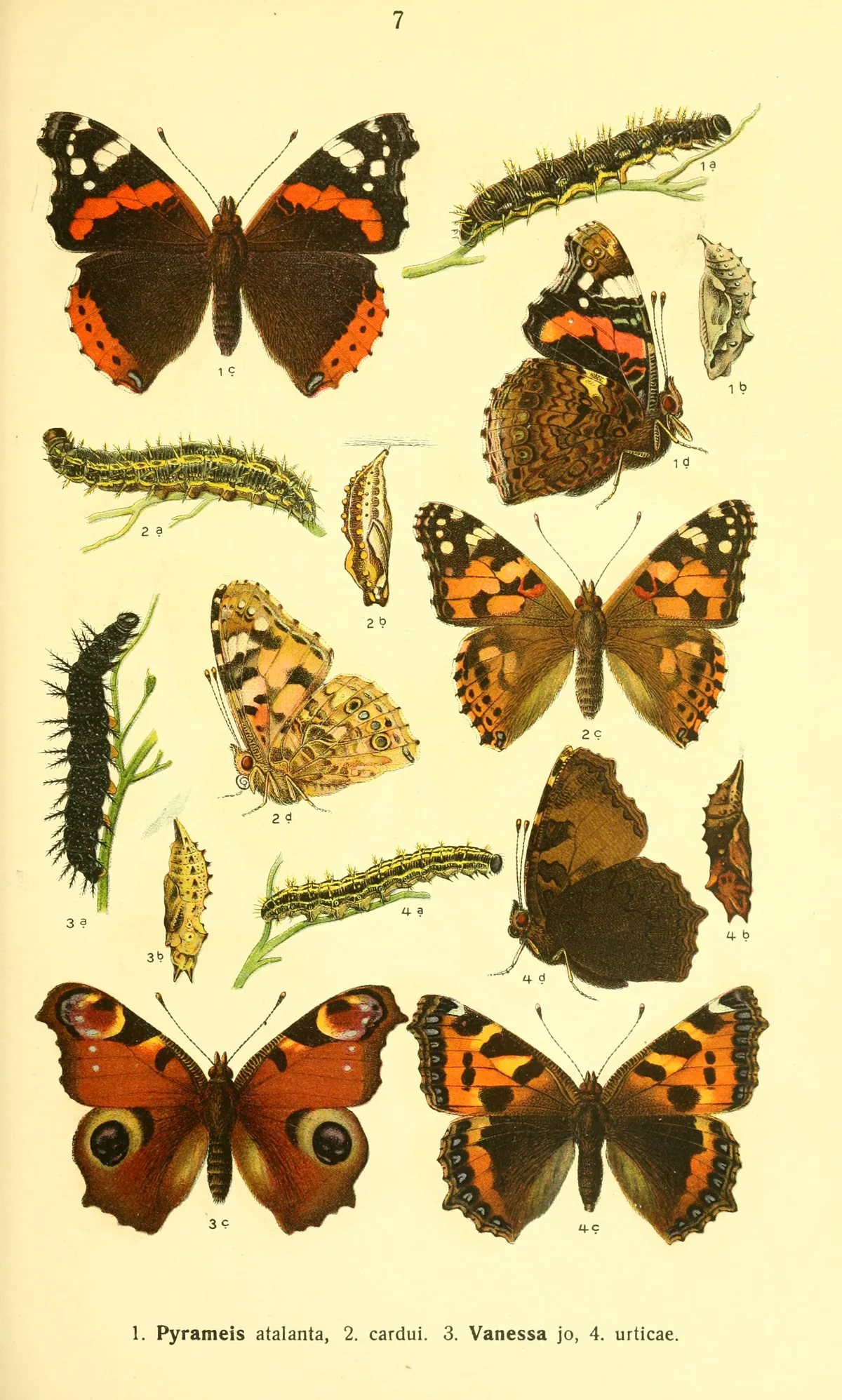
The Small Tortoiseshell in The Quiet Cabinet is figure 4c of this plate, which it shares with three close relatives: the Red Admiral, the Painted Lady and the Peacock. On its Field Guide page it flies above nettles, drawn from Otto Wilhelm Thomé's Flora von Deutschland, Österreich und der Schweiz (1885).
In The Quiet Cabinet
It's one of the twelve species of the Garden, the game's first chapter, which is free. When its case is completed, a marimba joins the plate's music.
Sources
- Butterfly Conservation, Small Tortoiseshell
- UK Butterflies, Small Tortoiseshell
More from the journal

Black-veined White: the butterfly Britain lost
A large white butterfly with black veins, lost from Britain around 1925 for reasons still unknown. Its story, its caterpillars' silk nests, its strange female.

Broad-bordered Yellow Underwing: orange hidden beneath
A brown late-summer moth that hides bright orange hindwings with a broad black border, showing them only in flight. How to know it, and its many forms.

Buff-tip moth: the moth that looks like a broken twig
A moth that rests looking just like a snapped birch twig, whose yellow-and-black caterpillars feed in crowds and strip branches bare. How to know the Buff-tip.