



 The Quiet Cabinet

Papilio machaon
Swallowtail butterfly: Britain's largest, in the Broads
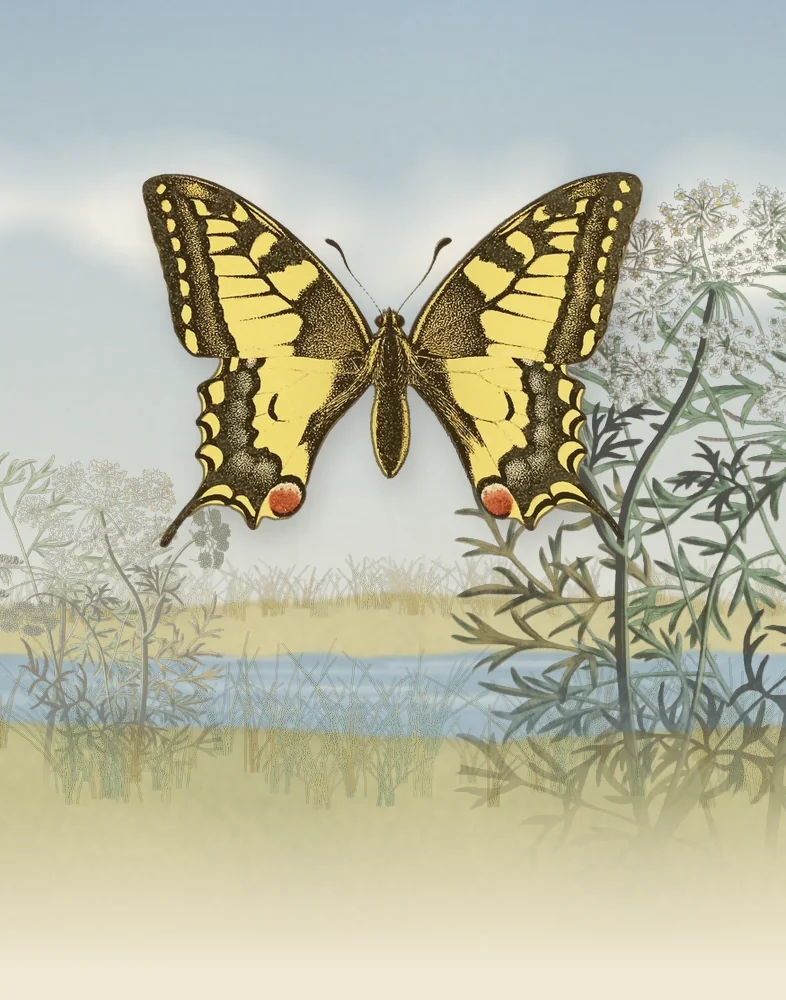
On a June day in the Norfolk Broads, something large and yellow powers over the reeds, much faster and stronger than any garden butterfly. It's a Swallowtail, the largest native butterfly in Britain, and the Broads are the only place in the country where it lives.
How to recognise it
- Size: large, with a wingspan of 76 to 83 millimetres in the male and 86 to 93 in the female.
- Colour: pale yellow, with strong black veins and a broad black band along the edges, dusted with blue.
- The tails: each hindwing ends in a short tail, like a swallow's, which gives it its name, and above each tail is a small red eyespot.
Even feeding, it keeps its wings beating, as if it can't quite be still.
Two Swallowtails
The British Swallowtail is a race of its own, called britannicus: a little darker than its European cousins, and a fenland specialist. It breeds only in open fens and marshes, usually dominated by sedge or reed and cut from time to time, where its food plant grows tall.
Now and then a Swallowtail of the continental race, gorganus, crosses the Channel and turns up somewhere else, most often in grassland near the south coast of England. It's far less fussy, laying its eggs on wild carrot and other plants of the carrot family.
When to see it
The British Swallowtail flies from late May to early July, usually in one generation, with a small second one in some summers. It feeds at pink and mauve flowers, such as ragged-robin and thistles. Reserves in the Broads such as Hickling Broad, Strumpshaw Fen and How Hill are among the places to look.
Its caterpillar and food plant
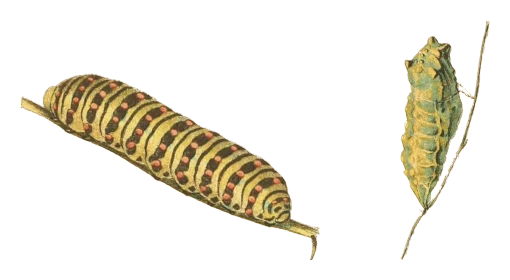
In the Broads the caterpillar eats only one plant: milk-parsley, a tall member of the carrot family that grows in the fens. The female lays her yellow eggs one at a time, on tall, flowering plants that stand out above the rest.
The young caterpillar is black and white, and looks like a bird dropping. As it grows it changes completely, to bright green banded with black and spotted with orange. Disturbed, it pushes out a forked orange organ from behind its head, called an osmeterium, which gives off a strong smell, a little like rotting pineapple.
When it's fully grown it leaves the plant and climbs a reed or woody stem nearby. There it becomes a chrysalis, held upright by a silk girdle, green-yellow or brown, and it stays that way all winter, until the butterfly comes out the following May or June.
A protected butterfly
The British Swallowtail is rare and listed as Vulnerable on Great Britain's Red List, and it's fully protected by law. It depends on the fens being cared for: cut regularly enough to stay open, so that the milk-parsley can grow tall in the light. With that care, its numbers have been stable.
The plate it comes from
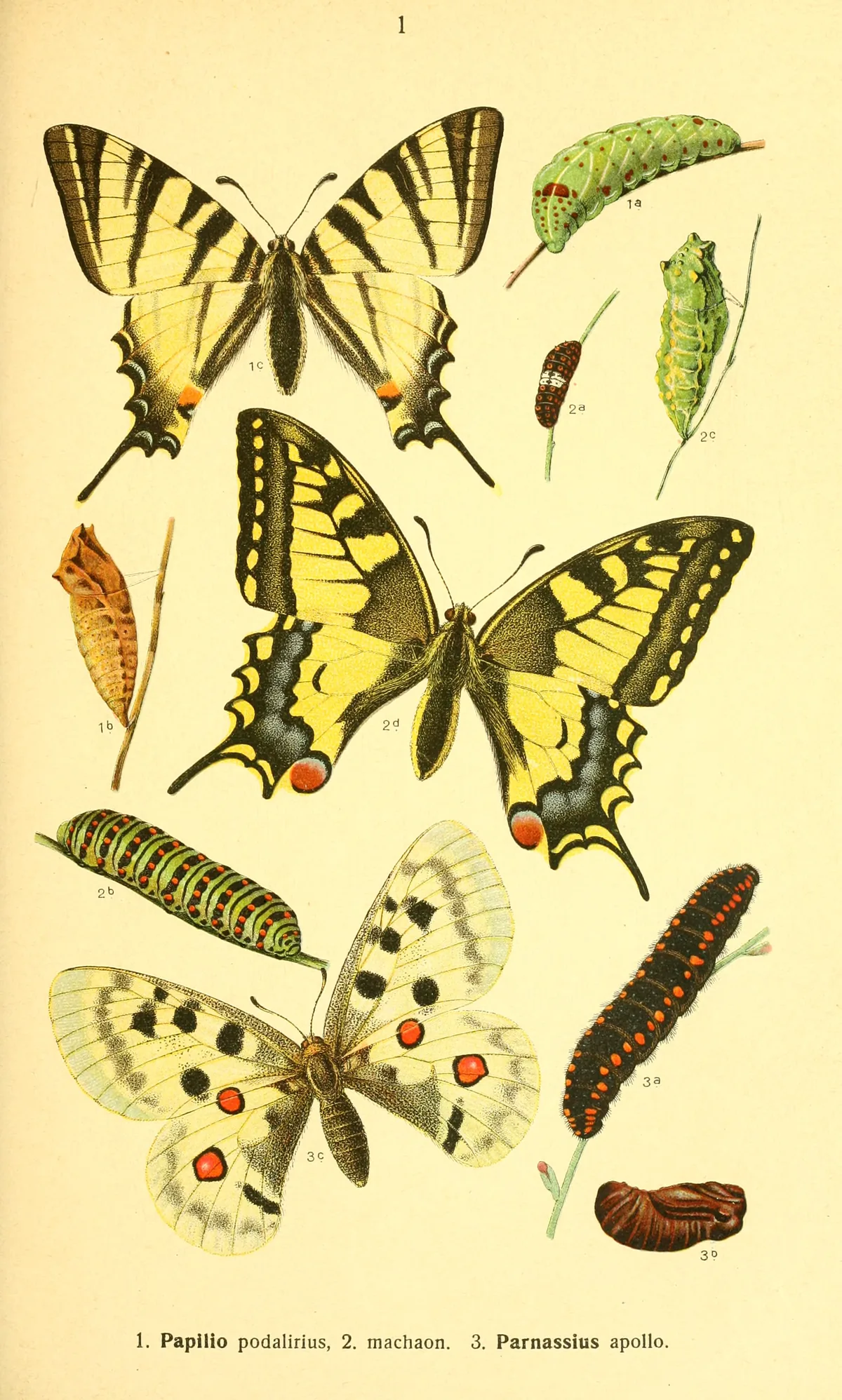
The Swallowtail in The Quiet Cabinet is figure 2d, Eckstein's male. On its Field Guide page it flies above milk-parsley, drawn from the Dutch Flora Batava, where the plant is named Thysselinum palustre. The Apollo, from the same plate, is one of the Garden's two treasures.
In The Quiet Cabinet
It's one of the twelve species of the Garden, the game's first chapter, which is free. When its case is completed, a flute joins the plate's music.
Sources
- Butterfly Conservation, Swallowtail
- UK Butterflies, Swallowtail
More from the journal

Black-veined White: the butterfly Britain lost
A large white butterfly with black veins, lost from Britain around 1925 for reasons still unknown. Its story, its caterpillars' silk nests, its strange female.

Broad-bordered Yellow Underwing: orange hidden beneath
A brown late-summer moth that hides bright orange hindwings with a broad black border, showing them only in flight. How to know it, and its many forms.

Buff-tip moth: the moth that looks like a broken twig
A moth that rests looking just like a snapped birch twig, whose yellow-and-black caterpillars feed in crowds and strip branches bare. How to know the Buff-tip.