



 The Quiet Cabinet

Aglia tau
Tau Emperor moth: the T in the eyespots of the beechwoods
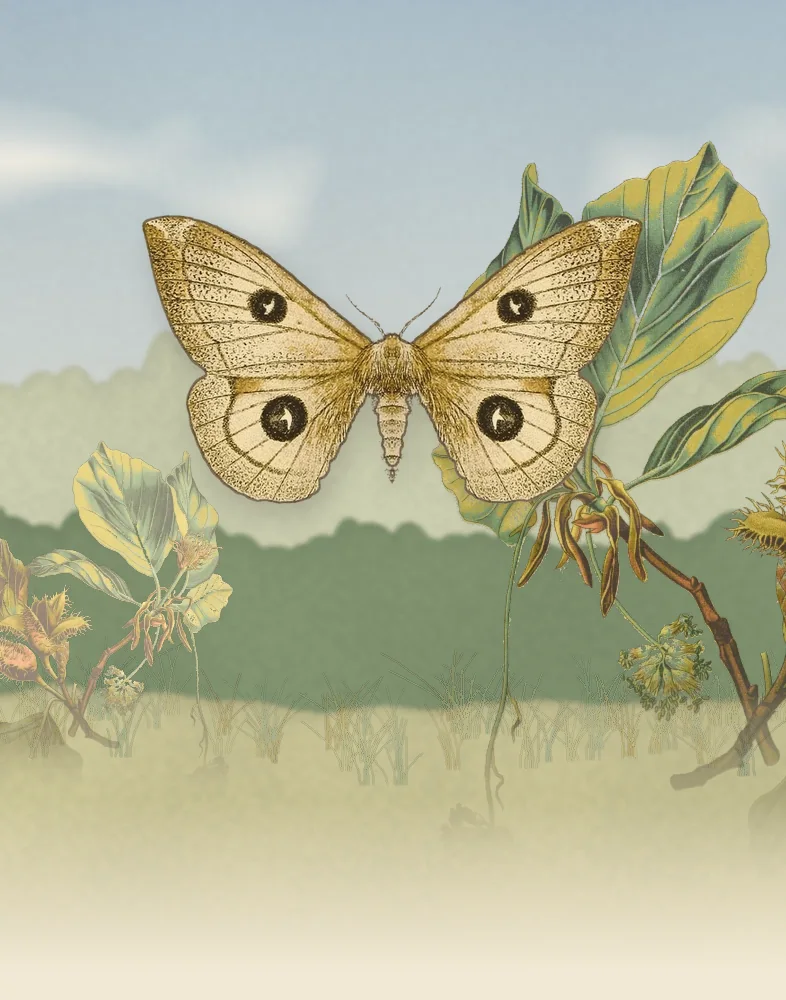
In April, in the beechwoods of Germany and much of Europe, large moths zigzag low between the grey trunks in daylight. They are male Tau Emperors, searching for females, and in the right wood they are a common sight.
How to recognise it
- Size: large, with a wingspan of about 60 to 84 millimetres.
- Eyespots: a dark eyespot on each of its four wings.
- The T: inside each eyespot is a small white mark shaped like a T, the Greek letter tau, which gives the moth its name. You can see it in Eckstein's figure.
- A dark form, called melaina, also occurs.
A moth of spring
The Tau Emperor has one generation a year. The moths fly from late March to late May, and higher in the mountains, at about 1,500 metres, into June. The males fly near the ground by day; the females fly at night. The adults have no mouth and cannot feed: they live only to breed, and the female dies once her eggs are laid.
It lives in forests with beech, and some without, from northern Spain across Europe and temperate Asia to the Pacific. It isn't found in the British Isles, in northern Scandinavia or in the far south of the Mediterranean. It's not endangered, though dark conifer plantings make many woods poorer for it.
Its caterpillar and food plants
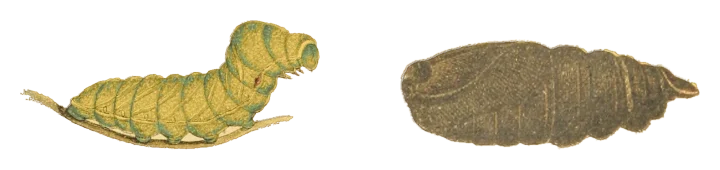
The female lays her eggs on trunks and branches, and they hatch in about three weeks. The caterpillars feed from May to July, chiefly on beech, and also on lime, elm, oak and birch. When fully grown they go down to the forest floor and become a chrysalis in a loose cocoon in the leaf litter, where it waits through the winter until the warmth of March.
The plate it comes from
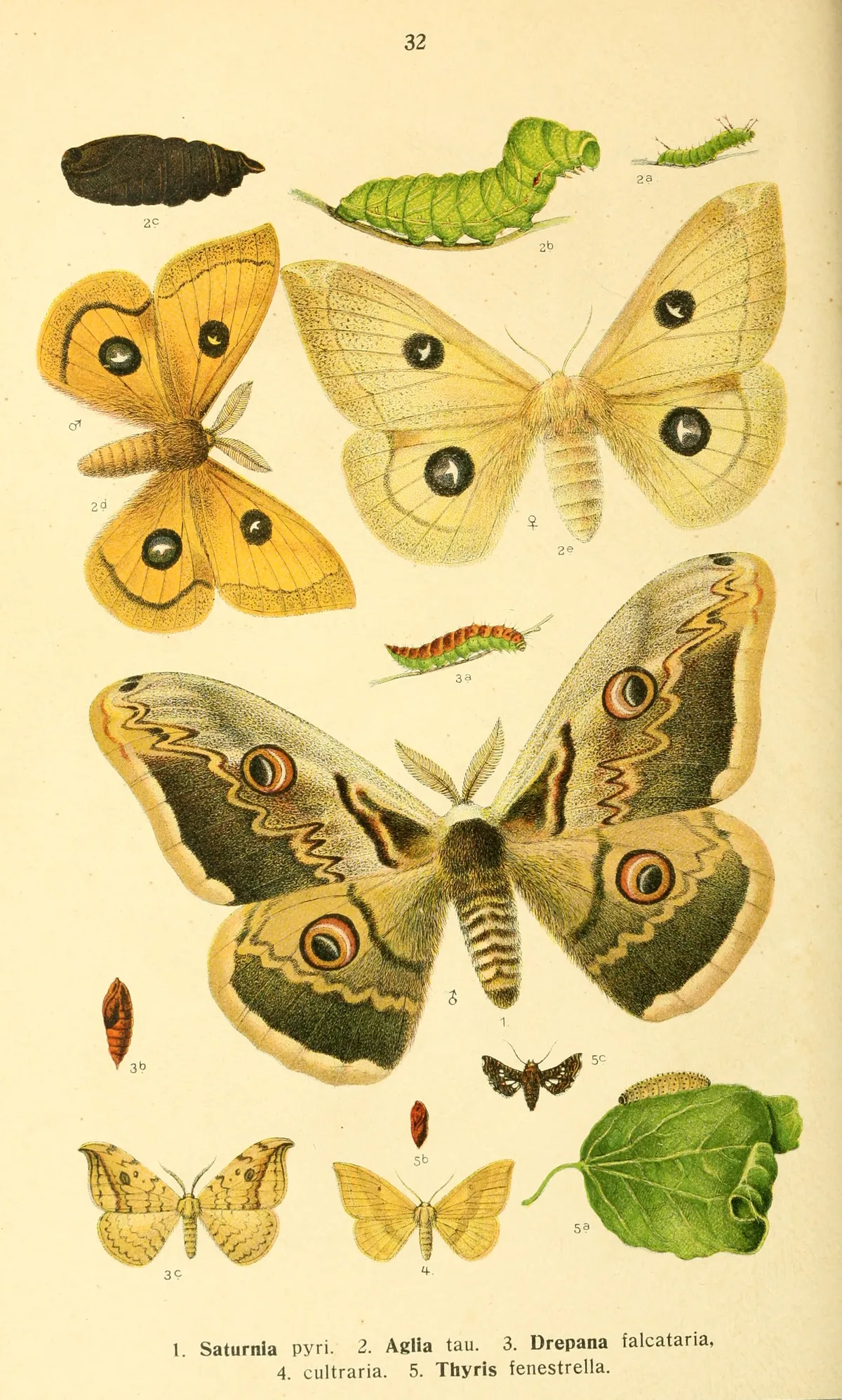
The Tau Emperor in The Quiet Cabinet is figure 2e, Eckstein's female. The Great Peacock Moth, figure 1 of the same plate, is one of the Forest's two treasures. On its Field Guide page the Tau Emperor flies above beech, drawn from Otto Wilhelm Thomé's Flora von Deutschland, Österreich und der Schweiz (1885).
In The Quiet Cabinet
It's one of the thirteen species of the Forest, the game's third chapter, part of the Butterfly Collection. When its case is completed, a music box joins the plate's music.
More from the journal

Black-veined White: the butterfly Britain lost
A large white butterfly with black veins, lost from Britain around 1925 for reasons still unknown. Its story, its caterpillars' silk nests, its strange female.

Broad-bordered Yellow Underwing: orange hidden beneath
A brown late-summer moth that hides bright orange hindwings with a broad black border, showing them only in flight. How to know it, and its many forms.

Buff-tip moth: the moth that looks like a broken twig
A moth that rests looking just like a snapped birch twig, whose yellow-and-black caterpillars feed in crowds and strip branches bare. How to know the Buff-tip.