



 The Quiet Cabinet

Papilio glaucus
Tiger Swallowtail: the first American butterfly ever drawn
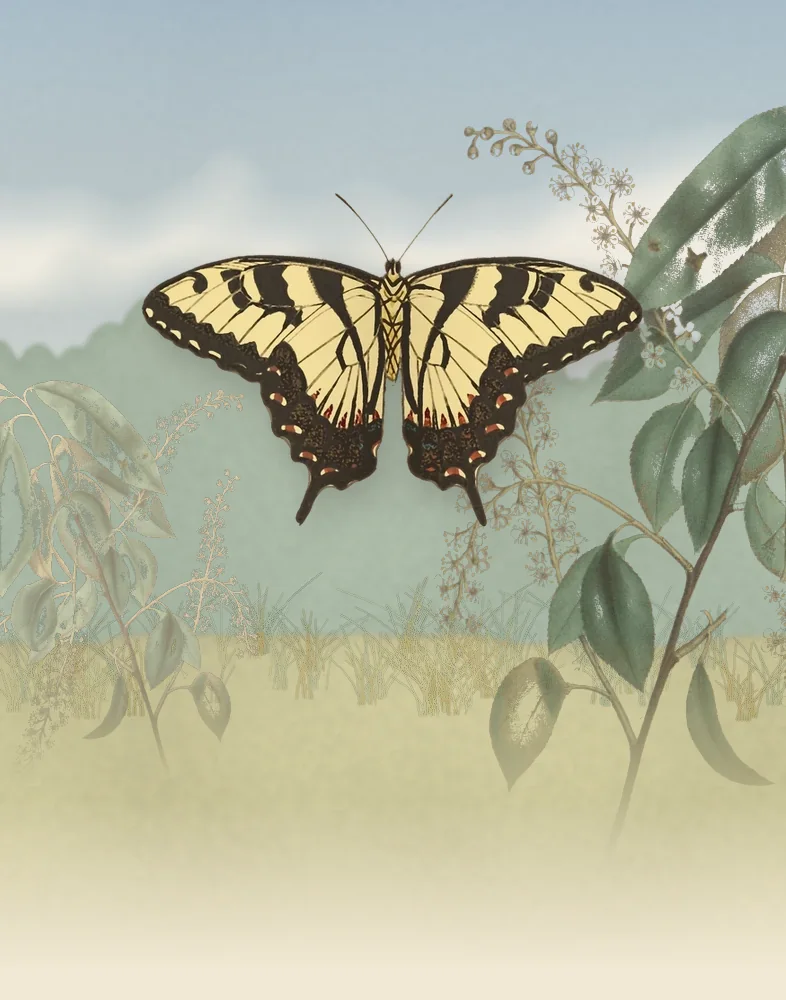
In 1587, on Sir Walter Raleigh's third expedition to Virginia, the artist John White painted a large yellow butterfly striped with black. He called it Mamankanois. It was the first North American butterfly anyone is known to have drawn: the Eastern Tiger Swallowtail.
How to recognise it
- Size: large, with a wingspan of about 7.9 to 14 centimetres; females are larger, and southern butterflies bigger than northern ones.
- The male is yellow, with four black "tiger stripes" across each forewing.
- The female comes in two forms: a yellow one like the male, with blue on the hindwings, and a dark form, almost black or dark grey.
The dark females are copying the Pipevine Swallowtail, a butterfly poisonous to birds, and so gain some protection. They are commoner in the south.
When and where to see it
It flies from February to November in the south, and from May to September in the north, in two or three generations. It lives in deciduous woods, fields, along rivers and roadsides, and in gardens, across the eastern United States, from southern Vermont to Florida and west to Texas and the Great Plains. It is secure, and not considered threatened.
Its caterpillar and food plants
Its caterpillar eats the leaves of more kinds of tree than almost any other swallowtail's: tulip tree, sweet bay magnolia and wild black cherry among them. Young, it is brown with a white saddle, looking like a bird dropping; later it turns green, with false eyes on its front end, and when threatened it can push out a forked scent organ behind its head. The chrysalis spends the winter where winters are cold.
The plate it comes from
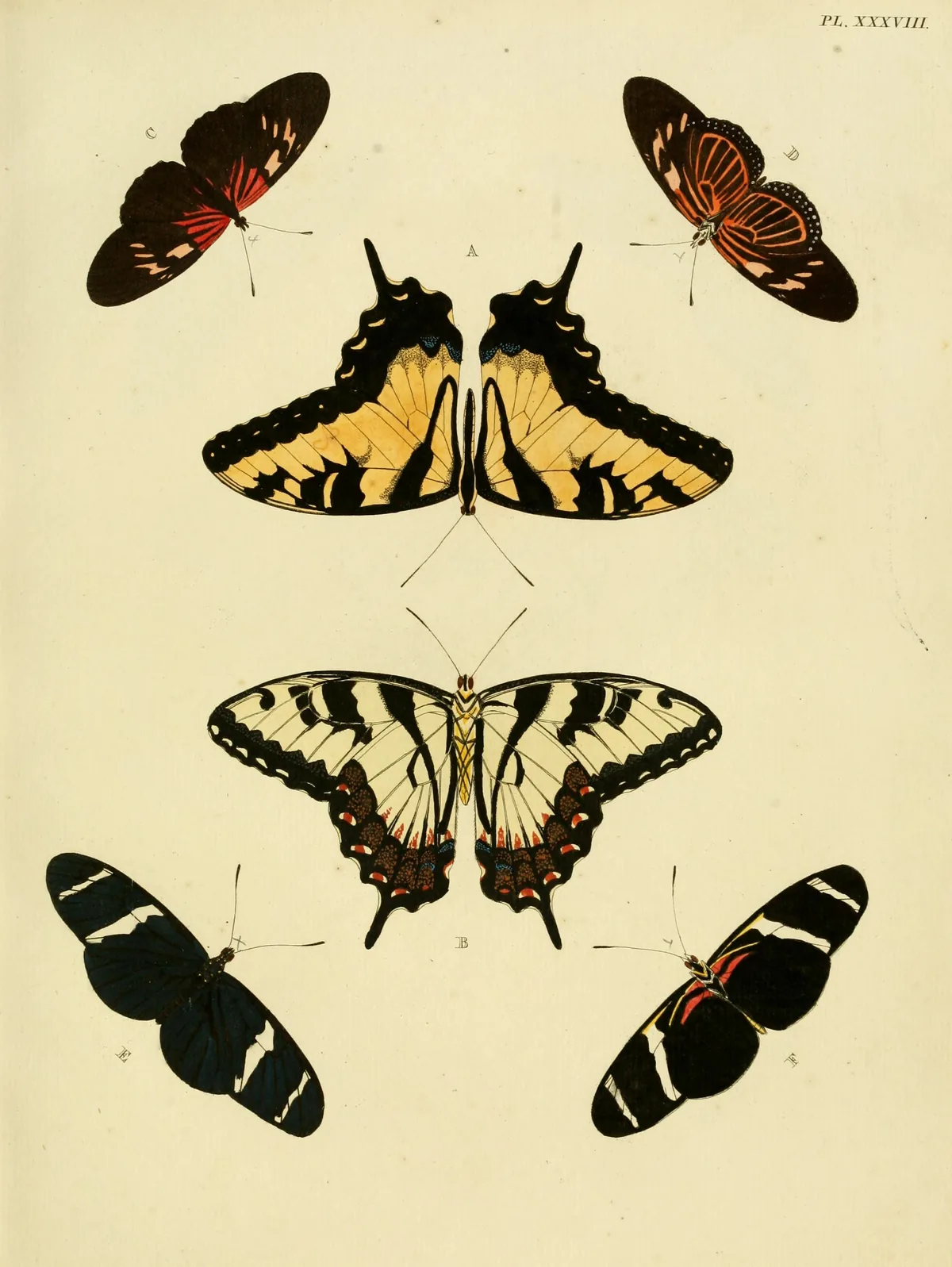
The Tiger Swallowtail in The Quiet Cabinet is Cramer's figure B, engraved and coloured by hand in Amsterdam in the 1770s; Cramer drew adults only, so its Field Guide page has no caterpillar. It flies above black cherry, drawn from John Carson's Illustrations of Medical Botany (1847).
In The Quiet Cabinet
It's one of the thirteen species of the Curiosity Cabinet, the game's last chapter, part of the Butterfly Collection. When its case is completed, a flute joins the plate's music.
Sources
- Wikipedia, Papilio glaucus
More from the journal

Black-veined White: the butterfly Britain lost
A large white butterfly with black veins, lost from Britain around 1925 for reasons still unknown. Its story, its caterpillars' silk nests, its strange female.

Broad-bordered Yellow Underwing: orange hidden beneath
A brown late-summer moth that hides bright orange hindwings with a broad black border, showing them only in flight. How to know it, and its many forms.

Buff-tip moth: the moth that looks like a broken twig
A moth that rests looking just like a snapped birch twig, whose yellow-and-black caterpillars feed in crowds and strip branches bare. How to know the Buff-tip.