



 The Quiet Cabinet

Papilio ulysses
Ulysses Swallowtail: the electric-blue swallowtail
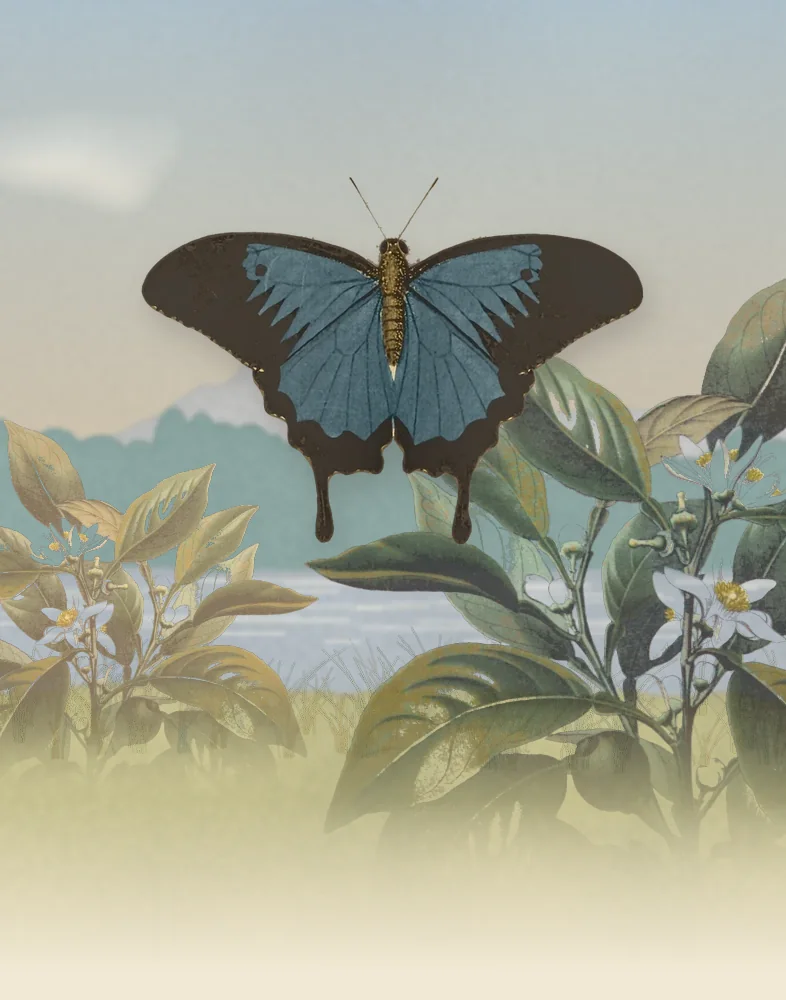
In the rainforests of north Queensland a large butterfly flashes past, a sudden burst of electric blue that can be seen hundreds of metres away, and then vanishes as it settles. It's the Ulysses Swallowtail, also called the Blue Emperor.
How to recognise it
- Size: large, with a wingspan of about 10 to 14 centimetres, depending on the island it comes from.
- Above: an iridescent electric blue, bordered in black, with a tail on each hindwing.
- Beneath: a quiet, cryptic black and brown. When it perches with its wings closed, the blue disappears.
- The female has small blue crescents on the hindwings where the male is solid black.
Its blue is not a pigment. Like the Blue Morpho's, it comes from the microscopic structure of the wing scales, and its shade shifts with the angle of the light.
Drawn to blue
The males are strongly drawn to anything blue, even from about 30 metres away, taking it for one of their own kind. Collectors once used blue paper or cloth to lure them. The adults feed at flowers, among them lantana and the blossom of pink-flowered doughwood.
It lives in tropical rainforest and in gardens, in Indonesia, Papua New Guinea, the Solomon Islands and north-eastern Australia. Linnaeus named it in 1758, presumably after Ulysses, the Greek hero whose long journey home followed the siege of Troy. It's an emblem of tourism in Queensland, and has appeared on Australian stamps.
Its caterpillar and food plants
The female lays her white eggs one at a time, usually on small trees, and the caterpillar feeds on the leaves of trees of the citrus family, euodia among them, and on citrus itself. It is green and spiky when young, and later smooth, with white spots and white horns at its tail. It rests by day on a pad of silk on a curled leaf.
It isn't endangered, though it was once threatened; planting its food trees has helped it, and the loss of euodia trees could harm it. In Australia, breeding it requires a permit.
The plate it comes from
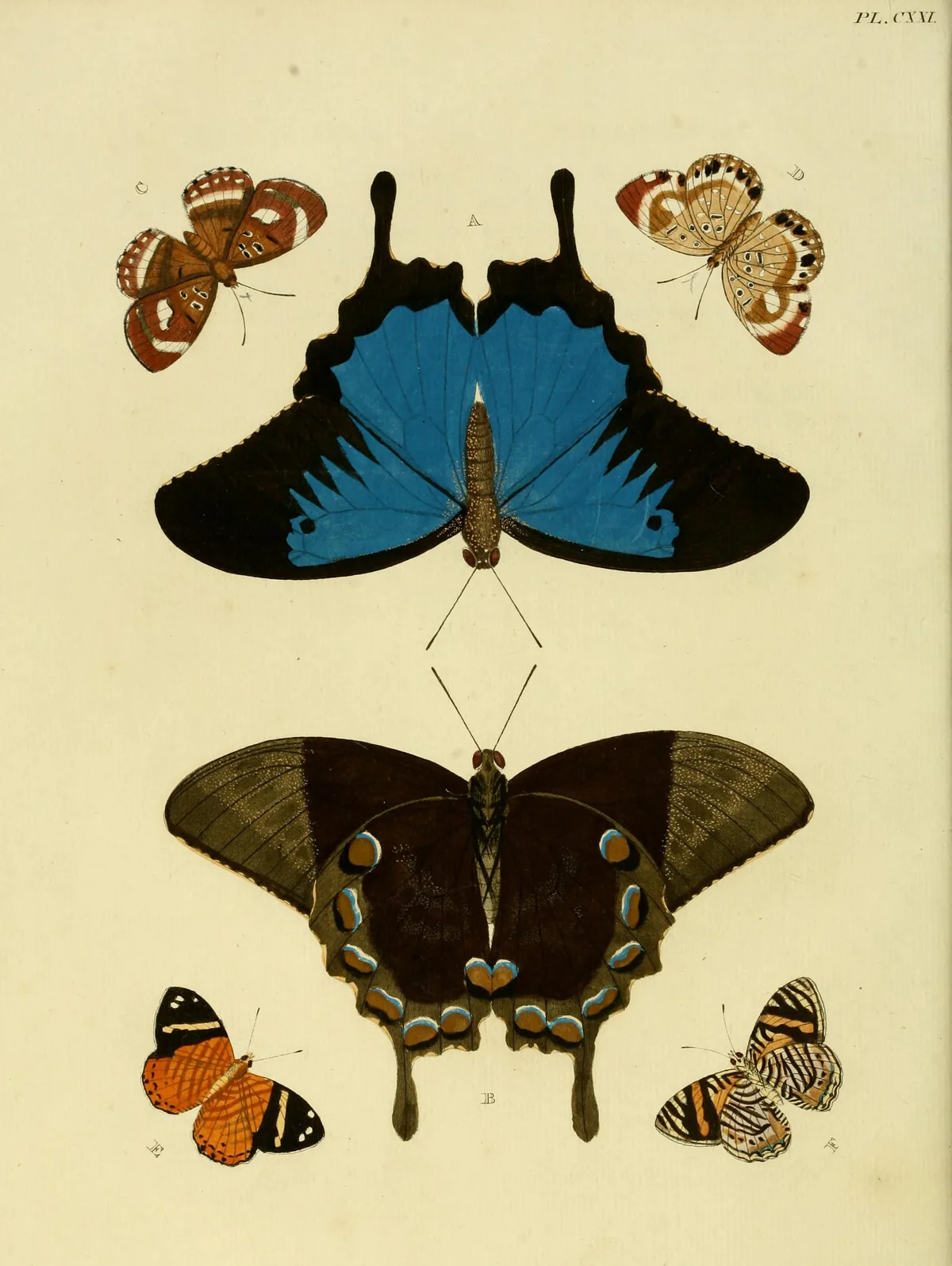
The Ulysses Swallowtail in The Quiet Cabinet was engraved and coloured by hand in Amsterdam in the 1770s, for Pieter Cramer's book of exotic butterflies. Cramer drew adults only, so its Field Guide page has no caterpillar. It flies above bitter orange, drawn from Köhler's Medizinal-Pflanzen (1887–1898); no old plate of euodia was found.
In The Quiet Cabinet
It's one of the thirteen species of the Curiosity Cabinet, the game's last chapter, part of the Butterfly Collection. When its case is completed, a harp joins the plate's music.
Sources
- Wikipedia, Papilio ulysses
- Butterfly House, Papilio ulysses
More from the journal

Black-veined White: the butterfly Britain lost
A large white butterfly with black veins, lost from Britain around 1925 for reasons still unknown. Its story, its caterpillars' silk nests, its strange female.

Broad-bordered Yellow Underwing: orange hidden beneath
A brown late-summer moth that hides bright orange hindwings with a broad black border, showing them only in flight. How to know it, and its many forms.

Buff-tip moth: the moth that looks like a broken twig
A moth that rests looking just like a snapped birch twig, whose yellow-and-black caterpillars feed in crowds and strip branches bare. How to know the Buff-tip.