



 The Quiet Cabinet

Vintage butterfly illustrations: the plates behind our game
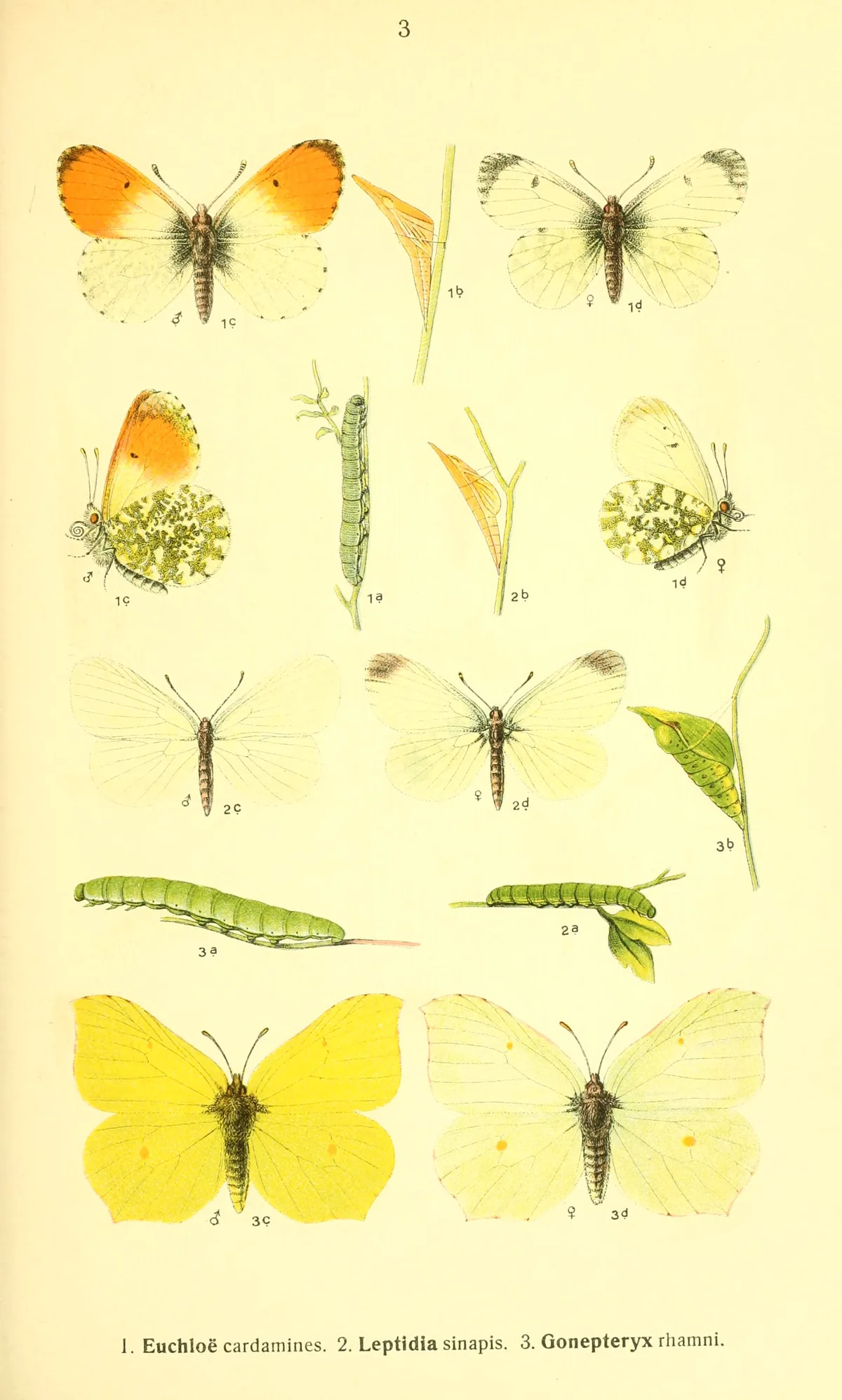
Every butterfly and moth in The Quiet Cabinet began as a figure on a printed page. Some were engraved and hand-coloured in Amsterdam in the 1770s; most were printed in Germany a little over a century ago. All of them are in the public domain, and none was drawn or generated for the game.
This is a short guide to those books: who made them, which species we took from each, how a figure on a plate becomes a specimen that breathes on your phone, and where you can find vintage butterfly illustrations of your own.
The books
Kurt Eckstein, Die Schmetterlinge Deutschlands (1913–1923)
Most of the game comes from here. Eckstein's survey of Germany's butterflies and moths, published in volumes from 1913, is a working naturalist's book: each plate shows a species from above and below, male and female, and often its caterpillar and chrysalis on the plant it feeds on. The plate at the top of this page is a good example: the Orange-tip (fig. 1), the Wood White (fig. 2) and the Brimstone (fig. 3).
We used figures from more than forty of its plates: the Orange-tip and Brimstone, the Small Tortoiseshell, Red Admiral, Painted Lady and Peacock, the Comma and the Marbled White, the Swallowtail, the hawk-moths and the underwings of the Night Wing. The scans are the Biodiversity Heritage Library's, and are on Wikimedia Commons; the plates our specimens come from are free to download here, whole.
Pieter Cramer and Caspar Stoll, De uitlandsche Kapellen (1775–1782)
The "foreign butterflies" of the title arrived in Amsterdam through Dutch trade, from Suriname, the Cape of Good Hope and the East Indies. Cramer described them and the plates were engraved and coloured by hand; Stoll finished the work after Cramer's death. They're the most theatrical plates we use, and they fill the game's last chapter, the Curiosity Cabinet: the Blue Morpho, the Atlas Moth, Priam's Birdwing, the Owl Butterfly, the Ulysses Swallowtail, the Malachite and the White Witch.
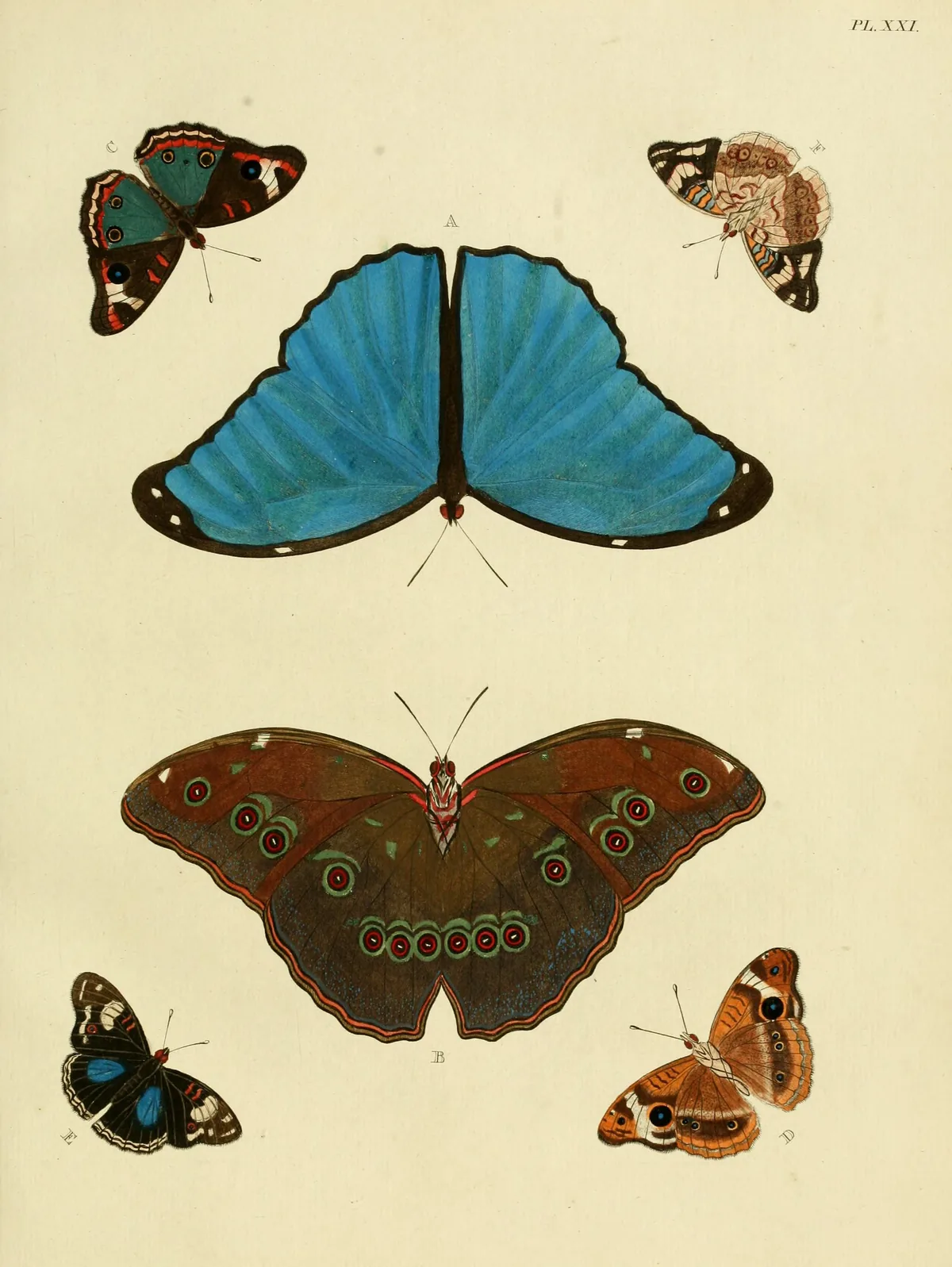
One plate taught us to read the old books carefully. Its file on Wikimedia Commons is labelled as the Monarch, but the figure is the Viceroy: the black line crossing its hindwing gives it away, the line a Monarch doesn't have.
John Abbot and James Edward Smith, The Natural History of the Rarer Lepidopterous Insects of Georgia (1797)
John Abbot painted the insects of colonial Georgia from life, each with its caterpillar, chrysalis and food plant on one sheet; James Edward Smith wrote the text in London. Our Monarch comes from Abbot's plate, with its milkweed.
The others
- William Buckler, The Larvae of the British Butterflies and Moths (1886): caterpillars and chrysalises, for the Field Guide's pages.
- W. S. Coleman, British Butterflies (1860): the Common Blue, and its bluer female form.
- Dru Drury, Illustrations of Natural History (1773): one of the earliest books of exotic insects in English.
- Adalbert Seitz, Die Gross-Schmetterlinge der Erde (1906–1909) and Richard South, The Moths of the British Isles (1908): for rare forms, like the Comma's pale summer form and the Ghost Moth's white male.
- Jacob Hübner (1761–1826): two of his butterflies, from a 20th-century reprint of his plates.
The plants
Every species in the Field Guide is shown in its habitat, with the plant its caterpillar eats. Those come from botanical plates of the same era, mostly Otto Wilhelm Thomé's Flora von Deutschland, Österreich und der Schweiz (1885): bird's-foot trefoil for the Common Blue, cuckooflower for the Orange-tip, alder buckthorn for the Brimstone. The Curiosity Cabinet's tropical plants come from Köhler's Medizinal-Pflanzen (1887–1898) and from Descourtilz's and Blanco's floras of the Antilles and the Philippines.
From plate to living specimen
A figure on a plate is flat, slightly yellowed and surrounded by a century of paper. Turning it into something you can pick up and move takes a few careful steps, all done in code so that every species gets the same treatment:
- Crop the figure from the full-resolution scan.
- Cut it out from the paper, antennae and all.
- Grade its colours onto the game's palette of nine warm tones, so a 1779 morpho and a 1913 brimstone sit together on one desk.
- Add a fine outline and a little paper grain, so it still reads as printed rather than painted.
- Split the wings into fore and hind, left and right, and rig them so they can turn in three dimensions. A resting butterfly breathes, opening its wings a few degrees, and one in flight beats them.
The caterpillar and chrysalis for each Field Guide page are cut from the same plates when the book shows them.
Where to find public-domain butterfly plates
If you want vintage butterfly illustrations for your own project, these are the places we use:
- Biodiversity Heritage Library: millions of pages of natural history books, scanned by libraries and museums. Search by author or by the Latin name of the species.
- Wikimedia Commons: many of the same scans as single files, often at full resolution, each with a page explaining why it's in the public domain.
A few things we learned along the way:
- Check every file's licence page. Age alone isn't the whole story: what matters is the original's public-domain status and the terms of the scan.
- Search by the old Latin names. Names have changed since 1913: Eckstein's Orange-tip is Euchloë cardamines, today's Anthocharis cardamines.
- Read the plate, not just the label. Captions and file names are sometimes wrong, as with the Viceroy above.
- Keep a record of every plate you use: the book, the plate number, the source and the date you downloaded it. We keep ours with each file's checksum.
The game itself is a calm sort puzzle: you put each species into its own wooden case, and every completed case adds an instrument to a piece of music. If you're curious how that plays, we wrote about the seven rules behind it.
More from the journal
Butterfly bush (buddleia): the butterflies it brings
Why buddleia is called the butterfly bush, which butterflies you'll see on it in late summer, and the catch: it feeds butterflies, never caterpillars.
Butterfly or moth? How to tell the difference
Antennae, bodies, wings at rest and the time of day: how to tell a butterfly from a moth, and the many moths that break the rules. With pictures from old plates.
What do butterflies eat? Nectar, fruit, mud and nothing
Butterflies drink, never chew: nectar, rotting fruit, honeydew, sap and salts from mud, while some moths never eat at all. What butterflies and caterpillars eat.