



 The Quiet Cabinet

Limenitis camilla
White Admiral butterfly: the glider of shady woods
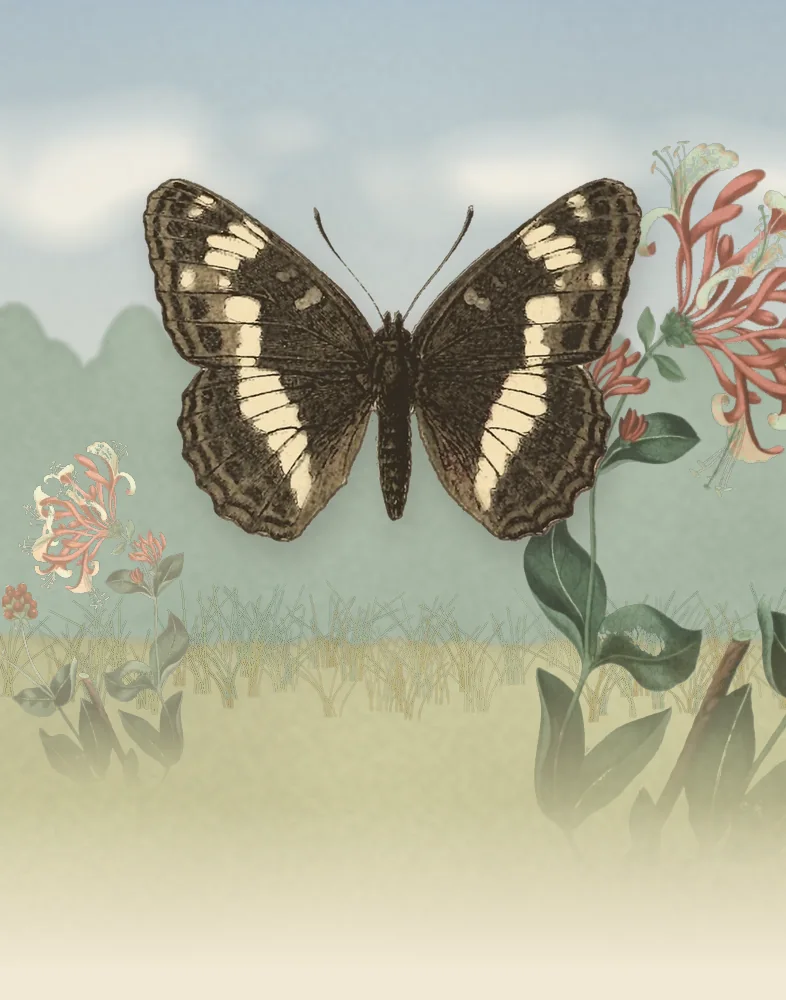
In the dappled light of a woodland ride in July, a black and white butterfly flickers into view: a few quick wingbeats, then a long, level glide, down from the treetops and along the path. The flight is the White Admiral's signature; some of its continental relatives are simply called "gliders".
How to recognise it
- Size: a wingspan of about 56 to 66 millimetres.
- Above: black, crossed by bands of white.
- Beneath: strikingly different from above, and said to be among the most beautiful undersides of any British butterfly.
- The sexes are alike; the female is slightly larger, browner and rounder-winged.
When and where to see it
It has one generation a year, coming out in the second half of June and at its peak in early July, with sometimes a small second brood in late summer. It feeds at bramble blossom and on honeydew, and takes salts from damp earth.
It's a butterfly of shade: mature, often rather neglected woods with sunny glades and big patches of bramble, where honeysuckle climbs in the shadows. It's found in central and southern England, with a few colonies in eastern Wales. Its range shrank to the south in the early 1900s, then spread again from the 1920s. In the last twenty years, though, its numbers have fallen steeply, for reasons that aren't clear: between 1976 and 2019 they dropped by about 60 per cent. It is listed as Vulnerable on Great Britain's Red List.
Its caterpillar and its winter shelter
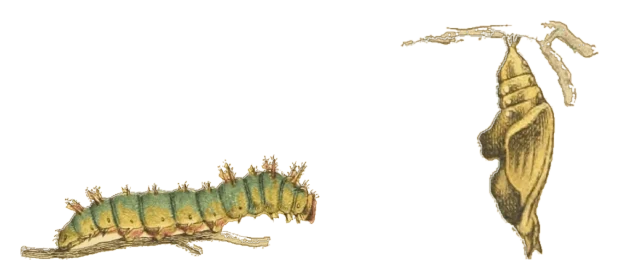
The female flits low through the undergrowth and lays a single egg on honeysuckle growing in partial shade, choosing straggly plants over lush ones in full sun. The caterpillar eats on either side of the leaf's midrib and leaves the rib standing.
In late summer, still small, it builds a shelter for the winter: it ties a leaf to the twig with silk, trims its edges and folds it into a little compartment, and sleeps inside it until spring. The chrysalis hangs under a leaf, with two small horns, its silver-gilt marks like a shrivelled honeysuckle leaf touched with dew.
The plate it comes from
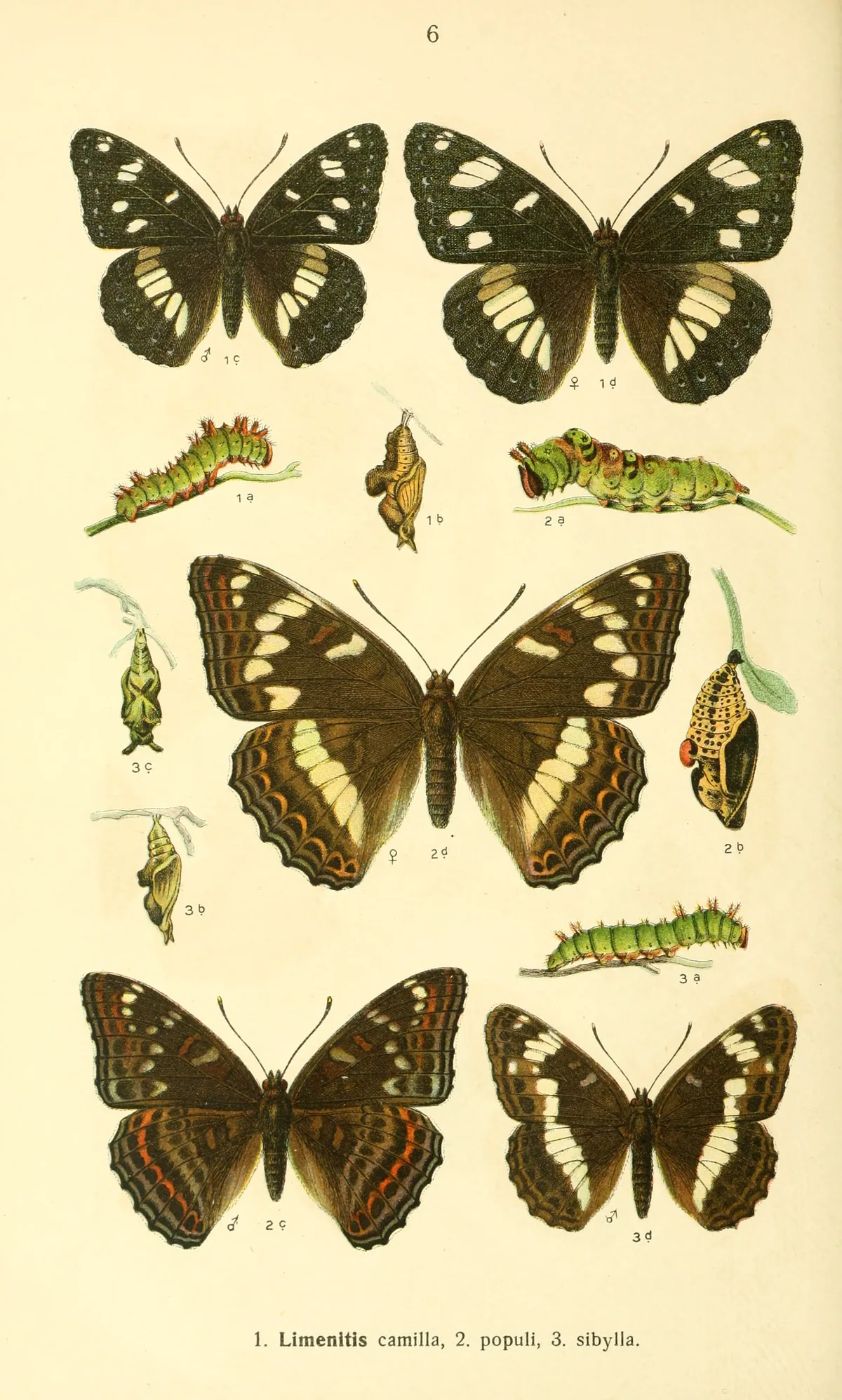
The White Admiral in The Quiet Cabinet is figure 3d, Eckstein's male. In his day it was called Limenitis sibylla, and the name camilla belonged to the Southern White Admiral, figure 1 of the same plate; the Poplar Admiral is figure 2. On its Field Guide page the White Admiral flies above honeysuckle, drawn from the Dutch Flora Batava.
In The Quiet Cabinet
It's one of the thirteen species of the Forest, the game's third chapter, part of the Butterfly Collection. When its case is completed, a celesta joins the plate's music.
Sources
- Butterfly Conservation, White Admiral
- UK Butterflies, White Admiral
More from the journal

Black-veined White: the butterfly Britain lost
A large white butterfly with black veins, lost from Britain around 1925 for reasons still unknown. Its story, its caterpillars' silk nests, its strange female.

Broad-bordered Yellow Underwing: orange hidden beneath
A brown late-summer moth that hides bright orange hindwings with a broad black border, showing them only in flight. How to know it, and its many forms.

Buff-tip moth: the moth that looks like a broken twig
A moth that rests looking just like a snapped birch twig, whose yellow-and-black caterpillars feed in crowds and strip branches bare. How to know the Buff-tip.