



 The Quiet Cabinet

Arctia plantaginis
Wood Tiger moth: black and cream, with a red-winged female
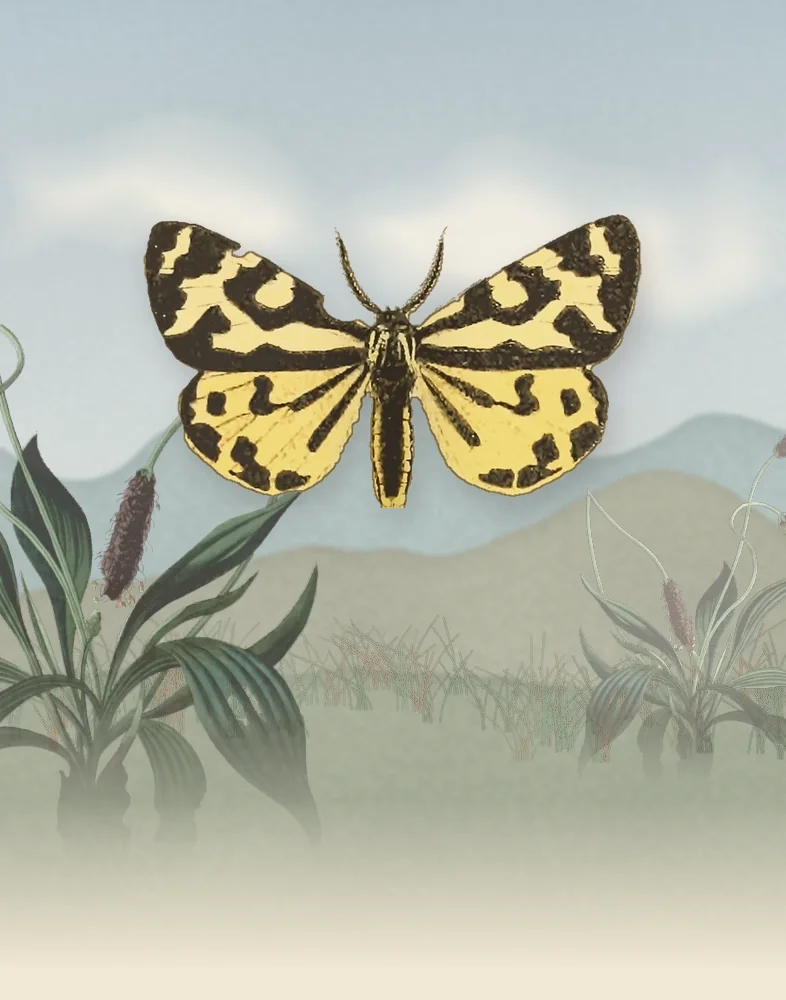
On a sunny day in June, on a heath or a moor, a boldly patterned moth flies past in an erratic zigzag, black and cream, flashing yellow. It's a male Wood Tiger, and the female, if you could find her, would look rather different.
How to recognise it
- Size: a wingspan of about 32 to 38 millimetres.
- Forewings: black, crossed by broad ivory-yellow bands, in both sexes.
- Hindwings: in the male, yellow or white with black; in the north and the uplands of Britain they are sometimes whitish rather than yellow. In the female the hindwings are red, with black at their base.
No other British moth looks quite like it.
Two lives, by day and by night
The males fly in sunshine, erratically, and are easily disturbed from low plants. The females are more sluggish, active mostly late in the afternoon and at night. The moths fly from late May to July, most of all in June, in one generation a year. The adults don't feed at all; they live on what they stored as caterpillars.
Its colours are a warning. Studies of the Wood Tiger have found that its yellow males are attacked by birds less than its white ones, and that it carries two defensive fluids, one that deters ants and one that deters birds. Disturbed, it may drop to the ground and lie rigid, legs folded.
It lives on moorland, heathland, downland, acid grassland and open woodland, in England, Wales, Scotland and Ireland. It's widespread but local in England and Wales, more common in mainland Scotland and Northern Ireland, and it is declining.
Its caterpillar and food plants
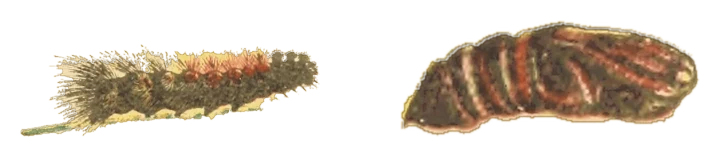
The caterpillar feeds on low plants: ribwort and greater plantain, bell heather, common rock-rose, salad burnet and groundsel. It's found from July until the following May, and spends the winter half-grown, low in the vegetation. In spring it spins a cocoon among plant stems, and the moth comes out a couple of weeks later.
The plate it comes from
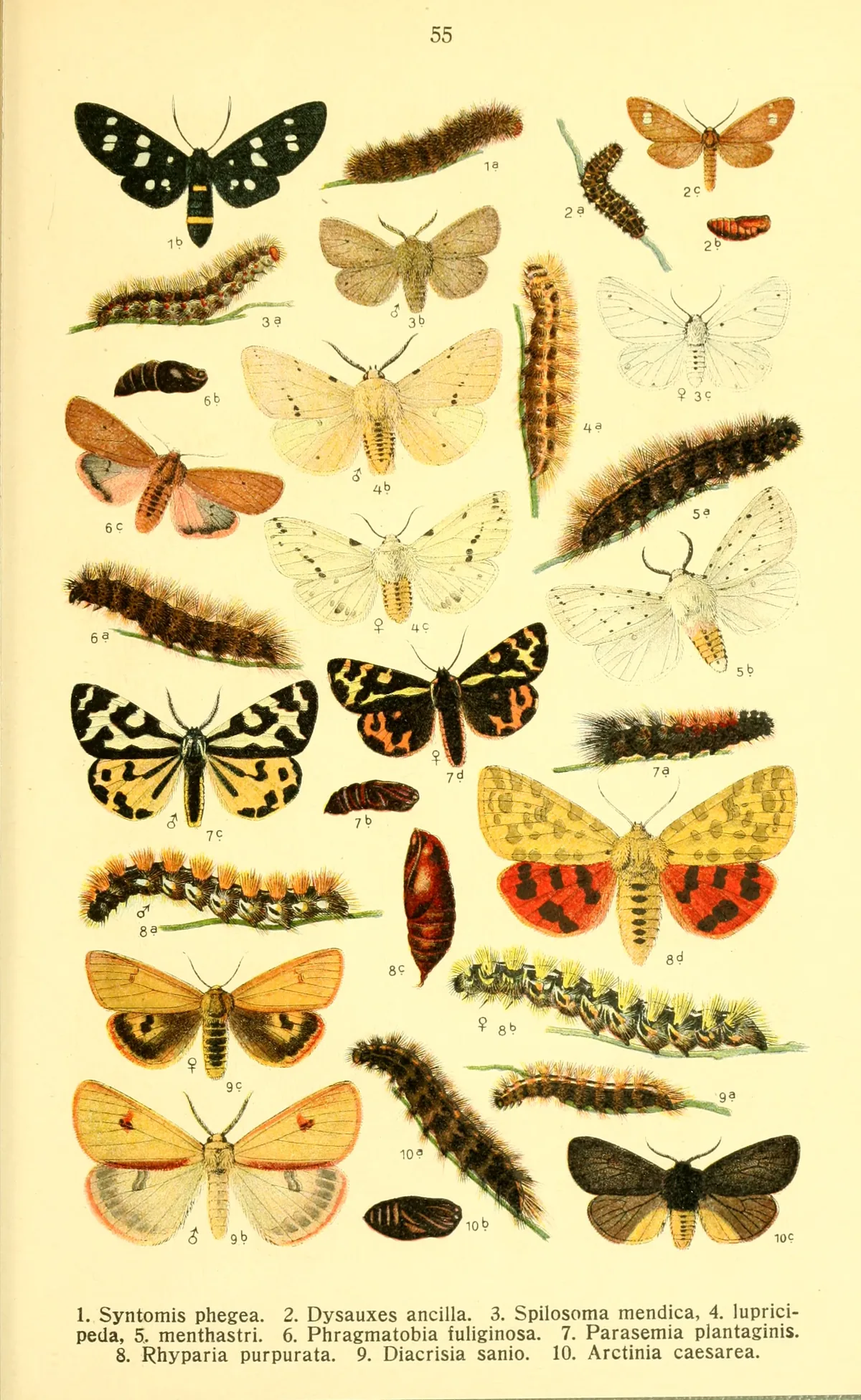
The Wood Tiger in The Quiet Cabinet is figure 7c, Eckstein's male. On its Field Guide page it flies above ribwort plantain, drawn from the Dutch Flora Batava. Its red-winged female turns up in the game as a rare form.
In The Quiet Cabinet
It's one of the thirteen species of the Meadow, the game's second chapter, part of the Butterfly Collection. When its case is completed, a low cello joins the plate's music.
Sources
- Butterfly Conservation, Wood Tiger
- UKMoths, Wood Tiger
- Wikipedia, Arctia plantaginis
More from the journal

Black-veined White: the butterfly Britain lost
A large white butterfly with black veins, lost from Britain around 1925 for reasons still unknown. Its story, its caterpillars' silk nests, its strange female.

Broad-bordered Yellow Underwing: orange hidden beneath
A brown late-summer moth that hides bright orange hindwings with a broad black border, showing them only in flight. How to know it, and its many forms.

Buff-tip moth: the moth that looks like a broken twig
A moth that rests looking just like a snapped birch twig, whose yellow-and-black caterpillars feed in crowds and strip branches bare. How to know the Buff-tip.