



 The Quiet Cabinet

Leptidea sinapis
Wood White butterfly: the delicate white of woodland rides
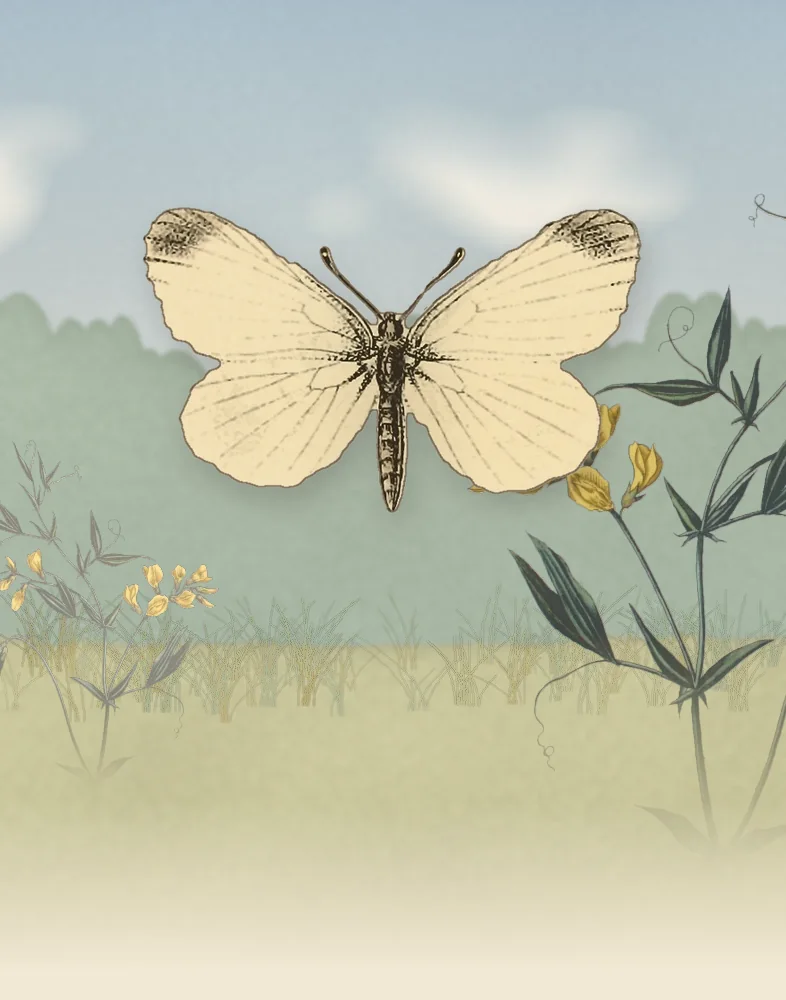
Along a sheltered ride in an English wood in May, a small white butterfly drifts slowly past at knee height, so delicate it seems to be made of paper. The Wood White is the most fragile-looking of Britain's whites, and one of its rarest.
How to recognise it
- Size: a wingspan of about 42 millimetres.
- Shape: rounded wings, with rounded forewing tips, unlike any other white. It always rests with its wings closed.
- The male has a dark mark at the tip of each forewing; in the female it is much fainter.
- A twin: the Cryptic Wood White, recognised as a separate species only recently, looks identical.
A courtship face to face
The males fly almost without stopping in fine weather, patrolling the rides, while the females spend much of their time feeding and resting. When a male finds a female, he lands facing her and waves his head and antennae from side to side, with his proboscis out, the two of them flashing their wings open. If she is willing, she bends her body towards him.
In England the butterflies fly from early May to the end of June, with a second generation at some sites in Surrey and Sussex; in Ireland, from late May to mid-July.
Its caterpillar and food plants
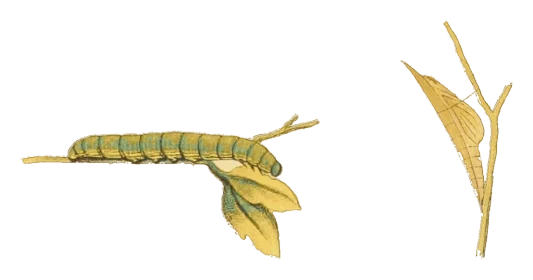
The female lays her eggs one at a time under the leaves of sheltered plants: meadow vetchling, bitter-vetch, tufted vetch and bird's-foot trefoils. The caterpillar feeds on the finest shoot tips and is beautifully camouflaged. The chrysalis is green, with pink along its wing edges and veins, and it spends the winter as a chrysalis.
Where to see it, and how it's faring
It lives in tall grass and light scrub at the partly shaded edges of woods: woodland rides and clearings, coastal undercliffs and old railway lines. Its strongholds are the woods of the West Midlands and Northamptonshire and the East Devon coast; in Ireland it is found in the limestone country of Clare and south-east Galway.
It has suffered badly. Between 1979 and 2019 its numbers in Britain fell by about 82 per cent, largely as woods stopped being coppiced, and it is not mobile enough to find new places easily. It is listed as Endangered on Great Britain's Red List.
The plate it comes from
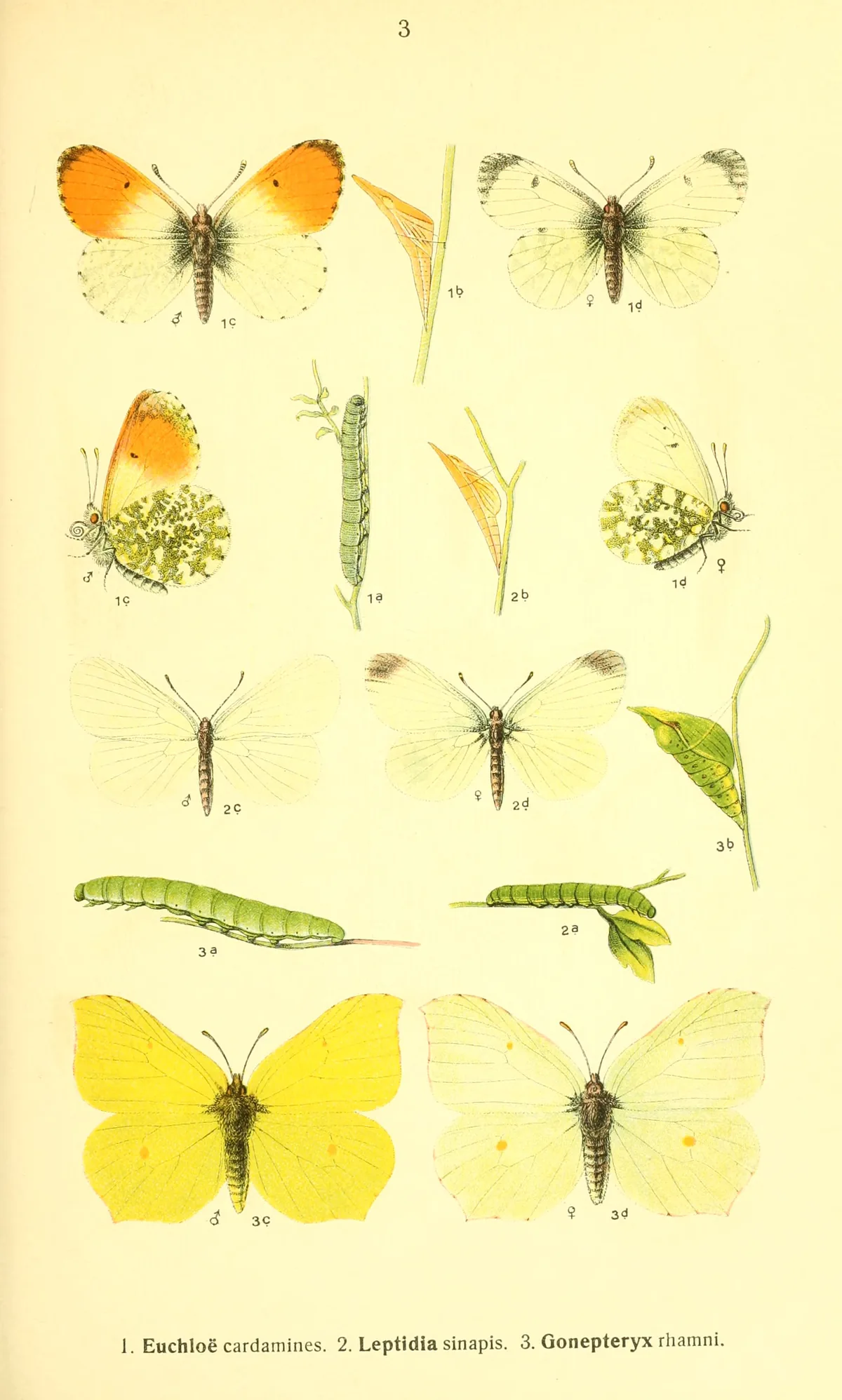
The Wood White in The Quiet Cabinet is figure 2d, Eckstein's female, between the Orange-tip and the Brimstone. On its Field Guide page it flies above meadow vetchling, drawn from the Dutch Flora Batava.
In The Quiet Cabinet
It's one of the thirteen species of the Forest, the game's third chapter, part of the Butterfly Collection. When its case is completed, a music box joins the plate's music.
Sources
- Butterfly Conservation, Wood White
- UK Butterflies, Wood White
More from the journal

Black-veined White: the butterfly Britain lost
A large white butterfly with black veins, lost from Britain around 1925 for reasons still unknown. Its story, its caterpillars' silk nests, its strange female.

Broad-bordered Yellow Underwing: orange hidden beneath
A brown late-summer moth that hides bright orange hindwings with a broad black border, showing them only in flight. How to know it, and its many forms.

Buff-tip moth: the moth that looks like a broken twig
A moth that rests looking just like a snapped birch twig, whose yellow-and-black caterpillars feed in crowds and strip branches bare. How to know the Buff-tip.