



 The Quiet Cabinet

Morpho menelaus
Blue Morpho butterfly: why its wings are so blue
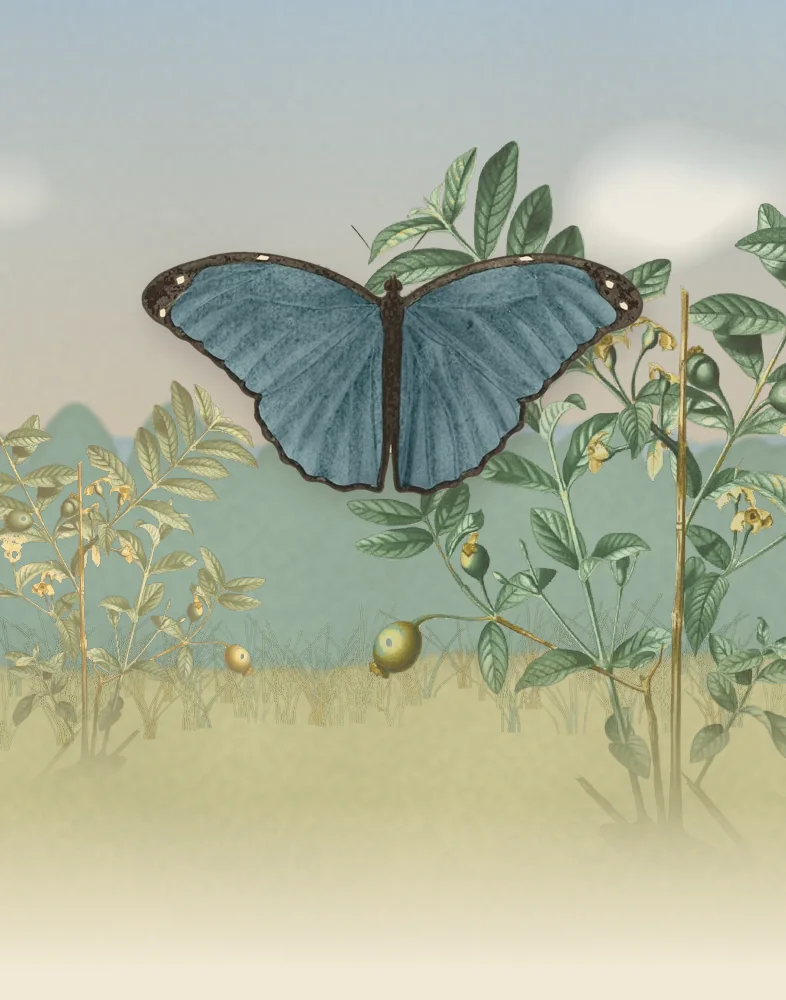
In the rainforests of Central and South America, a flash of blue crosses a clearing, vanishes, and flashes again a moment later. That's a Blue Morpho, flying slowly, opening and closing its wings, and seeming to switch on and off as it goes.
Blue without a blue pigment
The Blue Morpho's wings hold no blue pigment. Their colour comes from their structure. The scales on the upperside are built of extremely thin layers of chitin with air between them, spaced about 80 nanometres apart. Light reflecting from these layers interferes so that blue is strengthened and other colours cancel out. That's why the blue shimmers and shifts as the angle changes, and why scientists study morpho wings when designing new materials, coatings and sensors.
How to recognise it
- Size: a wingspan of about 12 centimetres.
- Upperside: in the male, a brilliant metallic blue edged with black. The female is less vivid, and better hidden.
- Underside: brown, with a row of eyespots. With its wings closed, the morpho is hard to see, which is why its flight looks like a light blinking: blue, brown, blue.
Where it lives
It's a butterfly of the Neotropics, from Mexico through Central America to Venezuela and Brazil. Males patrol open clearings and fly high in the canopy; females spend more time lower down in the forest, and climb towards the treetops to lay their eggs. Adults feed on the juice of fallen, rotting fruit, and live for three to four weeks.
Its caterpillar
The caterpillar is red-brown with bright green patches, and covered in bristles that can irritate the skin. It feeds on the young leaves of plants in the pea family and a few others, and may rest through the dry season. From egg to adult, the whole life takes about 115 days.
The plate it comes from
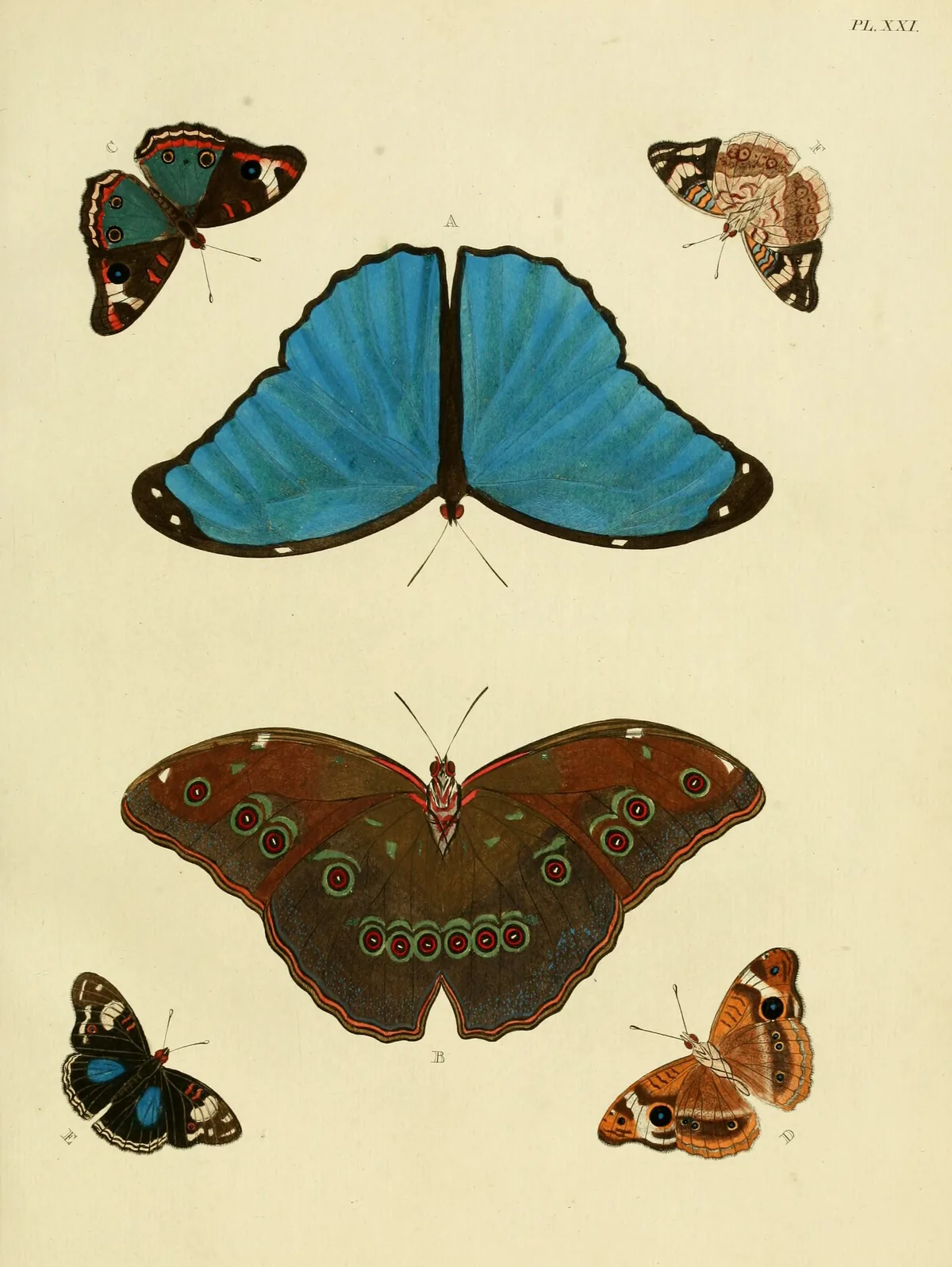
Our Blue Morpho was engraved and coloured by hand in Amsterdam almost 250 years ago, for Pieter Cramer's book of "foreign butterflies" brought back by Dutch trade. Cramer drew adults only, so its Field Guide page has no caterpillar. It flies above a guava tree, drawn from Francisco Manuel Blanco's Flora de Filipinas (1877–1883). We wrote more about Cramer and Stoll's plates and the others behind the game.
In The Quiet Cabinet
The Blue Morpho is one of the thirteen species of the Curiosity Cabinet, the game's last chapter, part of the Butterfly Collection. When its case is completed, a harp joins the plate's music.
Sources
- Natural History Museum, Blue morpho butterfly
- Wikipedia, Morpho menelaus and Morpho
- Rainforest Alliance, Blue morpho butterfly
More from the journal

Black-veined White: the butterfly Britain lost
A large white butterfly with black veins, lost from Britain around 1925 for reasons still unknown. Its story, its caterpillars' silk nests, its strange female.

Broad-bordered Yellow Underwing: orange hidden beneath
A brown late-summer moth that hides bright orange hindwings with a broad black border, showing them only in flight. How to know it, and its many forms.

Buff-tip moth: the moth that looks like a broken twig
A moth that rests looking just like a snapped birch twig, whose yellow-and-black caterpillars feed in crowds and strip branches bare. How to know the Buff-tip.