



 The Quiet Cabinet

The biggest moth in the world, and the largest in the UK
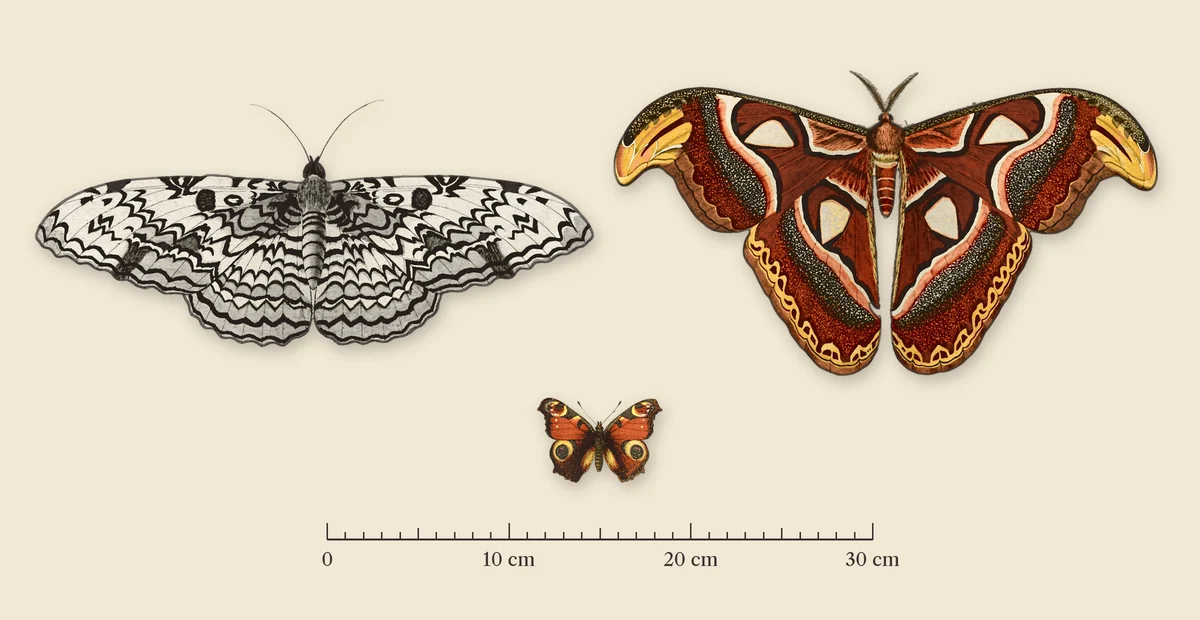
The biggest moth in the world depends on what you measure. The White Witch of tropical America has the widest wings: the record is 30.8 centimetres (about 12 inches) from tip to tip. The Atlas moth of Asia, at up to 30 centimetres, is usually called the largest moth in the world overall, with the Hercules moth of Australia and New Guinea as its rival for wing area. And the heaviest is Australia's giant wood moth, at up to 30 grams.
The largest moth in the UK is the Death's-head Hawk-moth, about 12 centimetres across, a rare visitor. The largest hawk-moth that lives here all year is the Privet Hawk-moth.
The largest moths in the world: a size comparison
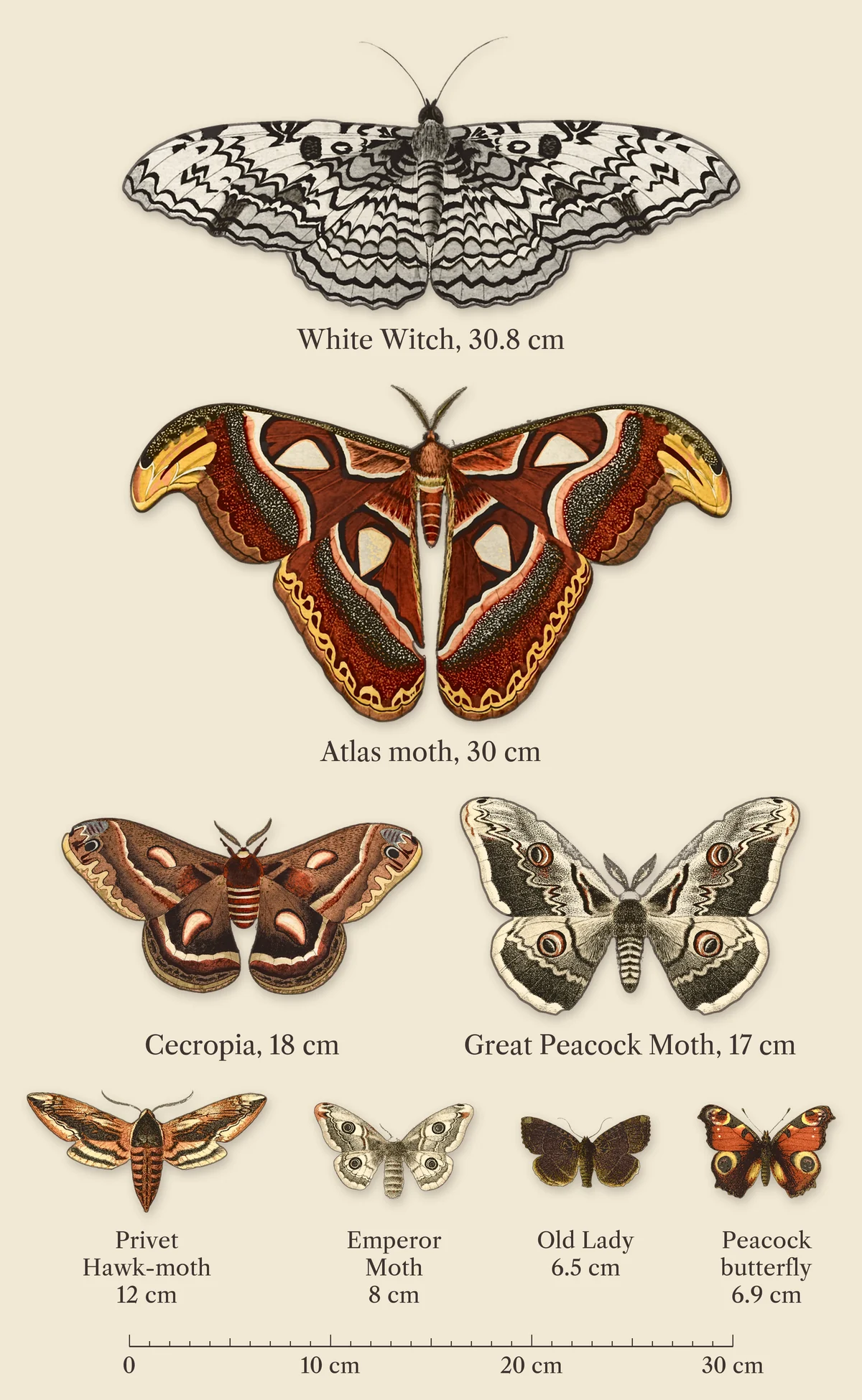
| Moth | Where it lives | Wingspan, at most |
|---|---|---|
| White Witch | Mexico to Uruguay | 28 cm; record 30.8 cm |
| Atlas moth | South and Southeast Asia | 30 cm |
| Hercules moth | Australia, New Guinea | 28 cm |
| Giant wood moth | Australia | 23 cm |
| Cecropia | North America | 18 cm |
| Black Witch | Tropical America | 18 cm |
| Great Peacock Moth | Southern and central Europe | 17 cm |
| Death's-head Hawk-moth | Africa, southern Europe; visits the UK | 12 to 13 cm |
| Privet Hawk-moth | Europe, the UK included | 12 cm |
Books and museums give different figures for the giant species. These are the ones in the sources at the foot of the page.
The biggest moth in the world by wingspan: the White Witch
Most White Witches reach up to 28 centimetres. Guinness World Records gives the record to one collected in Brazil in 1934, at 30.8 centimetres. It is a pale moth of tropical forests, finely lined, and its body is small for wings so large.
The largest overall: the Atlas moth
Guinness World Records names the Atlas moth the world's largest "in terms of overall size". Its wings often measure 25 to 30 centimetres, their tips curved and marked like the heads of snakes. The adult has no working mouth and lives only a week or two.
The biggest moth in Australia: the Hercules moth
The Hercules moth lives in New Guinea and tropical northern Australia. It is a little narrower than the Atlas, at up to 28 centimetres, but its wings may cover more: Guinness gives an area of up to 263 square centimetres. The male's hindwings end in long tails.
Australia also has the heaviest of all, the giant wood moth. It can weigh 30 grams, more than a robin, on wings up to 23 centimetres across.
The biggest moth ever recorded
The widest confirmed measurement is that 30.8 centimetre White Witch of 1934. A wingspan of 36 centimetres was reported in 1948 for a Hercules moth caught in Innisfail, Queensland, but it was never confirmed.
How big is that compared to a human?
Hold a sheet of A4 paper sideways against your chest. It is 29.7 centimetres wide: almost exactly an Atlas moth, and a centimetre short of the record White Witch. A Peacock butterfly, at about 7 centimetres, would fit along one of its wings twice.
The largest moth in the UK
- The biggest moth in the UK is the Death's-head Hawk-moth, with a wingspan of about 12 centimetres; some sources give 13. It's named for the pale, skull-shaped mark behind its head, and it squeaks when alarmed. It flies here from the south, mostly between August and October, is seen most in the south and east of England, and can't survive our winters.
- The largest resident hawk-moth is the Privet Hawk-moth, at 9 to 12 centimetres, with a body banded in pink and black. It flies in June and July.
- The Convolvulus Hawk-moth, another visitor, is as wide, at 8 to 12 centimetres. It's grey and comes to tobacco flowers at dusk, mostly from late August to November.
- Other big moths in the UK are the Clifden Nonpareil (7.5 to 9.5 centimetres), with its band of blue; the Goat Moth (6.4 to 8.4); and the Emperor Moth (5.5 to 8), with an eyespot on every wing.
A big moth in the house
In Britain, a large dark moth in a shed or an outhouse in July or August is often an Old Lady, which spends its days in old buildings. A bigger one at a lit window on a summer night may be a hawk-moth; they come to light.
Are big moths dangerous? Adult moths generally don't bite or sting, and being large doesn't change that. Put a glass over it, slide a card beneath, and let it out after dark. A few caterpillars are another matter. Those of the oak processionary moth, found in and around London, have hairs that can cause rashes and trouble breathing, so leave them and their nests alone.
The largest moth in North America
The Cecropia is the largest moth native to North America, at 13 to 18 centimetres. It lives in the hardwood forests east of the Rocky Mountains, and is drawn to porch lights. The red-brown moth in the picture above is one, from John Abbot and James Edward Smith's book on the insects of Georgia (1797).
The Black Witch is as wide, up to about 18 centimetres, and some call it the largest moth north of Mexico. It's a tropical moth, though: it wanders north from midsummer, sometimes as far as Newfoundland, and within the United States it is known to breed mainly in the far south of Texas and Florida, in Los Angeles and in Hawaii.
The Luna Moth, pale green with long tails, is usually about 11 centimetres across, and now and then more than 17.
The largest moth in Europe
The Great Peacock Moth, also called the Giant Peacock or Giant Emperor, is the biggest in Europe. Its females reach 17 centimetres, and some books say 20. It lives in the south and centre of the continent, and doesn't live in Britain, where its small cousin the Emperor Moth does.
The biggest moth caterpillars
The giants begin large. An Atlas moth's caterpillar grows to 11.5 centimetres, a Hercules moth's to 12 and a giant wood moth's, inside the trunk of a eucalyptus, to 15. Among those you might meet in Britain, the Death's-head Hawk-moth's grows to more than 10.
Sources
- Guinness World Records, Greatest wingspan for a moth specimen and Largest moth
- BBC Wildlife, What is the world's largest moth?
- Wikipedia, Attacus atlas, Coscinocera hercules, Endoxyla cinereus, Saturnia pyri
- Butterfly Conservation: Privet Hawk-moth, Death's-head Hawk-moth, Convolvulus Hawk-moth, Clifden Nonpareil, Goat Moth, Emperor Moth, Old Lady
- Wildlife Trusts, Death's-head hawk-moth; UCL Museums, The Death's-head Hawkmoth
- National Wildlife Federation, Cecropia Moth; University of Wisconsin–Milwaukee, Black Witch Moth
- Monaco Nature Encyclopedia, Saturnia pyri
- Forest Research, Oak processionary moth; Healthline, Do moths bite?
- Each species' page in the Journal, linked above, which names its own sources
More from the journal
Butterfly bush (buddleia): the butterflies it brings
Why buddleia is called the butterfly bush, which butterflies you'll see on it in late summer, and the catch: it feeds butterflies, never caterpillars.
Butterfly or moth? How to tell the difference
Antennae, bodies, wings at rest and the time of day: how to tell a butterfly from a moth, and the many moths that break the rules. With pictures from old plates.
What do butterflies eat? Nectar, fruit, mud and nothing
Butterflies drink, never chew: nectar, rotting fruit, honeydew, sap and salts from mud, while some moths never eat at all. What butterflies and caterpillars eat.